\n
## Flowchart: Division Algorithm
### Overview
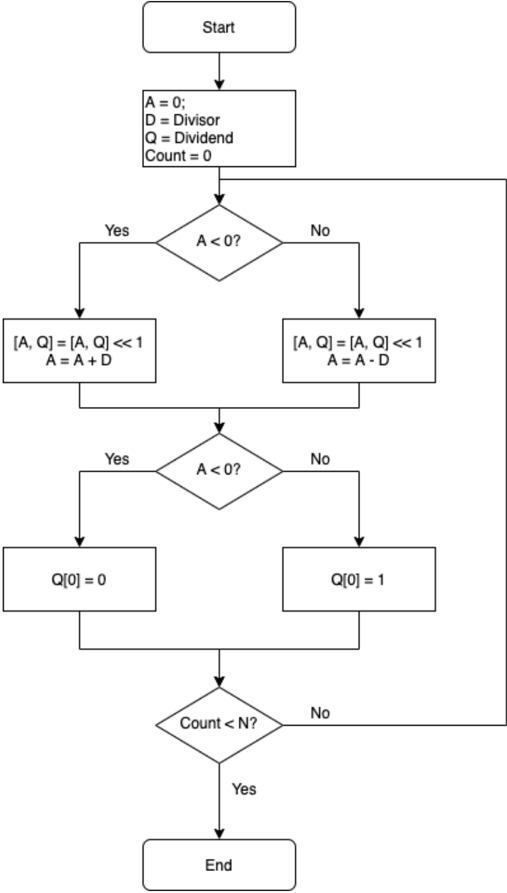
The image depicts a flowchart illustrating a division algorithm. The flowchart outlines the steps involved in dividing a dividend by a divisor, producing a quotient. It uses conditional branching based on comparisons between variables A and Q.
### Components/Axes
The flowchart consists of the following components:
* **Start/End:** Oval shapes indicating the beginning and end of the algorithm.
* **Process:** Rectangular boxes representing operations or assignments.
* **Decision:** Diamond shapes representing conditional checks.
* **Arrows:** Lines indicating the flow of control.
The following variables are initialized:
* A = 0
* D = Divisor
* Q = Dividend
* Count = 0
The following conditions are checked:
* A < Q
* Count < N
### Detailed Analysis or Content Details
The algorithm proceeds as follows:
1. **Start:** The algorithm begins.
2. **Initialization:** The variables A, D, Q, and Count are initialized to 0, Divisor, Dividend, and 0 respectively.
3. **First Decision:** Check if A < Q.
* **Yes:** `[A, Q] = [A, Q] << 1` and `A = A + D`. The algorithm proceeds to the next decision.
* **No:** `[A, Q] = [A, Q] << 1` and `A = A - D`. The algorithm proceeds to the next decision.
4. **Second Decision:** Check if A < Q.
* **Yes:** `Q[0] = 0`. The algorithm proceeds to the next decision.
* **No:** `Q[0] = 1`. The algorithm proceeds to the next decision.
5. **Third Decision:** Check if Count < N.
* **Yes:** The algorithm loops back to the first decision (A < Q).
* **No:** The algorithm ends.
6. **End:** The algorithm terminates.
### Key Observations
The algorithm appears to be a bit-wise division algorithm. The left shift operation (`<< 1`) suggests that the algorithm is working with binary representations of the numbers. The repeated subtraction or addition of the divisor (D) from A is a common technique in division algorithms. The variable Count is used to control the number of iterations.
### Interpretation
This flowchart represents a division algorithm that likely operates on binary representations of numbers. The algorithm iteratively adjusts a quotient (Q) based on comparisons between an accumulator (A) and the dividend (Q). The left shift operation effectively multiplies by 2, and the addition or subtraction of the divisor refines the quotient. The loop continues until a specified count (N) is reached, indicating the completion of the division process. The algorithm is a fundamental building block for implementing division operations in digital circuits or software. The use of `Q[0]` suggests that the quotient is being stored in an array, and only the least significant bit is being modified in each iteration. The algorithm is likely designed for unsigned integer division.