## Flowchart: Division Algorithm with Bit Shifting and Conditional Adjustments
### Overview
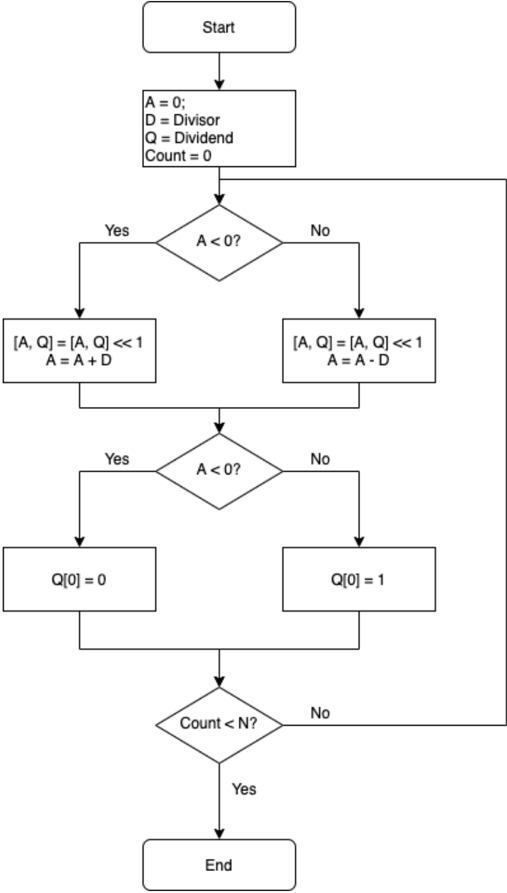
The flowchart depicts a computational algorithm for division or binary adjustment operations. It initializes variables, performs iterative adjustments to a value `A` based on comparisons with zero, and uses bit-shifting operations on a pair `[A, Q]`. The process terminates when a counter `Count` reaches a threshold `N`.
### Components/Axes
- **Start**: Initialization block setting `A = 0`, `D = Divisor`, `Q = Dividend`, `Count = 0`.
- **Decision Nodes**:
- `A < 0?` (diamond-shaped decision box).
- `Count < N?` (final decision box).
- **Process Boxes**:
- `[A, Q] = [A, Q] << 1` (bitwise left shift operation).
- `A = A + D` or `A = A - D` (conditional adjustments).
- `Q[0] = 0` or `Q[0] = 1` (binary assignment).
- **End**: Termination block.
### Detailed Analysis
1. **Initialization**:
- `A` starts at 0.
- `D` is defined as the divisor.
- `Q` is defined as the dividend.
- `Count` starts at 0.
2. **First Decision (`A < 0?`)**:
- **Yes**:
- `[A, Q]` is left-shifted by 1 bit.
- `A` is incremented by `D`.
- **No**:
- `[A, Q]` is left-shifted by 1 bit.
- `A` is decremented by `D`.
3. **Second Decision (`A < 0?`)**:
- **Yes**: Assign `Q[0] = 0`.
- **No**: Assign `Q[0] = 1`.
4. **Loop Control (`Count < N?`)**:
- If `Count` has not reached `N`, the process loops back to the first decision node.
- If `Count >= N`, the algorithm terminates.
### Key Observations
- The algorithm uses bit-shifting (`<< 1`) to manipulate `[A, Q]`, suggesting a focus on binary representation or efficiency.
- Conditional adjustments (`A ± D`) imply a search for a remainder or alignment with a divisor.
- The final assignment `Q[0] = 0/1` indicates binary output, possibly representing a quotient bit.
- The loop condition `Count < N` suggests iterative refinement over `N` steps.
### Interpretation
This flowchart likely implements a **division algorithm** or **binary approximation method**. The use of bit-shifting and conditional adjustments resembles techniques in:
- **Restoring Division Algorithms**: Where `A` is adjusted to approach zero, and `Q` accumulates quotient bits.
- **Newton-Raphson Division**: Iterative refinement of a quotient estimate.
- **Fixed-Point Arithmetic**: Efficient computation on hardware with limited precision.
The algorithm’s reliance on `Count < N` implies a trade-off between precision (more iterations) and computational cost. The final `Q[0]` value (`0` or `1`) could represent the least significant bit of the quotient, with higher bits determined in earlier iterations. The flowchart’s structure emphasizes deterministic, step-by-step refinement, typical of low-level arithmetic operations in embedded systems or hardware design.