## 3D Renderings: Collection of Character and Object Models
### Overview
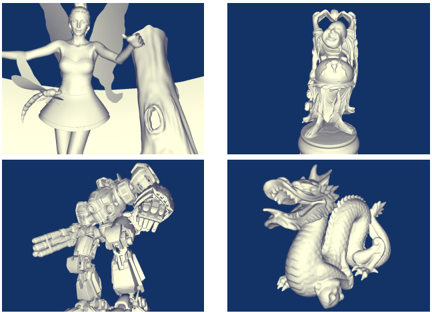
This image displays a grid of four distinct 3D rendered models, each presented in a separate quadrant. The models appear to be computer-generated, showcasing various character types and objects, rendered with a smooth, untextured, monochromatic (light grey/white) surface and distinct lighting, against either a simple two-tone background or a solid dark blue background. The purpose seems to be to highlight the geometric detail and form of the models.
### Image Sections
The image is divided into four approximately equal-sized quadrants, each containing a unique 3D render:
- **Top-Left Quadrant:** Features a fairy-like character alongside a tree trunk.
- **Top-Right Quadrant:** Features a statue of a figure standing on a pedestal.
- **Bottom-Left Quadrant:** Features a robotic mech.
- **Bottom-Right Quadrant:** Features a dragon.
### Detailed Analysis
#### Top-Left Quadrant: Fairy and Tree Trunk
This section displays a light-colored 3D model of a slender, humanoid female figure, resembling a fairy. She has large, delicate wings on her back, a fitted top, and a short, flared skirt. Her hair is styled upwards, and her arms are outstretched. In her left hand, she holds a small, elongated insect with visible wings and a segmented body, possibly a dragonfly or bee. Her right arm is extended towards a roughly cylindrical, light-colored object resembling a tree trunk, which features an oval-shaped indentation or hole on its visible side. The background behind the fairy and tree trunk is split horizontally: the lower portion is a light cream/yellowish color, suggesting ground, while the upper portion is a solid dark blue, suggesting a sky. The models are rendered with smooth surfaces and soft shadows, indicating a focus on form rather than detailed textures.
#### Top-Right Quadrant: Statue on Pedestal
This section features a single, intricately detailed 3D model of a statue, rendered in a light grey/white color against a solid dark blue background. The statue depicts a portly, smiling figure with a large head, prominent ears, and a joyful expression. The figure's arms are raised above its head, holding a spherical object (possibly a globe or pearl) between its hands. The figure is adorned with flowing robes or drapery, which are rendered with numerous folds and details. It stands on a multi-tiered, circular pedestal, which is also rendered in the same light grey/white material, suggesting it is part of the same sculptural piece. The overall appearance is reminiscent of a traditional Asian deity or a stylized chess piece.
#### Bottom-Left Quadrant: Robotic Mech
This section showcases a complex 3D model of a robotic mech or armored suit, rendered in a light grey/white color against a solid dark blue background. The mech is highly detailed with numerous panels, joints, and mechanical components, suggesting heavy armor and articulation. It is depicted in a dynamic pose, leaning slightly forward with its left arm raised and clenched into a large, powerful-looking fist. Its right arm, also heavily armored, extends forward and appears to have weapon-like attachments or barrels. The legs are robust and segmented, indicating powerful locomotion. The design suggests a combat-oriented machine, possibly from a science fiction setting, with visible vents and structural elements.
#### Bottom-Right Quadrant: Dragon
This section presents a detailed 3D model of a dragon, rendered in a light grey/white color against a solid dark blue background. The dragon exhibits characteristics of an Eastern-style dragon, with a long, serpentine body covered in visible scales. It has a large head with an open mouth revealing sharp teeth, prominent horns or antlers, and possibly whiskers or tendrils around its snout. Its limbs are muscular, ending in sharp claws. The dragon's body is coiled and dynamic, suggesting movement or an aggressive posture. The rendering highlights the intricate details of its scales, facial features, and overall form, with clear definition of its musculature and skeletal structure.
### Key Observations
- All models are rendered in a monochromatic light grey/white color, often referred to as a "clay render" or "white render," which emphasizes form, geometry, and lighting without the distraction of textures or colors.
- The lighting in all four renderings appears consistent, casting soft, diffuse shadows and highlighting the contours and details of the models.
- The backgrounds are either a simple two-tone (light ground, dark sky in the top-left) or a solid dark blue, providing a stark contrast that effectively isolates and emphasizes the models.
- The models represent a diverse range of subjects: a fantasy character (fairy), a cultural or mythological statue, a science fiction robot (mech), and a mythical creature (dragon).
- The level of geometric detail in the models is high, particularly evident in the intricate components of the mech and the scales and features of the dragon.
### Interpretation
This collection of 3D renderings likely serves as a portfolio or demonstration of 3D modeling and rendering capabilities. The consistent rendering style (monochromatic, smooth surfaces, simple backgrounds) suggests a focus on the fundamental aspects of 3D asset creation:
1. **Geometric Fidelity and Sculpting Skill:** The images showcase the ability to create complex and varied forms, from organic characters and creatures to intricate mechanical designs and detailed sculptures.
2. **Lighting and Composition:** The uniform lighting across the different scenes demonstrates proficiency in setting up effective lighting to highlight model details and create depth. The simple backgrounds ensure the models are the primary focus.
3. **Versatility in Asset Creation:** The diverse range of subjects indicates the artist's or software's capability to produce assets suitable for various genres, such as fantasy, cultural, and science fiction applications.
4. **Pre-Texturing Visualization:** These "white renders" are commonly used in 3D production pipelines to evaluate the form, silhouette, and overall composition of models before the more time-consuming processes of texturing and material application begin. They allow for critical assessment of the model's structure and aesthetic appeal.
In essence, the images collectively demonstrate a strong foundation in 3D asset creation, emphasizing the mastery of form, structure, and basic rendering principles.