## Diagram: Simple Diagram with Arrows and Labels
### Overview
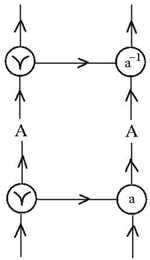
The image is a simple diagram consisting of two vertical lines connected by two horizontal lines. Arrows indicate the direction of flow along these lines. Circles are placed at the junctions, containing labels.
### Components/Axes
* **Vertical Lines:** Two vertical lines on the left and right sides of the diagram.
* **Horizontal Lines:** Two horizontal lines connecting the vertical lines.
* **Arrows:** Arrows indicate the direction of flow along the lines. All arrows point upwards on the vertical lines and from left to right on the horizontal lines.
* **Circles:** Circles are placed at the junctions of the lines.
* Top-left circle contains the symbol "Y".
* Top-right circle contains the label "a⁻¹".
* Bottom-left circle contains the symbol "Y".
* Bottom-right circle contains the label "a".
* **Labels "A":** The letter "A" is placed on the left and right vertical lines, between the top and bottom circles.
### Detailed Analysis
* The diagram shows a flow from bottom to top.
* The flow is modified by the elements in the circles.
* The "Y" symbol appears twice on the left side.
* The labels "a" and "a⁻¹" appear on the right side.
* The labels "A" appear on both vertical lines.
### Key Observations
* The diagram seems to represent a process or transformation.
* The "Y" symbol might represent a specific operation or component.
* The labels "a" and "a⁻¹" suggest inverse operations.
* The labels "A" might represent a constant or a variable.
### Interpretation
The diagram likely represents a sequence of operations or transformations. The "Y" symbol could represent a specific function or process, while "a" and "a⁻¹" could represent an operation and its inverse. The "A" labels might represent a constant value or a variable that is being modified by the operations. The diagram could be used to illustrate a mathematical or computational process. The flow direction indicates the order in which the operations are applied.