\n
## Text Block: Conditional Explanation Prompt
### Overview
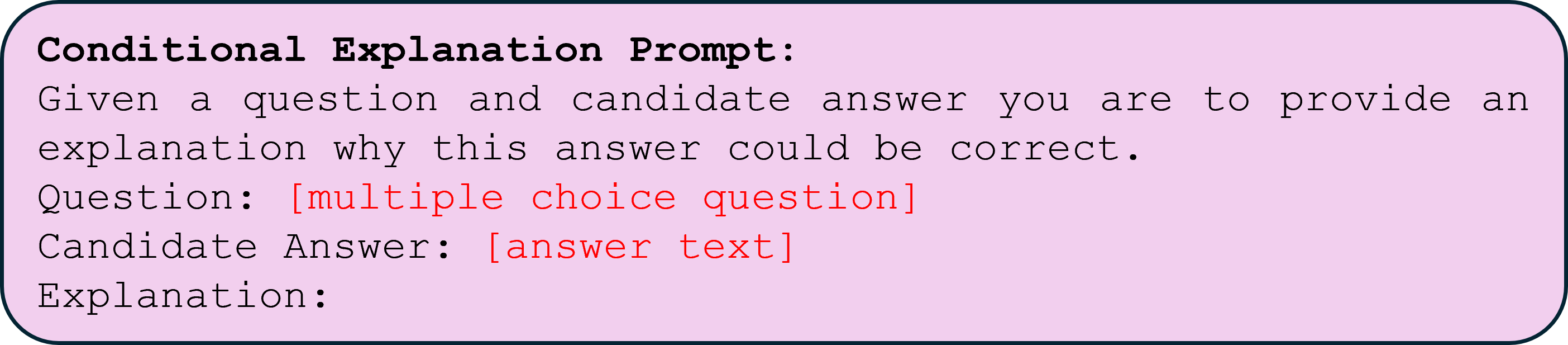
The image presents a text block outlining a prompt for generating explanations for multiple-choice questions. It defines the input format (question and candidate answer) and the desired output (an explanation of why the answer could be correct). The background is a solid lavender color.
### Components/Axes
There are no axes or components in the traditional sense. The image consists entirely of text. The text is structured into three labeled sections: "Conditional Explanation Prompt", "Question:", and "Explanation:".
### Detailed Analysis or Content Details
The text content is as follows:
**Conditional Explanation Prompt:**
"Given a question and candidate answer you are to provide an explanation why this answer could be correct."
**Question:**
"[multiple choice question]"
**Candidate Answer:**
"[answer text]"
**Explanation:**
(This section is left blank, indicating where the generated explanation would be placed.)
### Key Observations
The text is formatted to resemble a prompt template. The bracketed placeholders "[multiple choice question]" and "[answer text]" indicate where user input would be inserted. The prompt is designed to elicit a justification for a given answer, rather than simply stating whether it is correct or incorrect.
### Interpretation
This image represents a prompt used in a system designed to evaluate or generate explanations for multiple-choice questions. It suggests a focus on *conditional* reasoning – explaining *why* an answer *could* be correct, rather than asserting its absolute truth. This is a common approach in educational settings and AI systems that aim to provide more nuanced feedback. The blank "Explanation:" section highlights the core task: generating a reasoned justification. The lavender background is purely aesthetic and doesn't contribute to the informational content. The prompt is a meta-instruction, describing how to respond to a specific type of input.