## Screenshot: Conditional Explanation Prompt
### Overview
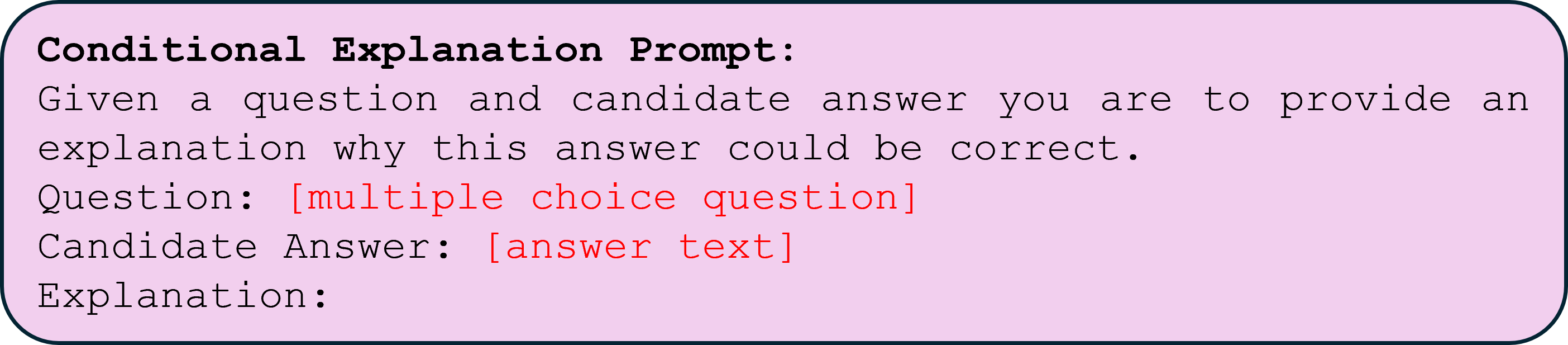
The image displays a structured prompt template designed to guide the generation of explanations for candidate answers to multiple-choice questions. The text is presented in a monospaced font on a light purple background with a dark border. Key elements include a title, instructional text, and placeholders for dynamic content.
### Components/Axes
- **Title**: "Conditional Explanation Prompt:" (bold, black text at the top).
- **Instructional Text**:
- "Given a question and candidate answer you are to provide an explanation why this answer could be correct."
- "Question: [multiple choice question]" (placeholder in red brackets).
- "Candidate Answer: [answer text]" (placeholder in red brackets).
- "Explanation:" (label for the generated response, no placeholder text).
### Detailed Analysis
- **Text Structure**:
- The prompt follows a hierarchical format, with the title at the top, followed by a directive, and then labeled sections for input (Question, Candidate Answer) and output (Explanation).
- Placeholders (`[multiple choice question]`, `[answer text]`) are highlighted in red to indicate replaceable content.
- **Spatial Grounding**:
- Title: Top-center alignment.
- Instructional text: Left-aligned, below the title.
- Placeholders: Indented under their respective labels ("Question:", "Candidate Answer:").
- "Explanation:" label: Positioned at the bottom, with no associated placeholder.
### Key Observations
1. The use of red brackets for placeholders emphasizes dynamic content insertion points.
2. The absence of a placeholder for "Explanation" suggests it is intended to be auto-generated.
3. The monospaced font and minimal formatting prioritize readability and clarity for technical use cases.
### Interpretation
This prompt template is designed for a system that processes multiple-choice questions and generates rationales for candidate answers. The structure ensures consistency in input-output pairs, critical for training or evaluating AI models in educational or assessment contexts. The lack of a placeholder for "Explanation" implies the system will populate this section programmatically, likely through reasoning or retrieval mechanisms. The simplicity of the template minimizes ambiguity, focusing on factual accuracy and logical coherence in explanations.
## No numerical data, charts, or diagrams are present in the image.