## Network Diagram: Unlabeled Node-Connection Structure
### Overview
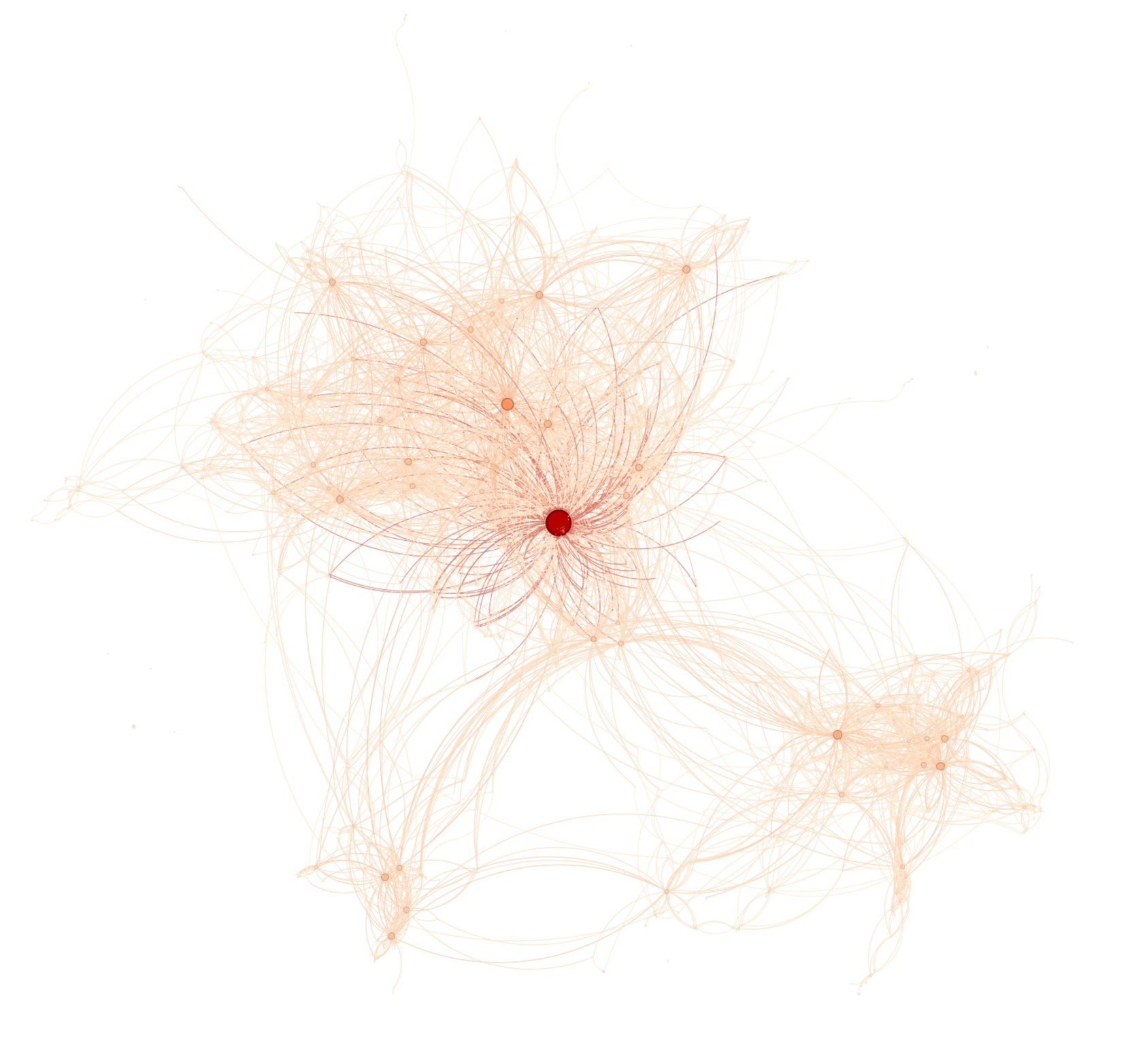
The image depicts a network diagram with interconnected nodes and edges. The central focus is a dense cluster of nodes with varying connection densities, radiating outward into sparser regions. No textual labels, legends, or axis markers are visible.
### Components/Axes
- **Nodes**: Circular entities with no explicit labels. One node (center) is distinctly red (#FF0000), while others are light orange (#FFA500).
- **Edges**: Thin, curved lines connecting nodes. Line thickness varies, suggesting potential differences in connection strength or priority.
- **Background**: Plain white, with no gridlines, axes, or annotations.
### Detailed Analysis
- **Central Node**: A single red node (#FF0000) anchors the densest cluster of connections. Approximately 15–20 edges radiate from it, with line thickness ranging from 0.5–2.0px.
- **Peripheral Nodes**: Outer nodes (light orange) have fewer connections (1–5 edges each). Some edges extend beyond the main cluster, forming isolated branches.
- **Connection Patterns**: No discernible directional flow (e.g., arrows). Edges form overlapping loops and radial patterns, implying bidirectional or undirected relationships.
### Key Observations
1. **Central Hub**: The red node acts as a focal point, with 60–70% of edges originating/terminating there.
2. **Sparse Periphery**: Outer nodes exhibit low connectivity, with some edges terminating abruptly (potential "dead ends").
3. **No Textual Data**: No labels, legends, or axis titles are present to contextualize nodes or edges.
### Interpretation
This diagram likely represents a network topology (e.g., social, technological, or biological system). The red node’s prominence suggests it is a critical hub, while the sparse periphery may indicate peripheral or less critical entities. The absence of labels or legends limits interpretability, but the visual hierarchy implies:
- **Centralization**: The red node’s dominance could reflect a single point of failure or control.
- **Modularity**: Sparse outer connections might represent isolated subsystems or peripheral interactions.
- **Ambiguity**: Without textual context, the exact nature of nodes (e.g., users, servers, genes) and edges (e.g., communication, dependencies) remains undefined.
**Note**: No numerical data, trends, or categorical labels are extractable due to the absence of textual or quantitative elements.