## Diagram: Human Subject Processing Models
### Overview
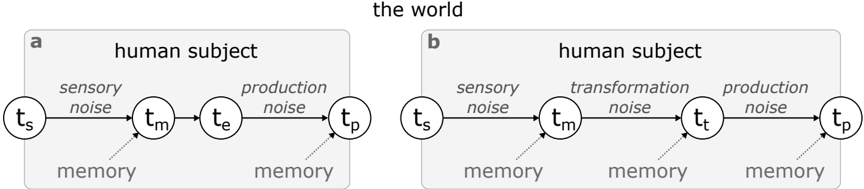
The image presents two diagrams, labeled 'a' and 'b', illustrating models of human subject processing. Both models depict a sequence of stages represented by circles, connected by arrows indicating the flow of information. Each stage is associated with a time point (t) and a type of noise. Model 'a' includes sensory noise and production noise, while model 'b' includes sensory noise, transformation noise, and production noise. Memory is referenced at multiple stages in both models.
### Components/Axes
* **Diagram Labels:** 'a' (top-left), 'b' (top-right)
* **Container Labels:** "human subject" (top of each diagram)
* **Stage Labels:**
* t\_s (sensory input)
* t\_m (memory)
* t\_e (execution - diagram a only)
* t\_t (transformation - diagram b only)
* t\_p (production/output)
* **Noise Labels:**
* sensory noise
* production noise
* transformation noise (diagram b only)
* **Memory Labels:** "memory" (associated with t\_m, t\_e/t\_t, and t\_p)
* **Overall Context:** "the world" (centered at the top of the image)
### Detailed Analysis
**Diagram a:**
* **Stages:** t\_s -> t\_m -> t\_e -> t\_p
* **Noise:** sensory noise (between t\_s and t\_m), production noise (between t\_e and t\_p)
* **Memory:** Associated with t\_m and t\_p
**Diagram b:**
* **Stages:** t\_s -> t\_m -> t\_t -> t\_p
* **Noise:** sensory noise (between t\_s and t\_m), transformation noise (between t\_m and t\_t), production noise (between t\_t and t\_p)
* **Memory:** Associated with t\_m, t\_t, and t\_p
### Key Observations
* Both diagrams model a sequence of processing stages.
* Diagram 'b' includes an additional "transformation" stage (t\_t) compared to diagram 'a', which has an "execution" stage (t\_e).
* Both diagrams include "sensory noise" and "production noise."
* Memory is referenced at multiple stages in both models, indicated by dotted arrows pointing from the memory label to the stage.
### Interpretation
The diagrams represent two different models of how a human subject processes information. Model 'a' might represent a simpler processing pathway, while model 'b' includes a transformation stage, suggesting a more complex cognitive process. The presence of "noise" at different stages indicates potential sources of error or variability in the processing. The memory references suggest that memory plays a role at various stages of processing, influencing how information is perceived, transformed, and produced. The "world" context suggests that these models are intended to represent how humans interact with and process information from their environment.