\n
## Diagram: Models of Human Subject Interaction with the World
### Overview
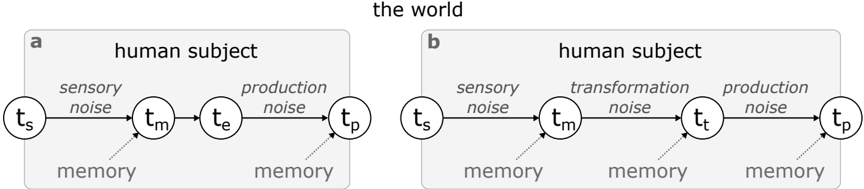
The image presents two diagrams, labeled 'a' and 'b', illustrating models of how a human subject interacts with "the world". Both diagrams depict a sequential process with stages represented by circles and labeled with time variables (ts, tm, te, tp). Arrows indicate the flow of information, and labels identify sources of noise and the role of memory at each stage.
### Components/Axes
The diagrams consist of the following components:
* **Rectangular Boxes:** Representing the "human subject" and "the world".
* **Circles:** Representing stages in the process, labeled:
* ts: Initial time point.
* tm: Intermediate time point.
* te (in diagram a): Intermediate time point.
* tp: Final time point.
* **Arrows:** Indicating the direction of information flow.
* **Labels:** Describing the processes and influences at each stage:
* "sensory noise"
* "production noise"
* "transformation noise" (only in diagram b)
* "memory" (appears below each circle)
* **Header:** "the world" positioned above both diagrams.
### Detailed Analysis or Content Details
**Diagram a:**
* The process begins with 'ts' (initial time) and proceeds linearly through 'tm' and 'te' to 'tp' (final time).
* "sensory noise" is indicated as affecting the transition from 'ts' to 'tm'.
* "production noise" is indicated as affecting the transition from 'te' to 'tp'.
* "memory" is labeled below each of the time points 'ts', 'tm', 'te', and 'tp'.
**Diagram b:**
* The process begins with 'ts' and proceeds linearly through 'tm' and 'tt' to 'tp'.
* "sensory noise" is indicated as affecting the transition from 'ts' to 'tm'.
* "transformation noise" is indicated as affecting the transition from 'tm' to 'tt'.
* "production noise" is indicated as affecting the transition from 'tt' to 'tp'.
* "memory" is labeled below each of the time points 'ts', 'tm', 'tt', and 'tp'.
### Key Observations
* Both diagrams represent a sequential process of information flow.
* Diagram 'b' introduces an additional stage ('tt') and a "transformation noise" component, suggesting a more complex internal processing step.
* The presence of "memory" at each stage indicates that past information influences the current state.
* The diagrams highlight the impact of noise at different stages of the process.
### Interpretation
These diagrams likely represent cognitive models of perception and action. Diagram 'a' could represent a simpler model where information is directly perceived and acted upon, with noise affecting sensory input and motor output. Diagram 'b' represents a more sophisticated model, incorporating an internal transformation stage where information is processed and interpreted before action. The "transformation noise" suggests that this internal processing is also subject to errors or distortions.
The inclusion of "memory" at each stage emphasizes the role of past experiences and internal representations in shaping perception and action. The diagrams suggest that human interaction with the world is not a passive process but is actively constructed and influenced by internal factors such as memory and noise. The diagrams are conceptual and do not provide quantitative data, but rather illustrate a theoretical framework for understanding cognitive processes. They are likely part of a larger discussion on the limitations and biases inherent in human perception and action.