## Diagram: Cognitive Processing Model in Human Subjects
### Overview
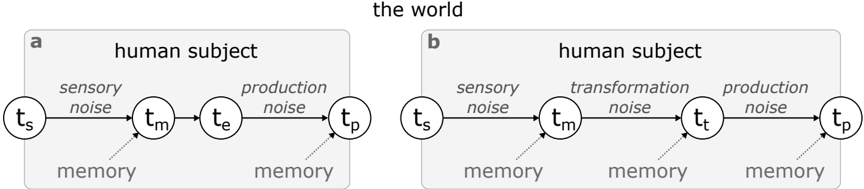
The image presents two side-by-side diagrams (labeled **a** and **b**) illustrating a cognitive processing model for human subjects. Both diagrams depict sequential stages of information processing, with labeled components representing sensory input, memory, noise interference, and output. Diagram **a** shows a simplified model, while diagram **b** introduces an additional "transformation" stage.
### Components/Axes
- **Stages**:
- **t_s**: Sensory input (starting point).
- **t_m**: Memory retrieval/processing.
- **t_e/t_t**: Production noise (diagram **a**) or transformation noise (diagram **b**).
- **t_p**: Final output (production).
- **Noise Types**:
- Sensory noise (between **t_s** and **t_m**).
- Production noise (diagram **a**: between **t_m** and **t_p**).
- Transformation noise (diagram **b**: between **t_m** and **t_t**).
- **Memory**:
- Dotted arrows from **t_m** and **t_t/t_e** to "memory," indicating feedback loops.
### Detailed Analysis
- **Diagram a**:
- Flow: `t_s → (sensory noise) → t_m → (production noise) → t_p`.
- Memory feedback: From **t_m** and **t_p**.
- **Diagram b**:
- Flow: `t_s → (sensory noise) → t_m → (transformation noise) → t_t → (production noise) → t_p`.
- Memory feedback: From **t_m** and **t_t**.
### Key Observations
1. **Diagram a** represents a linear model with two noise stages (sensory and production).
2. **Diagram b** adds a "transformation" stage, suggesting an intermediate processing step.
3. Both models include memory as a feedback mechanism, implying iterative refinement.
4. Noise types are explicitly labeled, highlighting their role in disrupting processing.
### Interpretation
The diagrams model cognitive processing as a multi-stage system where sensory input is filtered through memory and noise interference before producing output. Diagram **b**’s inclusion of a "transformation" stage suggests a more granular breakdown of cognitive tasks, possibly reflecting complex decision-making or problem-solving processes. The feedback loops from memory indicate that prior experiences modulate current processing, aligning with theories of adaptive cognition. The explicit labeling of noise types underscores the importance of environmental and internal interference in shaping perceptual and motor outputs.
**Note**: No numerical data or trends are present; the diagrams focus on structural relationships and process flow.