## Table: Classification of Semi-algebraic Sets and Causal Models
### Overview
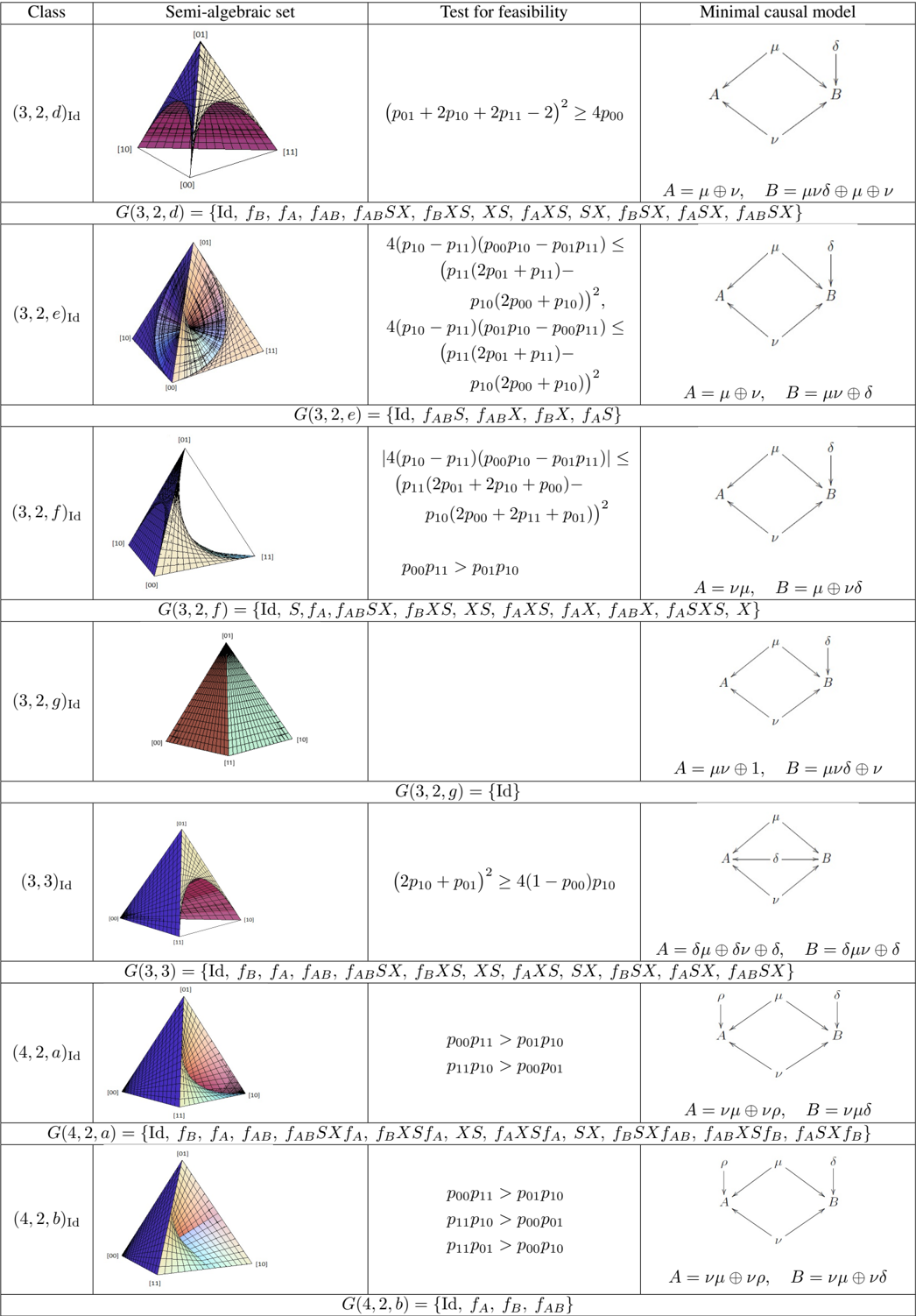
The image presents a table that classifies semi-algebraic sets based on certain criteria, relates them to feasibility tests, and provides corresponding minimal causal models. The table is organized into rows, each representing a different class, and columns representing the semi-algebraic set, feasibility test, and causal model.
### Components/Axes
The table has the following columns:
1. **Class**: Identifies the class of the semi-algebraic set.
2. **Semi-algebraic set**: Shows a graphical representation of the set, along with its algebraic description. The graphical representation is a triangle with coordinates [00], [01], [10], and [11].
3. **Test for feasibility**: Provides mathematical conditions that must be satisfied for the set to be feasible.
4. **Minimal causal model**: Depicts a causal diagram representing the relationships between variables, along with equations defining these relationships.
### Detailed Analysis or ### Content Details
Here's a breakdown of each row:
* **Row 1: Class (3, 2, d)Id**
* **Semi-algebraic set**: A triangle with a curved surface.
* **Test for feasibility**: (p01 + 2p10 + 2p11 - 2)^2 ≥ 4p00
* **Minimal causal model**: A diagram with nodes A and B, connected by edges labeled μ and ν. A = μ ⊕ ν, B = μνδ ⊕ μ ⊕ ν
* **Row 2: Class (3, 2, e)Id**
* **Semi-algebraic set**: A triangle with a complex curved surface.
* **Test for feasibility**: Two inequalities:
* 4(p10 - p11)(p00p10 - p01p11) ≤ (p11(2p01 + p11) - p10(2p00 + p10))^2
* 4(p10 - p11)(p01p10 - p00p11) ≤ (p11(2p01 + p11) - p10(2p00 + p10))^2
* **Algebraic Description**: G(3, 2, e) = {Id, fABS, fABX, fBX, fAS}
* **Minimal causal model**: A diagram with nodes A and B, connected by edges labeled μ and ν. A = μ ⊕ ν, B = μν ⊕ δ
* **Row 3: Class (3, 2, f)Id**
* **Semi-algebraic set**: A triangle with a curved surface.
* **Test for feasibility**:
* |4(p10 - p11)(p00p10 - p01p11)| ≤ (p11(2p01 + 2p10 + p00) - p10(2p00 + 2p11 + p01))^2
* p00p11 > p01p10
* **Algebraic Description**: G(3, 2, f) = {Id, S, fA, fABSX, fBXS, XS, fAXS, fAX, fABX, fASXS, X}
* **Minimal causal model**: A diagram with nodes A and B, connected by edges labeled μ and ν. A = νμ, B = μ ⊕ νδ
* **Row 4: Class (3, 2, g)Id**
* **Semi-algebraic set**: A triangle divided into regions.
* **Test for feasibility**: G(3, 2, g) = {Id}
* **Minimal causal model**: A diagram with nodes A and B, connected by edges labeled μ and ν. A = μν ⊕ 1, B = μνδ ⊕ ν
* **Row 5: Class (3, 3)Id**
* **Semi-algebraic set**: A triangle with a curved surface.
* **Test for feasibility**: (2p10 + p01)^2 ≥ 4(1 - p00)p10
* **Minimal causal model**: A diagram with nodes A and B, connected by edges labeled μ and ν. A = δμ ⊕ δν ⊕ δ, B = δμν ⊕ δ
* **Algebraic Description**: G(3,3) = {Id, fB, fA, fAB, fABSX, fBXS, XS, fAXS, SX, fBSX, fASX, fABSX}
* **Row 6: Class (4, 2, a)Id**
* **Semi-algebraic set**: A triangle with a curved surface.
* **Test for feasibility**:
* p00p11 > p01p10
* p11p10 > p00p01
* **Minimal causal model**: A diagram with nodes A and B, connected by edges labeled μ and ν. A = νμ ⊕ νρ, B = νμδ
* **Algebraic Description**: G(4,2, a) = {Id, fB, fa, fAB, fABSXfA, fBXSfA, XS, fAXSfA, SX, fBSXfAB, fABXSfB, fASXfB}
* **Row 7: Class (4, 2, b)Id**
* **Semi-algebraic set**: A triangle with a curved surface.
* **Test for feasibility**:
* p00p11 > p01p10
* p11p10 > p00p01
* p11p01 > p00p10
* **Minimal causal model**: A diagram with nodes A and B, connected by edges labeled μ and ν. A = νμ ⊕ νρ, B = νμ ⊕ νδ
* **Algebraic Description**: G(4,2,b) = {Id, fA, fB, fAB}
### Key Observations
* The semi-algebraic sets are represented graphically as triangles, with different surface characteristics.
* The feasibility tests involve inequalities and equations related to probabilities (p00, p01, p10, p11).
* The minimal causal models are represented as directed graphs with nodes A and B, and edges labeled with Greek letters (μ, ν, δ, ρ).
* The algebraic descriptions of the sets involve functions denoted by 'f' with various subscripts.
### Interpretation
The table provides a classification system for semi-algebraic sets, linking their geometric properties, feasibility conditions, and causal relationships. The probabilities (p00, p01, p10, p11) likely represent probabilities associated with different states or events within the system. The causal models provide a simplified representation of the dependencies between variables A and B, which are influenced by factors represented by the Greek letters. The algebraic descriptions provide a formal way to define the sets based on specific functions and operations. The different classes represent different types of relationships and constraints within the system being modeled.