## 3D Render: Geometric Objects on Neutral Surface
### Overview
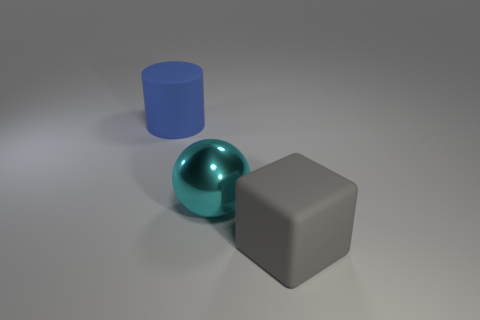
The image depicts a minimalist 3D render featuring three distinct geometric objects arranged on a flat, neutral gray surface. The composition includes a blue cylinder, a teal reflective sphere, and a gray cube. Lighting is soft and diffused, casting subtle shadows to emphasize depth and material properties. No textual elements, labels, or annotations are visible.
### Components/Axes
- **Objects**:
1. **Blue Cylinder**: Positioned in the upper-left quadrant of the frame.
- Shape: Vertical cylinder with uniform diameter.
- Color: Matte blue.
- Spatial Relationship: Furthest from the viewer, slightly angled toward the center.
2. **Teal Sphere**: Central focus of the composition.
- Shape: Perfectly symmetrical sphere with a glossy, reflective surface.
- Color: Iridescent teal with specular highlights.
- Spatial Relationship: Mid-ground, slightly overlapping the cube’s shadow.
3. **Gray Cube**: Foreground object, occupying the lower-right quadrant.
- Shape: Matte gray cube with sharp edges and flat faces.
- Color: Uniform gray, matching the surface.
- Spatial Relationship: Closest to the viewer, casting a faint shadow toward the sphere.
- **Surface**:
- Neutral gray, non-reflective, with a matte finish.
- Extends uniformly across the entire frame.
### Detailed Analysis
- **Lighting and Shadows**:
- Light source originates from the top-left, casting soft shadows diagonally toward the bottom-right.
- The sphere’s reflective surface creates a faint highlight on its upper-left quadrant, consistent with the light direction.
- **Material Properties**:
- Cylinder and cube exhibit matte textures, absorbing light without reflection.
- Sphere’s glossy finish contrasts with the other objects, emphasizing its material uniqueness.
- **Spatial Composition**:
- Objects are evenly spaced but staggered in depth: cylinder (background), sphere (mid-ground), cube (foreground).
- No overlapping occurs between objects, maintaining clear visual hierarchy.
### Key Observations
1. **Absence of Text**: No labels, legends, or annotations are present, suggesting the image focuses purely on geometric and material representation.
2. **Color Contrast**: The teal sphere stands out against the blue cylinder and gray cube/surface, drawing immediate attention.
3. **Shadow Consistency**: Shadows align with the light source’s direction, reinforcing the image’s realism.
### Interpretation
This image likely serves as a study in 3D rendering techniques, demonstrating:
- **Material Simulation**: How different surface properties (matte vs. glossy) interact with light.
- **Spatial Arrangement**: Use of depth and perspective to create a sense of three-dimensionality.
- **Color Theory**: Contrast between cool tones (blue, teal) and neutral grays to guide visual focus.
The lack of textual elements implies the image is not data-driven but rather an artistic or technical demonstration of rendering capabilities. The precise positioning of objects and lighting suggests intentional composition to highlight form, texture, and spatial relationships.