## Bar Chart: F1 Score vs. Number of Retrieval Questions
### Overview
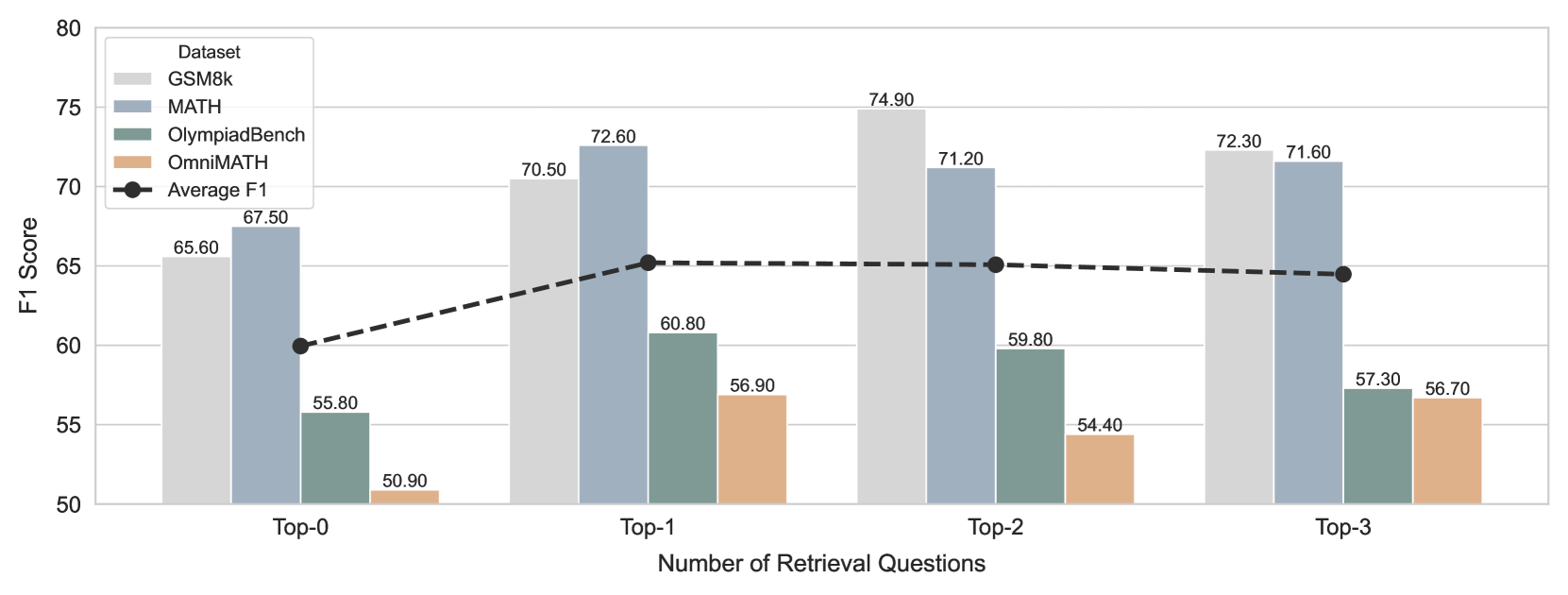
The image is a bar chart comparing the F1 scores of different datasets (GSM8k, MATH, OlympiadBench, and OmniMATH) across varying numbers of retrieval questions (Top-0, Top-1, Top-2, and Top-3). The chart also includes a line graph representing the average F1 score across all datasets for each number of retrieval questions.
### Components/Axes
* **Title (X-axis):** Number of Retrieval Questions
* Categories: Top-0, Top-1, Top-2, Top-3
* **Title (Y-axis):** F1 Score
* Scale: 50 to 80, incrementing by 5
* **Legend (Top-Left):**
* GSM8k (Light Gray)
* MATH (Light Blue)
* OlympiadBench (Dark Green)
* OmniMATH (Light Orange)
* Average F1 (Black Dashed Line with Circle Markers)
### Detailed Analysis
**GSM8k (Light Gray Bars):**
* Top-0: 65.60
* Top-1: 70.50
* Top-2: 74.90
* Top-3: 72.30
* Trend: Generally increasing from Top-0 to Top-2, then slightly decreasing at Top-3.
**MATH (Light Blue Bars):**
* Top-0: 67.50
* Top-1: 72.60
* Top-2: 71.20
* Top-3: 71.60
* Trend: Increasing from Top-0 to Top-1, then slightly decreasing at Top-2, and slightly increasing at Top-3.
**OlympiadBench (Dark Green Bars):**
* Top-0: 55.80
* Top-1: 60.80
* Top-2: 59.80
* Top-3: 57.30
* Trend: Increasing from Top-0 to Top-1, then decreasing at Top-2 and Top-3.
**OmniMATH (Light Orange Bars):**
* Top-0: 50.90
* Top-1: 56.90
* Top-2: 54.40
* Top-3: 56.70
* Trend: Increasing from Top-0 to Top-1, then decreasing at Top-2, and slightly increasing at Top-3.
**Average F1 (Black Dashed Line with Circle Markers):**
* Top-0: 60
* Top-1: 65.5
* Top-2: 65.2
* Top-3: 64.5
* Trend: Increasing from Top-0 to Top-1, then slightly decreasing at Top-2 and Top-3.
### Key Observations
* MATH and GSM8k generally outperform OlympiadBench and OmniMATH across all retrieval question numbers.
* The average F1 score peaks at Top-1 and then gradually declines.
* The F1 scores for all datasets tend to converge as the number of retrieval questions increases (Top-3).
### Interpretation
The chart suggests that increasing the number of retrieval questions initially improves the F1 score, but beyond a certain point (around Top-1), the performance plateaus or even declines slightly. This could indicate that while retrieving more information can be helpful, the quality and relevance of the retrieved information become more critical as the number of retrieval questions increases. The higher F1 scores for MATH and GSM8k might reflect the nature of these datasets, possibly indicating they are more amenable to retrieval-based question answering compared to OlympiadBench and OmniMATH. The convergence of F1 scores at Top-3 could imply that the benefits of additional retrieval questions diminish as the retrieval process becomes saturated.