## Line Chart: WinRate/ASR vs SecAlign DPO Learning Rate
### Overview
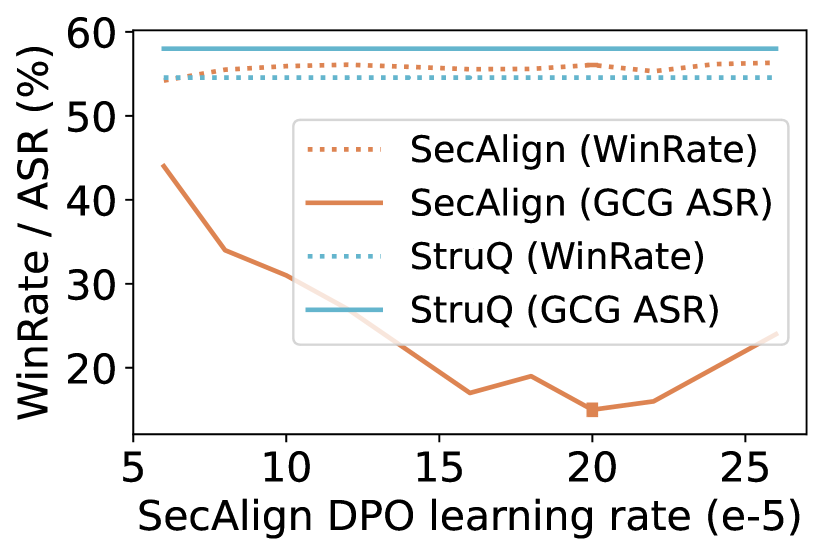
The chart compares performance metrics (WinRate and GCG ASR) of two algorithms (SecAlign and StruQ) across varying DPO learning rates (5e-5 to 25e-5). Four data series are plotted, with distinct line styles and colors for differentiation.
### Components/Axes
- **X-axis**: "SecAlign DPO learning rate (e-5)" with increments at 5, 10, 15, 20, 25.
- **Y-axis**: "WinRate / ASR (%)" scaled from 20 to 60.
- **Legend**: Located in the top-right corner, with four entries:
- Orange dotted line: SecAlign (WinRate)
- Solid orange line: SecAlign (GCG ASR)
- Blue dotted line: StruQ (WinRate)
- Solid blue line: StruQ (GCG ASR)
### Detailed Analysis
1. **SecAlign (WinRate)**
- Dotted orange line starts at ~55% at x=5, dips slightly to ~53% at x=15, then stabilizes near 55% at x=25.
- Trend: Relatively flat with minor fluctuations.
2. **SecAlign (GCG ASR)**
- Solid orange line begins at ~45% at x=5, sharply declines to ~15% at x=20, then rises to ~25% at x=25.
- Trend: U-shaped with a pronounced trough at x=20.
3. **StruQ (WinRate)**
- Blue dotted line remains constant at ~55% across all x-values.
- Trend: Flatline.
4. **StruQ (GCG ASR)**
- Solid blue line stays steady at ~55% throughout.
- Trend: Flatline.
### Key Observations
- **Performance Divergence**: SecAlign's GCG ASR metric exhibits significant volatility (45% → 15% → 25%), while StruQ's metrics remain stable (~55%).
- **Learning Rate Sensitivity**: SecAlign's GCG ASR shows a sharp decline at x=20, suggesting sensitivity to higher learning rates.
- **Consistency**: StruQ outperforms SecAlign in WinRate/ASR stability across all learning rates.
### Interpretation
The data suggests that StruQ maintains consistent performance regardless of learning rate adjustments, while SecAlign's GCG ASR metric is highly sensitive to learning rate changes. The U-shaped trend in SecAlign's GCG ASR implies a potential trade-off: lower learning rates (x=5) yield moderate performance, mid-range rates (x=20) cause severe degradation, and higher rates (x=25) partially recover performance. This could indicate an optimization challenge for SecAlign, where learning rate tuning is critical for GCG ASR stability. The flatlines for StruQ's metrics highlight its robustness compared to SecAlign.