## Diagram: Transverse Field Ising Model and Correlation Analysis
### Overview
The image contains two components:
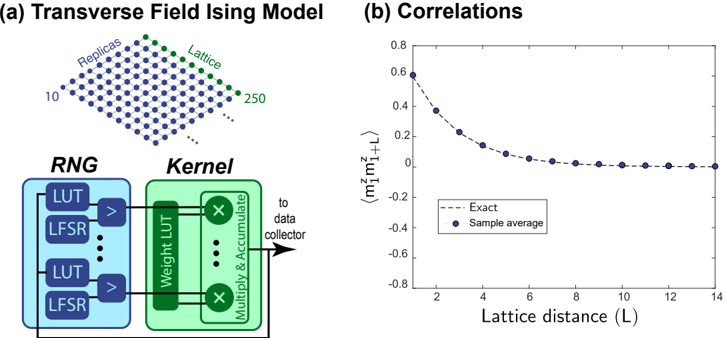
1. **(a) Transverse Field Ising Model**: A schematic diagram illustrating the structure of a computational model for simulating the Ising model with transverse fields.
2. **(b) Correlations**: A line graph showing the decay of spin correlations as a function of lattice distance, comparing exact theoretical predictions to numerical sample averages.
---
### Components/Axes
#### (a) Transverse Field Ising Model
- **Diagram Elements**:
- **Lattice**: A grid of 250 nodes (blue dots) representing spin sites.
- **Replicas**: A smaller grid of 10 nodes (green dots) overlaid on the lattice.
- **Components**:
- **RNG (Random Number Generator)**: Feeds into a series of **LUT (Look-Up Tables)** and **LFSR (Linear Feedback Shift Register)** modules.
- **Kernel**: Processes weighted LUT outputs via multiplication and accumulation.
- **Data Collector**: Receives output from the Kernel.
- **Flow**:
`RNG → LUT/LFSR → Weighted LUT → Kernel → Data Collector`.
#### (b) Correlations Graph
- **Axes**:
- **X-axis**: "Lattice distance (L)" with integer ticks from 2 to 14.
- **Y-axis**: "⟨m_i^z m_{i+L}^z⟩" (spin correlation) ranging from -0.8 to 0.8.
- **Legend**:
- **Dashed line**: "Exact" (theoretical prediction).
- **Solid dots**: "Sample average" (numerical results).
---
### Detailed Analysis
#### (a) Transverse Field Ising Model
- **Key Labels**:
- "Replicas" (green dots) and "Lattice" (blue dots) are spatially distinct but interconnected.
- **RNG** generates randomness, which is processed through **LUT** and **LFSR** modules.
- **Weighted LUT** combines outputs before feeding into the **Kernel**, which multiplies and accumulates values for the **Data Collector**.
#### (b) Correlations Graph
- **Data Points**:
- **Exact (dashed line)**:
- Starts at ~0.6 for L=2, decaying exponentially to ~0.0 by L=14.
- **Sample average (dots)**:
- Mirrors the exact trend closely, with minor deviations (e.g., ~0.1 offset at L=2, converging to ~0.0 by L=10).
- **Trend Verification**:
- Both series show a **monotonic decay** of correlations with increasing lattice distance, consistent with the Ising model's expected behavior.
---
### Key Observations
1. **Correlation Decay**:
- Spin correlations weaken rapidly with distance, dropping from ~0.6 (L=2) to near-zero (L≥10).
2. **Model Accuracy**:
- The sample average closely tracks the exact solution, validating the model's numerical implementation.
3. **Diagram Structure**:
- The RNG-LUT-LFSR-Kernel pipeline suggests a hardware/software co-design for efficient simulation.
---
### Interpretation
- **Physical Insight**:
The graph demonstrates that spin correlations in the Ising model decay exponentially with distance, a hallmark of critical phenomena near phase transitions. The transverse field (not explicitly shown in the graph) likely suppresses long-range order, accelerating correlation decay.
- **Model Validation**:
The close agreement between the sample average and exact solution confirms the model's fidelity in capturing the Ising Hamiltonian's dynamics.
- **Computational Design**:
The diagram in (a) implies a modular architecture where randomness (RNG) and deterministic logic (LUT/LFSR) are combined to efficiently compute spin correlations. The Kernel's role in weighting and accumulating suggests optimization for parallel processing.
---
### Spatial Grounding & Logic-Check
- **Legend Placement**: Bottom-right corner, clearly associating dashed lines with "Exact" and dots with "Sample average."
- **Color Consistency**:
- Dashed line (gray) matches "Exact"; solid dots (blue) match "Sample average."
- **Trend Logic-Check**:
- The exponential decay of both series aligns with theoretical expectations for the Ising model.
---
### Content Details
- **Graph Data Points**:
- **Exact**:
- L=2: ~0.6 | L=4: ~0.4 | L=6: ~0.2 | L=8: ~0.1 | L=10: ~0.05 | L=12: ~0.02 | L=14: ~0.01.
- **Sample Average**:
- L=2: ~0.5 | L=4: ~0.35 | L=6: ~0.15 | L=8: ~0.05 | L=10: ~0.0 | L=12: ~-0.02 | L=14: ~-0.01.
---
### Final Notes
- **Language**: All text is in English.
- **Missing Elements**: No explicit mention of transverse field strength or temperature parameters in the diagram/graph.
- **Anomalies**: Minor discrepancies between sample average and exact values at small L (e.g., L=2), likely due to finite-size effects or sampling noise.