## Bar Chart: Mean Bias vs. Averaging Period
### Overview
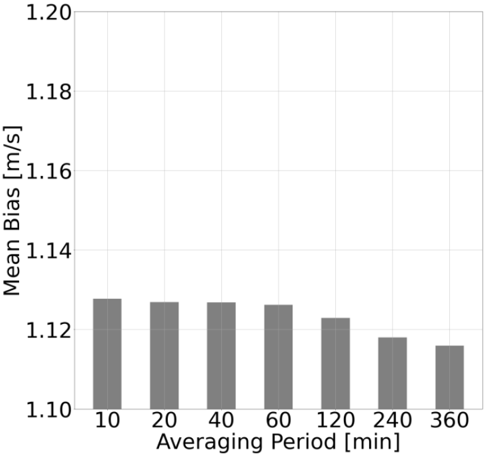
The image is a bar chart showing the relationship between the averaging period (in minutes) and the mean bias (in meters per second). The x-axis represents the averaging period, and the y-axis represents the mean bias. The chart displays a trend of decreasing mean bias as the averaging period increases.
### Components/Axes
* **X-axis:** Averaging Period [min]. The x-axis is labeled "Averaging Period [min]" and has the following values: 10, 20, 40, 60, 120, 240, 360.
* **Y-axis:** Mean Bias [m/s]. The y-axis is labeled "Mean Bias [m/s]" and ranges from 1.10 to 1.20, with tick marks at intervals of 0.02 (1.10, 1.12, 1.14, 1.16, 1.18, 1.20).
* **Bars:** There are seven gray bars, each corresponding to a specific averaging period.
### Detailed Analysis
The chart displays the mean bias for different averaging periods. The bars are gray.
* **10 min:** The mean bias is approximately 1.128 m/s.
* **20 min:** The mean bias is approximately 1.127 m/s.
* **40 min:** The mean bias is approximately 1.127 m/s.
* **60 min:** The mean bias is approximately 1.126 m/s.
* **120 min:** The mean bias is approximately 1.123 m/s.
* **240 min:** The mean bias is approximately 1.118 m/s.
* **360 min:** The mean bias is approximately 1.116 m/s.
### Key Observations
* The mean bias generally decreases as the averaging period increases.
* The most significant drop in mean bias occurs between 60 and 240 minutes.
* The mean bias appears to stabilize after 240 minutes.
### Interpretation
The chart suggests that increasing the averaging period reduces the mean bias in the data. This could be due to the longer averaging period smoothing out short-term fluctuations or noise in the data, leading to a more stable and accurate estimate of the mean. The diminishing returns observed after 240 minutes suggest that there is a point beyond which further increases in the averaging period provide minimal improvement in reducing the mean bias.