\n
## Bar Chart: Mean Bias vs. Averaging Period
### Overview
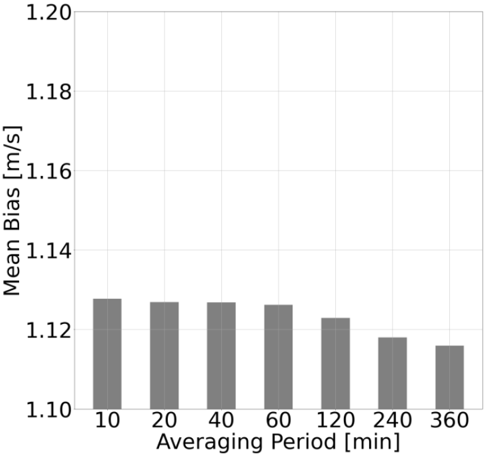
The image presents a bar chart illustrating the relationship between the averaging period and the mean bias, likely in a wind speed measurement or similar application. The x-axis represents the averaging period in minutes, and the y-axis represents the mean bias in meters per second (m/s).
### Components/Axes
* **X-axis Title:** Averaging Period [min]
* **Y-axis Title:** Mean Bias [m/s]
* **X-axis Markers:** 10, 20, 40, 60, 120, 240, 360
* **Y-axis Scale:** Ranges from approximately 1.10 to 1.20, with gridlines at 0.02 intervals.
* **Data Series:** A single series of bars representing the mean bias for each averaging period.
* **Bar Color:** Gray
### Detailed Analysis
The chart displays seven bars, each corresponding to a different averaging period. The trend is generally downward, indicating that as the averaging period increases, the mean bias decreases.
* **Averaging Period = 10 min:** Mean Bias ≈ 1.13 m/s
* **Averaging Period = 20 min:** Mean Bias ≈ 1.13 m/s
* **Averaging Period = 40 min:** Mean Bias ≈ 1.13 m/s
* **Averaging Period = 60 min:** Mean Bias ≈ 1.125 m/s
* **Averaging Period = 120 min:** Mean Bias ≈ 1.12 m/s
* **Averaging Period = 240 min:** Mean Bias ≈ 1.118 m/s
* **Averaging Period = 360 min:** Mean Bias ≈ 1.115 m/s
### Key Observations
The mean bias is relatively stable between 10 and 40 minutes, hovering around 1.13 m/s. A slight decrease is observed from 60 minutes onwards, with the lowest mean bias occurring at 360 minutes (approximately 1.115 m/s). The differences in mean bias between consecutive averaging periods are small, suggesting a gradual reduction in bias as the averaging period increases.
### Interpretation
The data suggests that increasing the averaging period reduces the mean bias in the measured quantity. This is likely due to the smoothing effect of averaging, which reduces the impact of short-term fluctuations or noise in the data. The diminishing returns observed after 60 minutes suggest that there is a point beyond which increasing the averaging period provides only marginal improvements in bias reduction. This information is valuable for optimizing the measurement process, balancing the need for accuracy (low bias) with the desire for responsiveness to changes in the measured quantity. The chart implies that an averaging period of around 360 minutes provides a good balance between bias reduction and temporal resolution.