## Flowchart: Signal Processing and Machine Learning Pipeline
### Overview
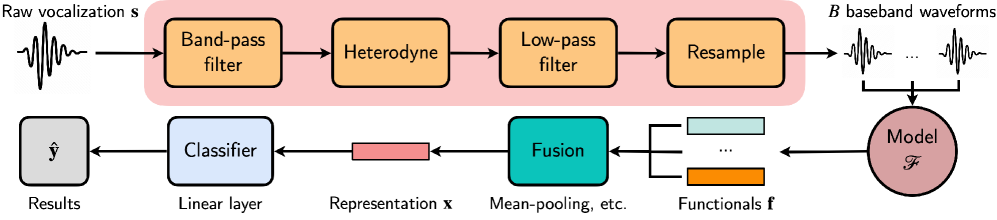
The diagram illustrates a two-stage pipeline for processing raw vocalizations into model outputs. The top section shows signal preprocessing steps, while the bottom section depicts a machine learning model architecture. The flow progresses from left to right, with preprocessing feeding into the model's feature extraction and fusion stages.
### Components/Axes
**Top Section (Preprocessing):**
- **Input:** Raw vocalization `s` (black squiggly line)
- **Processing Steps (orange boxes):**
1. Band-pass filter
2. Heterodyne
3. Low-pass filter
4. Resample
- **Output:** `B` baseband waveforms (black squiggly lines with arrow)
**Bottom Section (Model Pipeline):**
- **Input:** Results `ŷ` (gray box)
- **Components:**
1. Classifier (blue box)
2. Linear layer (pink rectangle)
3. Representation `x` (black arrow)
4. Fusion (teal box)
- Sub-components:
- Mean-pooling (light blue rectangle)
- Functionals `f` (orange rectangle)
5. Model `F` (pink circle)
- **Output:** Final model output (black arrow from `F`)
**Legend/Color Coding:**
- Orange: Preprocessing filters
- Blue: Classifier
- Pink: Linear layer/model
- Teal: Fusion
- Light blue/orange: Fusion sub-components
### Detailed Analysis
**Preprocessing Flow:**
1. Raw vocalization passes through sequential filters (band-pass → heterodyne → low-pass) before resampling
2. Output is baseband waveforms `B` with multiple frequency components (three waveform examples shown)
**Model Pipeline:**
1. Classifier processes results `ŷ` through a linear layer
2. Output representation `x` feeds into fusion module
3. Fusion combines mean-pooling features with learned functionals `f`
4. Final model `F` synthesizes fused features for final output
### Key Observations
1. **Signal Conditioning:** Preprocessing focuses on frequency domain manipulation (filtering, resampling)
2. **Feature Hierarchy:** Model pipeline progresses from raw results → linear features → fused representations
3. **Modular Design:** Fusion module explicitly separates mean-pooling from learned functionals
4. **Color Consistency:** Orange dominates preprocessing, while model components use cooler tones (blue/pink/teal)
### Interpretation
This architecture suggests a hybrid approach combining traditional signal processing with modern machine learning:
- **Preprocessing Stage:** Prepares raw audio for feature extraction through analog-style filtering techniques
- **Model Stage:** Employs a classifier with linear features, then enhances through fusion of handcrafted (mean-pooling) and learned (functionals) features
- **Model F:** Likely represents a non-linear decision boundary or generative model operating on fused features
The separation of mean-pooling (static feature) and functionals (learned features) in the fusion module implies an attention mechanism or feature weighting system. The use of baseband waveforms as input to the classifier suggests frequency-domain feature extraction precedes temporal processing in the model.