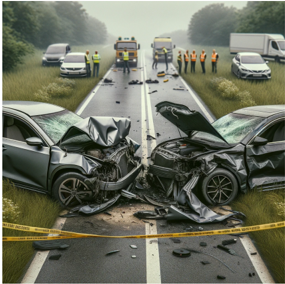
## Photograph: Multi-Vehicle Collision Scene on a Highway
### Overview
The image is a photograph depicting the aftermath of a severe multi-vehicle collision on a multi-lane highway. The scene is captured from a low angle, looking down the road. The primary focus is on two heavily damaged passenger cars in the immediate foreground. The environment appears to be a rural or semi-rural highway, with grassy verges and trees visible in the background under overcast, foggy, or misty conditions, suggesting poor visibility.
### Components & Spatial Layout
**Foreground (Bottom Third):**
* **Yellow Police/Caution Tape:** Stretches horizontally across the lower portion of the frame, indicating the secured perimeter of the accident scene. It is slightly blurred, suggesting it is very close to the camera.
* **Debris Field:** Scattered across the asphalt are numerous pieces of dark debris, likely fragments of plastic, metal, and glass from the vehicles.
* **Primary Collision Point:** Two cars are positioned in a near head-on or severe offset frontal collision configuration.
* **Left Vehicle:** A dark grey or silver sedan/hatchback. Its front end is completely crumpled, with the hood buckled upwards and the engine compartment severely compressed. The front left wheel is visibly displaced.
* **Right Vehicle:** A dark-colored (possibly black or dark blue) sedan. Its front end is also destroyed, with the hood folded and the bumper detached. The damage appears concentrated on the front right side.
**Middle Ground (Center):**
* **Highway Lanes:** The road is a divided highway with at least two lanes visible in each direction, separated by a solid white line and a grassy median.
* **Emergency Response Personnel:** Approximately 8-10 individuals are visible. They are wearing high-visibility uniforms (orange and yellow/lime green vests). They are clustered in two main groups:
* One group is near a white vehicle on the right shoulder.
* Another group is further down the road, near the center line, appearing to assess the scene or manage traffic.
* **Emergency Vehicles:**
* A white ambulance or emergency response vehicle is parked on the right shoulder, facing away from the camera.
* A larger white truck (possibly a fire department or heavy rescue vehicle) is parked further down the road in the left lane/shoulder area.
* **Other Vehicles Involved:**
* A white sedan is stopped on the right shoulder, behind the primary collision.
* A dark-colored SUV or van is stopped on the left shoulder, further back.
* Another white vehicle is partially visible behind the large truck.
**Background (Top Third):**
* **Road Continuation:** The highway stretches into the distance, disappearing into fog or mist.
* **Additional Vehicles:** Several more vehicles are stopped in the distance, including what appears to be a large white semi-trailer truck on the right side.
* **Environment:** Dense green trees line both sides of the highway. The sky is uniformly grey and overcast.
### Detailed Analysis
* **Vehicle Damage Assessment:** The damage to both primary vehicles is catastrophic and localized to the front ends. The crumple zones have been fully engaged. The upward buckling of the hoods and the intrusion into the passenger compartments suggest a high-energy impact. The left vehicle's front left wheel assembly appears compromised.
* **Scene Management:** The presence of multiple emergency personnel in distinct groups indicates an organized response, likely involving triage, scene investigation, and traffic control. The placement of emergency vehicles on the shoulders is standard procedure to protect the scene and responders.
* **Environmental Conditions:** The fog/mist is a critical factor. It significantly reduces visibility and likely contributed to the collision by limiting the drivers' sight distance and reaction time. The road surface appears dry.
### Key Observations
1. **Severity of Impact:** The extent of deformation to both vehicles indicates a very high-speed collision.
2. **Configuration:** The final resting positions of the two main cars suggest an offset frontal impact, where the front corners of the vehicles collided, rather than a full head-on.
3. **Secondary Incidents:** The number of stopped vehicles in the background (at least 5-6 others) suggests this may be a multi-vehicle pile-up, with the foreground collision being the most severe.
4. **Absence of Visible Text:** There are no legible signs, license plates, or textual labels visible in the image. All information is derived from visual analysis of objects and their states.
### Interpretation
This photograph documents a major traffic accident with likely severe injuries or fatalities, given the vehicle damage. The scene tells a story of a chain-reaction event, possibly initiated by the primary collision in the foreground, exacerbated by poor visibility conditions. The emergency response is in its active phase, with personnel securing the area and managing the aftermath. The image serves as a stark visual record of the consequences of high-speed collisions and the importance of visibility and safe following distances. From a forensic perspective, the debris field, skid marks (not clearly visible), and final vehicle positions would be critical for accident reconstruction. The fog is a key environmental factor that would be central to any investigation into the cause.