## Flowchart: Statute Law Task Workflow
### Overview
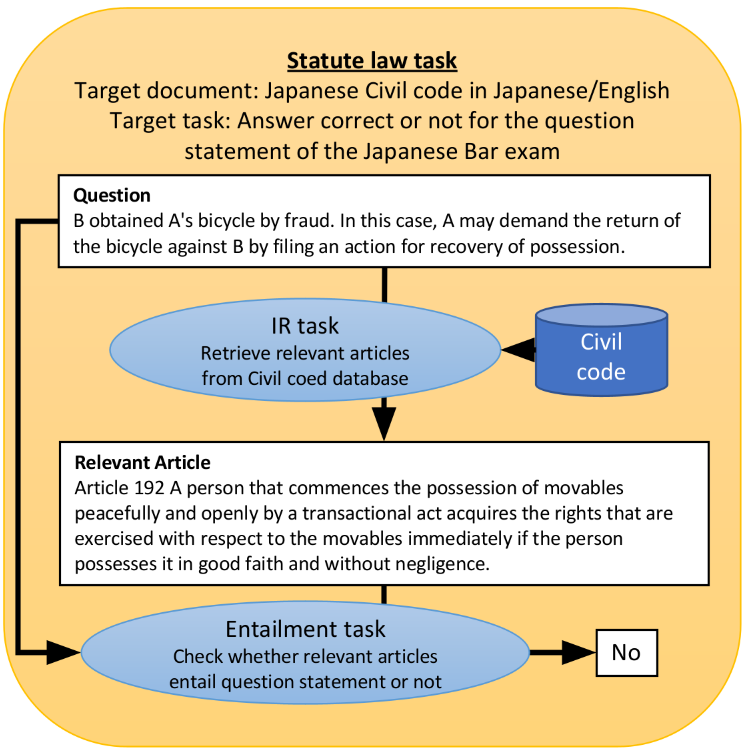
This image displays a flowchart illustrating an automated legal reasoning process, specifically designed to evaluate a question from the Japanese Bar exam against the Japanese Civil Code. The diagram outlines a pipeline that retrieves relevant legal articles and determines if they entail the statement provided in the question. The entire process is contained within a light orange rounded rectangle.
### Components/Axes
The diagram is composed of several distinct shapes connected by directional arrows, representing the flow of information:
* **Header (Top):**
* **Title:** "Statute law task"
* **Subtitle 1:** "Target document: Japanese Civil code in Japanese/English"
* **Subtitle 2:** "Target task: Answer correct or not for the question statement of the Japanese Bar exam"
* **Main Process Flow (Top to Bottom):**
* **Question Box (Top-Center):** A rectangular box containing the input question.
* **IR Task Oval (Center):** An oval representing the Information Retrieval process.
* **Civil Code Cylinder (Right of Center):** A database icon representing the source of the legal text.
* **Relevant Article Box (Lower-Center):** A rectangular box containing the retrieved legal text.
* **Entailment Task Oval (Bottom-Center):** An oval representing the logical verification process.
* **Result Box (Bottom-Right):** A small rectangular box containing the final output.
### Detailed Analysis
**1. Input Phase (Question Box)**
* **Position:** Top-center, below the header.
* **Content:** "Question: B obtained A's bicycle by fraud. In this case, A may demand the return of the bicycle against B by filing an action for recovery of possession."
**2. Retrieval Phase (IR Task & Database)**
* **IR Task Oval (Center):**
* **Content:** "IR task: Retrieve relevant articles from Civil code database"
* **Civil Code Cylinder (Right of IR Task):**
* **Content:** "Civil code"
* **Connection:** An arrow points from the cylinder to the left, into the "IR task" oval.
**3. Processing Phase (Relevant Article)**
* **Relevant Article Box (Lower-Center):**
* **Content:** "Relevant Article: Article 192 A person that commences the possession of movables peacefully and openly by a transactional act acquires the rights that are exercised with respect to the movables immediately if the person possesses it in good faith and without negligence."
* **Connection:** An arrow points from the "IR task" oval down to this box.
**4. Verification Phase (Entailment Task)**
* **Entailment Task Oval (Bottom-Center):**
* **Content:** "Entailment task: Check whether relevant articles entail question statement or not"
* **Connections:**
* An arrow points down from the "Relevant Article" box into the top of this oval.
* A long arrow originates from the left side of the "Question" box, travels down the left margin, and enters the left side of this oval. This indicates the "Entailment task" requires both the original question and the retrieved article as inputs.
**5. Output Phase**
* **Result Box (Bottom-Right):**
* **Content:** "No"
* **Connection:** An arrow points from the right side of the "Entailment task" oval to this box.
### Key Observations
* **Logic Flow:** The diagram explicitly shows that the "Entailment task" is a multi-input process. It requires the original "Question" (fed via the long left-hand arrow) and the "Relevant Article" (fed from the box above).
* **Legal Context:** The retrieved article (Article 192) deals with the acquisition of rights over movables (like a bicycle) in good faith. The system concludes "No," implying that Article 192 does not support the claim in the question regarding the recovery of possession in a case of fraud.
### Interpretation
This diagram represents a **Natural Language Processing (NLP) pipeline for legal reasoning**.
* **The Process:** The system acts as an automated legal assistant. It takes a legal scenario (the question), searches a database (the Civil Code) to find the governing law (Article 192), and then performs a logical check (entailment) to see if the law supports the assertion made in the question.
* **The Outcome:** The final output "No" suggests that the system has determined the legal claim in the question is not supported by the retrieved article. In legal terms, this implies that the specific conditions of Article 192 (good faith, no negligence, peaceful/open possession) do not align with the scenario of "fraud" described in the question, or that the article is insufficient to grant the right to recover possession in this specific context.
* **Significance:** This is a classic example of a "Retrieval-Augmented Generation" (RAG) or "Question Answering" workflow in AI, where the model must ground its answer in a specific, retrieved document rather than relying on internal training data alone.