## Flow Diagram: Statute Law Task
### Overview
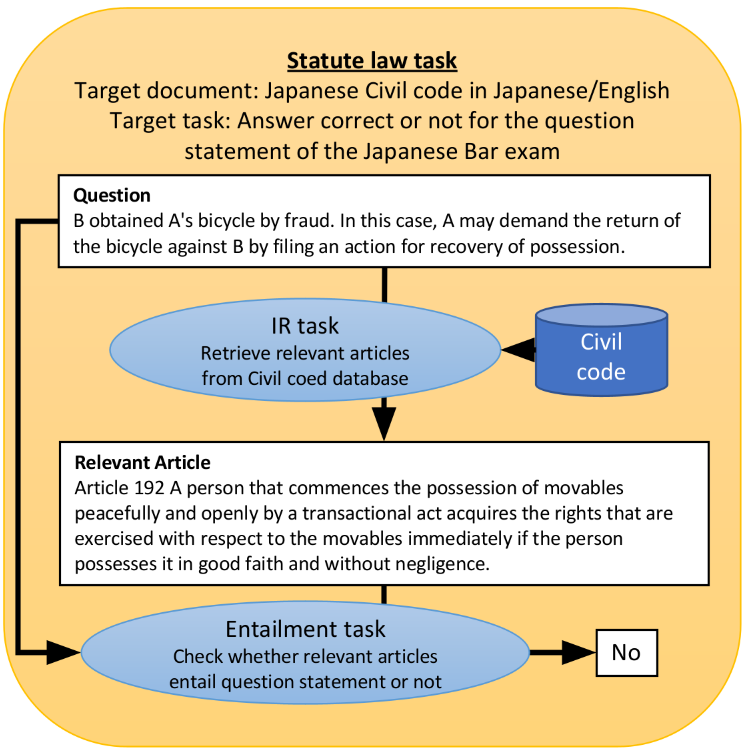
The image is a flowchart describing a statute law task. It outlines the steps involved in answering a question related to the Japanese Civil Code, including retrieving relevant articles and checking if they entail the question statement.
### Components/Axes
* **Title:** Statute law task
* **Target document:** Japanese Civil code in Japanese/English
* **Target task:** Answer correct or not for the question statement of the Japanese Bar exam
* **Flowchart elements:**
* Question (text box)
* IR task (oval): Retrieve relevant articles from Civil coed database
* Civil code (cylinder)
* Relevant Article (text box): Article 192 A person that commences the possession of movables peacefully and openly by a transactional act acquires the rights that are exercised with respect to the movables immediately if the person possesses it in good faith and without negligence.
* Entailment task (oval): Check whether relevant articles entail question statement or not
* No (rectangle)
* **Arrows:** Indicate the flow of the process.
### Detailed Analysis or ### Content Details
1. **Question:**
* "B obtained A's bicycle by fraud. In this case, A may demand the return of the bicycle against B by filing an action for recovery of possession."
2. **IR task:**
* "Retrieve relevant articles from Civil coed database"
3. **Civil code:**
* Labelled as "Civil code"
4. **Relevant Article:**
* "Article 192 A person that commences the possession of movables peacefully and openly by a transactional act acquires the rights that are exercised with respect to the movables immediately if the person possesses it in good faith and without negligence."
5. **Entailment task:**
* "Check whether relevant articles entail question statement or not"
6. **No:**
* Labelled as "No"
The flowchart starts with the "Question". The process flows from the "Question" to the "IR task", which retrieves relevant articles from the "Civil code". The "Relevant Article" is then presented. Next, the "Entailment task" checks if the relevant articles entail the question statement. If not, the process leads to "No".
### Key Observations
* The flowchart outlines a process for answering a legal question using the Japanese Civil Code.
* The process involves retrieving relevant articles and checking if they entail the question statement.
* The "Civil code" is represented as a database.
* The "Relevant Article" provides a specific legal rule.
### Interpretation
The flowchart illustrates a simplified legal reasoning process. It demonstrates how a legal question can be analyzed by retrieving relevant legal rules and determining if those rules apply to the facts presented in the question. The process highlights the importance of legal databases and the ability to extract and apply relevant legal principles. The "No" outcome suggests that if the relevant articles do not entail the question statement, further analysis or a different approach may be needed.
```