## Flowchart: Statute Law Task for Japanese Civil Code Analysis
### Overview
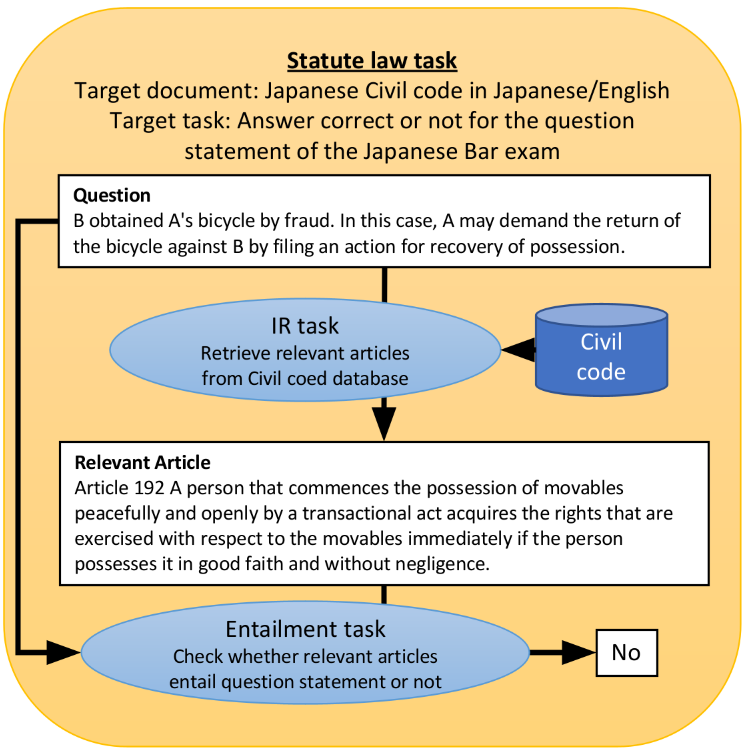
This flowchart illustrates a legal reasoning process for determining whether a question statement about Japanese Civil Code entitlements is correct or not. It combines information retrieval (IR) tasks with legal entailment checks using a Civil Code database.
### Components/Axes
1. **Question Box** (White rectangle with black text)
- Contains a legal scenario: "B obtained A's bicycle by fraud..."
2. **IR Task Oval** (Light blue oval with black text)
- Action: "Retrieve relevant articles from Civil code database"
3. **Relevant Article Box** (White rectangle with black text)
- Contains Article 192 text about possession rights
4. **Entailment Task Oval** (Light blue oval with black text)
- Action: "Check whether relevant articles entail question statement or not"
5. **Decision Box** (White rectangle with black text)
- Output: "No" (indicating negative entailment)
6. **Civil Code Database** (Blue cylinder icon)
- Source for legal articles
### Detailed Analysis
- **Flow Direction**: Top-to-bottom sequential process
- **Color Coding**:
- Blue: Task ovals (IR/Entailment)
- White: Text boxes (Question/Relevant Article/Decision)
- Blue Cylinder: Civil Code database
- **Key Text Elements**:
- Target Document: Japanese Civil Code (Japanese/English)
- Target Task: Answer correctness for Japanese Bar exam questions
- Example Scenario: Fraudulent possession of movable property
- Legal Principle: Article 192's good faith possession requirement
### Key Observations
1. The process terminates at "No" in this example, suggesting the question statement is not entailed by Article 192
2. The Civil Code database is the sole knowledge source
3. The example focuses on movable property rights (bicycle)
4. No positive entailment path is shown in this diagram
### Interpretation
This flowchart represents a simplified legal reasoning system for Japanese Civil Code analysis. The absence of a "Yes" path in the example suggests:
1. The question statement likely violates Article 192's good faith requirement
2. The system prioritizes negative entailment verification
3. The process emphasizes direct article-text matching rather than broader legal interpretation
4. The diagram serves as both a technical workflow and educational tool for Bar exam preparation
The system's design reflects the Japanese legal principle that fraudulent acquisition of property (bad faith possession) invalidates ownership rights, as demonstrated by the bicycle fraud scenario.