## System Architecture Diagram: Decentralized AI Marketplace with zkSNARK Verification
### Overview
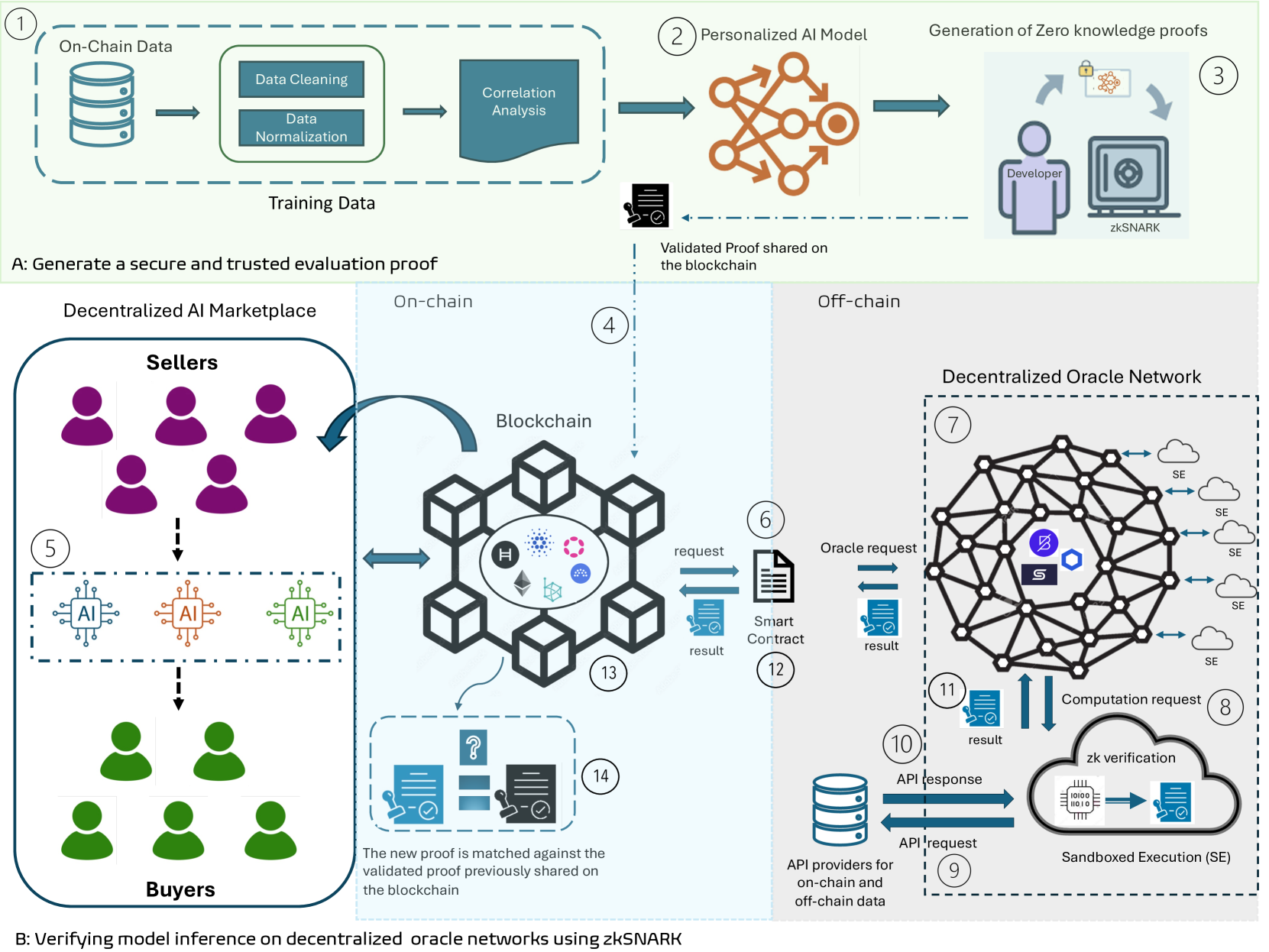
This image is a technical system architecture diagram illustrating a two-part process for creating and verifying AI models in a decentralized marketplace. The diagram is divided into two main sections labeled **A** and **B**, connected by a dashed line representing the flow of a "Validated Proof." The overall system combines on-chain (blockchain) and off-chain (oracle network) components to enable secure, trustless AI model evaluation and inference.
### Components/Axes
The diagram is structured into distinct regions and components, each with specific labels and functions.
**Part A: Generate a secure and trusted evaluation proof** (Top section, light green background)
* **1. On-Chain Data:** Represented by a database icon. This is the starting point.
* **Training Data Processing Pipeline:** A dashed box containing:
* **Data Cleaning** (blue box)
* **Data Normalization** (blue box)
* **Correlation Analysis** (blue box)
* **2. Personalized AI Model:** Represented by a neural network icon.
* **3. Generation of Zero knowledge proofs:** Shows a developer icon, a zkSNARK icon, and a lock icon, indicating the creation of a cryptographic proof.
* **Output:** A document icon labeled "Validated Proof shared on the blockchain" connects Part A to Part B.
**Part B: Verifying model inference on decentralized oracle networks using zkSNARK** (Bottom section, light blue background)
This section is divided into three vertical zones: **Decentralized AI Marketplace** (left), **On-chain** (center), and **Off-chain** (right).
* **Decentralized AI Marketplace (Left Zone):**
* **Sellers:** Represented by purple person icons.
* **5. AI Models:** Three distinct AI chip icons (blue, orange, green) in a dashed box, representing models for sale.
* **Buyers:** Represented by green person icons.
* **Flow:** Sellers provide AI models, which are then available to Buyers.
* **On-chain (Center Zone):**
* **4. Blockchain:** A central hexagonal network diagram containing logos for Hyperledger (H), Ethereum (ETH), and others.
* **13. Blockchain Interaction:** Arrows show data flow to/from the blockchain.
* **14. Proof Matching:** A dashed box showing a question mark icon and two document icons with checkmarks. Text: "The new proof is matched against the validated proof previously shared on the blockchain."
* **Off-chain (Right Zone):**
* **6. Smart Contract:** A document icon that sends a "request" and receives a "result."
* **7. Decentralized Oracle Network:** A large, complex network diagram with interconnected nodes. It contains logos for Chainlink (link icon) and API3 (hexagon icon).
* **8. Computation request:** An arrow pointing from the Oracle Network to a cloud.
* **9. API providers for on-chain and off-chain data:** A database icon.
* **10. API request/response:** Arrows showing communication between the Oracle Network and API providers.
* **11. Result:** A document icon returning from the Oracle Network.
* **12. Result:** A document icon returning to the Smart Contract.
* **Sandboxed Execution (SE):** A cloud icon containing a chip and a document icon, labeled "zk verification." Multiple "SE" clouds are connected to the Oracle Network.
**Numbered Process Steps:** The diagram includes circled numbers (1 through 14) indicating a sequential or logical flow of operations, though the exact sequence is not strictly linear.
### Detailed Analysis
The diagram details a multi-stage workflow:
1. **Proof Generation (Part A):** On-chain data is cleaned, normalized, and analyzed to train a personalized AI model. A developer then uses zkSNARK technology to generate a cryptographic proof of the model's properties or performance. This "Validated Proof" is shared on the blockchain.
2. **Marketplace & Verification (Part B):**
* Sellers list AI models in a decentralized marketplace.
* A buyer's interaction triggers a **Smart Contract (6)** on the blockchain.
* The Smart Contract sends an **Oracle request (7)** to a **Decentralized Oracle Network**.
* The Oracle Network coordinates a **Computation request (8)** to **Sandboxed Execution (SE)** environments for secure, verified processing. It also fetches necessary data via **API requests (9, 10)** to external providers.
* Results are returned through the Oracle Network **(11)** to the Smart Contract **(12)**.
* Crucially, the system performs **Proof Matching (14)**: the new proof generated from the inference is matched against the original "Validated Proof" stored on the blockchain to ensure the model's integrity and correct execution.
### Key Observations
* **Hybrid Architecture:** The system explicitly separates on-chain (blockchain, smart contracts) and off-chain (oracle network, API providers, sandboxed execution) components, highlighting a common pattern in decentralized applications.
* **zkSNARK Integration:** Zero-knowledge proofs are used in two key places: initially to create a trusted evaluation proof (Part A) and later for verification within the sandboxed execution environment (Part B, SE cloud).
* **Trust Model:** The architecture aims to create trust between anonymous sellers and buyers in a marketplace by using cryptographic proofs and decentralized verification, removing the need for a central trusted authority.
* **Complex Flow:** The numbered steps (1-14) suggest a complex, multi-transaction process involving data preparation, model training, proof generation, marketplace listing, request handling, off-chain computation, and on-chain verification.
### Interpretation
This diagram outlines a sophisticated framework for a **trustless AI economy**. It addresses the core problem of verifying that an AI model sold in a decentralized marketplace is both the one advertised and that it performs computations correctly, without requiring the buyer to trust the seller or a central platform.
* **How Elements Relate:** The "Validated Proof" from Part A is the linchpin. It acts as a cryptographic benchmark stored immutably on the blockchain. Part B's entire verification process (steps 11-14) exists to check new model inferences against this benchmark. The Decentralized Oracle Network acts as the secure bridge between the deterministic blockchain and the external world (APIs, computation), while zkSNARKs provide the mathematical guarantees for verification.
* **Purpose:** The system enables **verifiable AI-as-a-service**. A buyer can purchase an inference from a model and receive not just the result, but also a cryptographic proof that the result was generated correctly by the specific, validated model.
* **Notable Anomalies/Considerations:** The diagram is conceptual and does not specify the blockchain platform, the exact zk-SNARK circuit design, or the economic incentives for oracle nodes and sellers. The complexity of the flow (14 steps) implies significant overhead, which would be a practical consideration for implementation. The security of the entire system hinges on the correctness of the initial proof generation (Part A) and the security of the sandboxed execution environments (SE).