## Flowchart: Decentralized AI Marketplace with Zero-Knowledge Proofs
### Overview
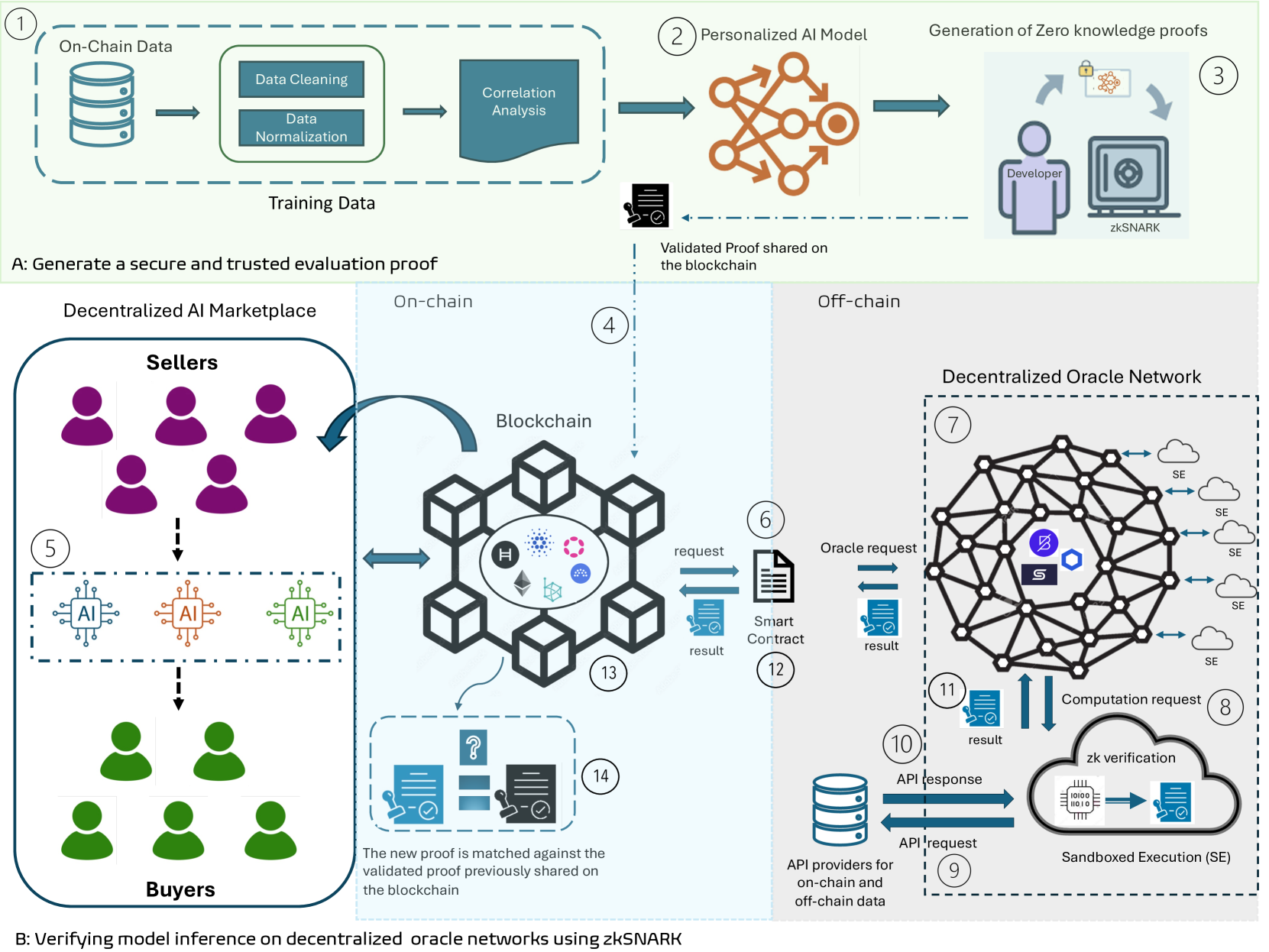
The diagram illustrates a decentralized AI marketplace workflow, emphasizing secure data processing, model training, and verification using blockchain and zero-knowledge proofs (zkSNARK). It is divided into two main sections:
1. **A: Generate a secure and trusted evaluation proof** (Steps 1–3)
2. **B: Verifying model inference on decentralized oracle networks using zkSNARK** (Steps 4–14)
---
### Components/Axes
#### Section A: Secure Evaluation Proof Generation
1. **On-Chain Data** → **Data Cleaning** → **Data Normalization** → **Correlation Analysis** → **Personalized AI Model** → **Generation of Zero-Knowledge Proofs**
- **Key Elements**:
- **On-Chain Data**: Represented as stacked database icons.
- **Data Cleaning/Normalization**: Green-bordered rectangle.
- **Correlation Analysis**: Wavy rectangle.
- **Personalized AI Model**: Orange neural network diagram.
- **Zero-Knowledge Proofs**: Locked document icon labeled "zkSNARK."
#### Section B: Model Inference Verification
- **Decentralized Marketplace**:
- **Sellers** (purple figures) and **Buyers** (green figures) interact via blockchain.
- **Blockchain**: Hexagonal structure with cryptocurrency symbols (e.g., Ethereum, Bitcoin).
- **Smart Contract**: Labeled "request" and "result" arrows.
- **Decentralized Oracle Network**:
- **API Providers**: Stacked database icons.
- **Sandboxed Execution (SE)**: Cloud icons with "SE" labels.
- **zk Verification**: Circuit diagram with "zk verification" label.
---
### Detailed Analysis
#### Section A: Secure Evaluation Proof Generation
1. **On-Chain Data** (Step 1): Raw data stored on the blockchain.
2. **Data Cleaning/Normalization** (Step 1): Preprocessing to ensure data quality.
3. **Correlation Analysis** (Step 1): Identifies relationships in the data.
4. **Personalized AI Model** (Step 2): Custom model trained on processed data.
5. **Zero-Knowledge Proofs** (Step 3): Generated by the developer using zkSNARK, validated on-chain.
#### Section B: Model Inference Verification
1. **Decentralized Marketplace** (Steps 5–6):
- Sellers offer AI models; buyers request inference.
- Blockchain validates proofs against previously shared data.
2. **Oracle Network** (Steps 7–14):
- **API Requests/Responses**: On-chain and off-chain data integration.
- **Computation Requests**: Sent to SE nodes for secure execution.
- **zk Verification**: Ensures model inference results are trustworthy without exposing data.
---
### Key Observations
1. **Blockchain Integration**: Central to trust and validation across both sections.
2. **Zero-Knowledge Proofs**: Enable privacy-preserving verification (e.g., zkSNARK).
3. **Decentralized Oracles**: Bridge on-chain and off-chain data for reliable model inputs.
4. **Sandboxed Execution**: Isolates computations to prevent tampering.
---
### Interpretation
The diagram demonstrates a trustless AI ecosystem where:
- **Data Integrity**: On-chain preprocessing ensures reliable training data.
- **Model Privacy**: Zero-knowledge proofs allow verification without exposing proprietary model details.
- **Decentralized Trust**: Oracles and smart contracts eliminate single points of failure, while zkSNARK ensures computational honesty.
- **Marketplace Dynamics**: Sellers and buyers interact via blockchain, with proofs validated against historical data to prevent fraud.
This architecture prioritizes security, transparency, and scalability for decentralized AI services.