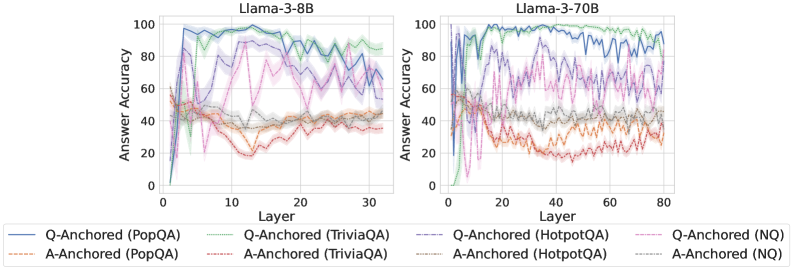
## Line Graph: Answer Accuracy Across Layers for Llama-3-8B and Llama-3-70B Models
### Overview
The image contains two side-by-side line graphs comparing answer accuracy across layers for two versions of the Llama-3 model (8B and 70B parameters). Each graph tracks performance across 30 layers (8B) or 80 layers (70B) for six distinct methods/dataset combinations. The y-axis represents answer accuracy (0-100%), while the x-axis represents layer depth. Multiple colored lines with distinct styles represent different Q-Anchored and A-Anchored methods applied to specific datasets.
### Components/Axes
- **X-Axis (Layer Depth)**:
- Llama-3-8B: 0–30 layers (discrete increments)
- Llama-3-70B: 0–80 layers (discrete increments)
- **Y-Axis (Answer Accuracy)**: 0–100% (continuous scale)
- **Legends**:
- **Llama-3-8B** (left chart):
- Solid blue: Q-Anchored (PopQA)
- Dashed green: Q-Anchored (TriviaQA)
- Dotted orange: A-Anchored (PopQA)
- Dashed gray: A-Anchored (TriviaQA)
- Solid purple: Q-Anchored (HotpotQA)
- Dotted pink: Q-Anchored (NQ)
- **Llama-3-70B** (right chart):
- Same legend entries as above, with matching colors/styles
### Detailed Analysis
#### Llama-3-8B (Left Chart)
1. **Q-Anchored (PopQA)** (solid blue):
- Starts at ~90% accuracy, dips to ~70% at layer 10, then stabilizes near 80%.
2. **Q-Anchored (TriviaQA)** (dashed green):
- Peaks at ~95% at layer 5, drops to ~60% by layer 20, then fluctuates between 50–70%.
3. **A-Anchored (PopQA)** (dotted orange):
- Begins at ~50%, rises to ~70% at layer 15, then declines to ~40% by layer 30.
4. **A-Anchored (TriviaQA)** (dashed gray):
- Starts at ~40%, peaks at ~60% at layer 10, then drops to ~30% by layer 30.
5. **Q-Anchored (HotpotQA)** (solid purple):
- Starts at ~80%, dips to ~60% at layer 10, then stabilizes near 70%.
6. **Q-Anchored (NQ)** (dotted pink):
- Highly volatile: starts at ~50%, peaks at ~90% at layer 5, crashes to ~20% at layer 15, then fluctuates between 10–50%.
#### Llama-3-70B (Right Chart)
1. **Q-Anchored (PopQA)** (solid blue):
- Starts at ~95%, dips to ~80% at layer 20, then stabilizes near 90%.
2. **Q-Anchored (TriviaQA)** (dashed green):
- Peaks at ~98% at layer 10, drops to ~70% by layer 40, then fluctuates between 60–80%.
3. **A-Anchored (PopQA)** (dotted orange):
- Begins at ~60%, rises to ~80% at layer 30, then declines to ~50% by layer 80.
4. **A-Anchored (TriviaQA)** (dashed gray):
- Starts at ~50%, peaks at ~70% at layer 20, then drops to ~40% by layer 80.
5. **Q-Anchored (HotpotQA)** (solid purple):
- Starts at ~85%, dips to ~70% at layer 40, then stabilizes near 80%.
6. **Q-Anchored (NQ)** (dotted pink):
- Less volatile than 8B: starts at ~60%, peaks at ~85% at layer 10, then fluctuates between 50–70%.
### Key Observations
1. **Model Size Impact**:
- Llama-3-70B consistently outperforms Llama-3-8B across most methods/datasets.
- Larger model shows smoother accuracy curves with fewer extreme fluctuations.
2. **Method Performance**:
- Q-Anchored methods generally outperform A-Anchored methods.
- NQ dataset shows the most instability, especially in the 8B model.
3. **Layer-Specific Trends**:
- Early layers (0–10) often show peak accuracy for Q-Anchored methods.
- Later layers (20–80) exhibit gradual declines or stabilization.
4. **Dataset Variability**:
- HotpotQA and TriviaQA show moderate stability.
- PopQA and NQ exhibit higher volatility, particularly in the 8B model.
### Interpretation
The data suggests that:
- **Model Scale Matters**: The 70B model achieves higher baseline accuracy and more stable performance across layers compared to the 8B model.
- **Q-Anchored Superiority**: Q-Anchored methods consistently outperform A-Anchored counterparts, likely due to better contextual grounding.
- **Dataset Sensitivity**: NQ (Natural Questions) introduces significant instability, possibly due to its open-ended nature or data complexity.
- **Layer Depth Dynamics**: Early layers (0–10) are critical for establishing accuracy, with later layers showing diminishing returns or degradation.
The graphs highlight trade-offs between model size, anchoring strategies, and dataset characteristics. The 70B model’s improved performance suggests that scaling enhances robustness, while Q-Anchored methods provide more reliable accuracy across diverse datasets.