## Diagram: AgentFlow: In-the-Flow Agentic System
### Overview
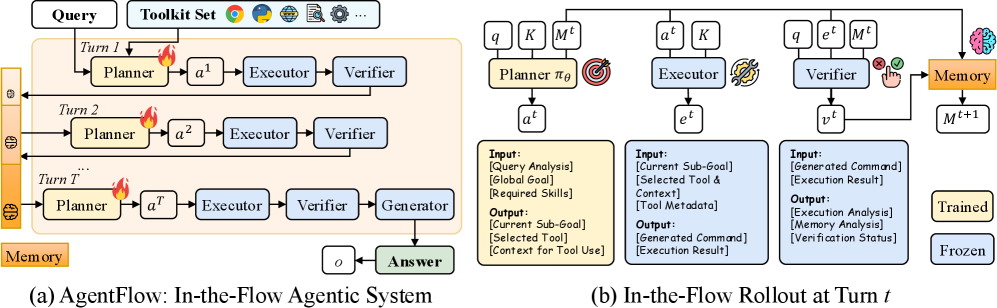
The image presents a diagram illustrating an agentic system called "AgentFlow". It depicts the flow of information and processing within the system across multiple turns (labeled Turn 1, Turn 2, ... Turn T). The diagram is split into two main sections: (a) AgentFlow: In-the-Flow Agentic System, which shows the overall system architecture, and (b) In-the-Flow Rollout at Turn t, which details the input and output of each component at a specific turn.
### Components/Axes
The diagram consists of several key components:
* **Query:** The initial input to the system.
* **Toolkit Set:** A collection of tools available to the agent (represented by icons).
* **Planner:** Generates a plan based on the query and available tools.
* **Executor:** Executes the plan.
* **Verifier:** Verifies the results of the execution.
* **Generator:** Generates the final answer.
* **Memory:** Stores information across turns.
* **Input/Output Blocks:** Represent the data flow into and out of each component at a given turn.
* **Turn Indicators:** Labels indicating the current turn (Turn 1, Turn 2, ... Turn T).
* **a<sup>1</sup>, a<sup>2</sup>, ..., a<sup>T</sup>:** Represent the actions taken at each turn.
* **q, K, M<sup>t</sup>:** Inputs to the Planner at turn t.
* **a<sup>t</sup>, K:** Inputs to the Executor at turn t.
* **e<sup>t</sup>, M<sup>t</sup>:** Inputs to the Verifier at turn t.
* **v<sup>t</sup>:** Output of the Verifier.
* **o:** The final answer.
### Detailed Analysis or Content Details
**(a) AgentFlow: In-the-Flow Agentic System**
* The system starts with a "Query" and a "Toolkit Set".
* The query is fed into a "Planner" at each turn (Turn 1, Turn 2, ... Turn T).
* The Planner outputs an action (a<sup>1</sup>, a<sup>2</sup>, ..., a<sup>T</sup>) which is passed to an "Executor".
* The Executor then passes its output to a "Verifier".
* At the final turn (Turn T), the Verifier's output is passed to a "Generator", which produces the "Answer".
* "Memory" is used across turns, with feedback loops from the Verifier to the Memory.
* The arrows indicate the flow of information.
**(b) In-the-Flow Rollout at Turn t**
* **Planner Input:** [Query Analysis], [Global Goal], [Required Skills].
* **Planner Output:** [Current Sub-goal], [Selected Tool], [Context for Tool Use].
* **Executor Input:** [Current Sub-goal], [Selected Tool & Context].
* **Executor Output:** [Generated Command], [Execution Result].
* **Verifier Input:** [Generated Command], [Execution Result].
* **Verifier Output:** [Execution Analysis], [Memory Analysis], [Verification Status].
* The "Memory" block is divided into "Trained" and "Frozen" sections.
* The diagram shows the inputs and outputs of each component at a single turn 't'.
* The inputs to the Planner are 'q', 'K', and 'M<sup>t</sup>'.
* The inputs to the Executor are 'a<sup>t</sup>' and 'K'.
* The inputs to the Verifier are 'e<sup>t</sup>' and 'M<sup>t</sup>'.
### Key Observations
* The system operates iteratively across multiple turns.
* Each turn involves planning, execution, and verification.
* The "Memory" component plays a crucial role in retaining information across turns.
* The system utilizes a toolkit of tools to accomplish tasks.
* The diagram clearly delineates the input and output of each component at each stage.
* The "Memory" is divided into "Trained" and "Frozen" sections, suggesting a learning or adaptation process.
### Interpretation
The diagram illustrates a sophisticated agentic system designed to solve complex tasks through iterative planning, execution, and verification. The system's ability to leverage a toolkit and maintain memory across turns suggests a capacity for learning and adaptation. The separation of "Trained" and "Frozen" memory indicates a mechanism for preserving knowledge while allowing for ongoing refinement. The detailed breakdown of inputs and outputs for each component at turn 't' highlights the system's transparency and modularity. The flow of information is clearly defined, allowing for a comprehensive understanding of the system's operation. The system appears to be designed for tasks that require reasoning, tool use, and memory retention. The diagram suggests a robust and adaptable agent capable of tackling complex challenges.