## Heatmaps: Word Alignment Matrices for Machine Translation
### Overview
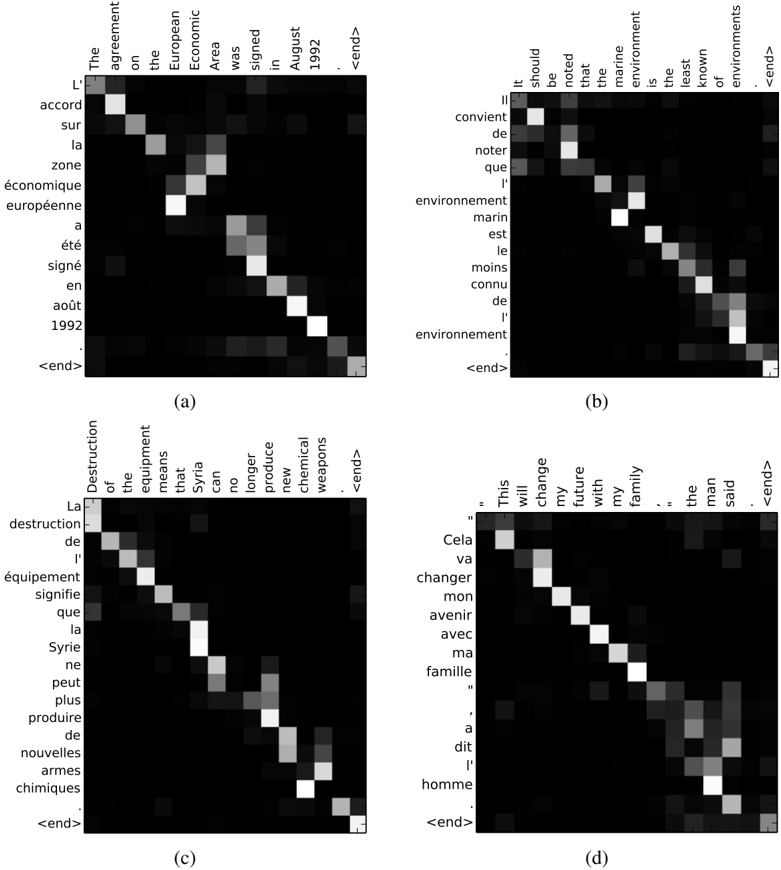
The image presents four heatmaps, each representing a word alignment matrix for a different English-French sentence pair. These matrices visualize the relationships between words in the original English sentence and their corresponding translations in French. The intensity of each cell in the heatmap indicates the strength of the alignment between the corresponding English and French words.
### Components/Axes
Each heatmap has the following components:
* **X-axis:** Represents the English sentence, tokenized into individual words.
* **Y-axis:** Represents the French translation of the English sentence, also tokenized.
* **Cells:** Each cell at position (x, y) represents the alignment strength between the x-th English word and the y-th French word. The intensity of the cell (darkness) indicates the strength of the alignment. Darker cells indicate stronger alignments.
* **Labels:** Each heatmap is labeled with a letter (a, b, c, d) at the bottom.
* **End Token:** Both the English and French sentences end with an "\<end\>" token.
### Detailed Analysis
**Heatmap (a): "The agreement on the European Economic Area was signed in August 1992" vs. "L' accord sur la zone économique européenne a été signé en août 1992"**
* **English:** "The agreement on the European Economic Area was signed in August 1992 \<end\>"
* **French:** "L' accord sur la zone économique européenne a été signé en août 1992 \<end\>"
* **Trend:** Strong diagonal alignment, indicating a direct word-to-word translation.
* **Observations:**
* "The" aligns strongly with "L'".
* "agreement" aligns strongly with "accord".
* "European" aligns strongly with "européenne".
* "Economic" aligns strongly with "économique".
* "Area" aligns strongly with "zone".
* "signed" aligns strongly with "signé".
* "August" aligns strongly with "août".
* "1992" aligns strongly with "1992".
**Heatmap (b): "It should be noted that the marine environment is the least known of environments" vs. "Il convient de noter que l' environnement marin est le moins connu de l' environnement"**
* **English:** "It should be noted that the marine environment is the least known of environments \<end\>"
* **French:** "Il convient de noter que l' environnement marin est le moins connu de l' environnement \<end\>"
* **Trend:** Mostly diagonal alignment, with some deviations.
* **Observations:**
* "It" aligns strongly with "Il".
* "should" aligns with "convient".
* "be" aligns with "de".
* "noted" aligns strongly with "noter".
* "that" aligns strongly with "que".
* "marine" aligns strongly with "marin".
* "environment" aligns strongly with "environnement".
* "is" aligns strongly with "est".
* "least" aligns strongly with "moins".
* "known" aligns strongly with "connu".
**Heatmap (c): "Destruction of the equipment means that Syria can no longer produce new chemical weapons" vs. "La destruction de l' équipement signifie que la Syrie ne peut plus produire de nouvelles armes chimiques"**
* **English:** "Destruction of the equipment means that Syria can no longer produce new chemical weapons \<end\>"
* **French:** "La destruction de l' équipement signifie que la Syrie ne peut plus produire de nouvelles armes chimiques \<end\>"
* **Trend:** Strong diagonal alignment.
* **Observations:**
* "Destruction" aligns strongly with "destruction".
* "of" aligns strongly with "de".
* "the" aligns strongly with "l'".
* "equipment" aligns strongly with "équipement".
* "means" aligns strongly with "signifie".
* "that" aligns strongly with "que".
* "Syria" aligns strongly with "Syrie".
* "can" aligns strongly with "ne".
* "no" aligns strongly with "peut".
* "longer" aligns strongly with "plus".
* "produce" aligns strongly with "produire".
* "new" aligns strongly with "nouvelles".
* "chemical" aligns strongly with "chimiques".
* "weapons" aligns strongly with "armes".
**Heatmap (d): "This will change my future with my family the man said" vs. "Cela va changer mon avenir avec ma famille a dit l' homme"**
* **English:** "This will change my future with my family the man said \<end\>"
* **French:** "Cela va changer mon avenir avec ma famille a dit l' homme \<end\>"
* **Trend:** Diagonal alignment, with some deviations.
* **Observations:**
* "This" aligns strongly with "Cela".
* "will" aligns strongly with "va".
* "change" aligns strongly with "changer".
* "my" aligns strongly with "mon".
* "future" aligns strongly with "avenir".
* "with" aligns strongly with "avec".
* "my" aligns strongly with "ma".
* "family" aligns strongly with "famille".
* "the" aligns strongly with "l'".
* "man" aligns strongly with "homme".
* "said" aligns strongly with "a dit".
### Key Observations
* The heatmaps show the alignment between English and French words in different sentences.
* Stronger alignments are represented by darker cells.
* Most sentences exhibit a diagonal alignment pattern, indicating a direct word-to-word translation.
* Some sentences show deviations from the diagonal, indicating reordering or more complex translation patterns.
### Interpretation
The heatmaps visualize the word alignment process in machine translation. They demonstrate how a model attempts to map words from one language to their corresponding words in another language. The intensity of the cells reflects the model's confidence in the alignment. These visualizations are useful for understanding the inner workings of machine translation models and for identifying potential areas for improvement. The deviations from a perfect diagonal alignment highlight the challenges of machine translation, such as word order differences and the need to handle idiomatic expressions.