\n
## Heatmaps: Textual Association Analysis
### Overview
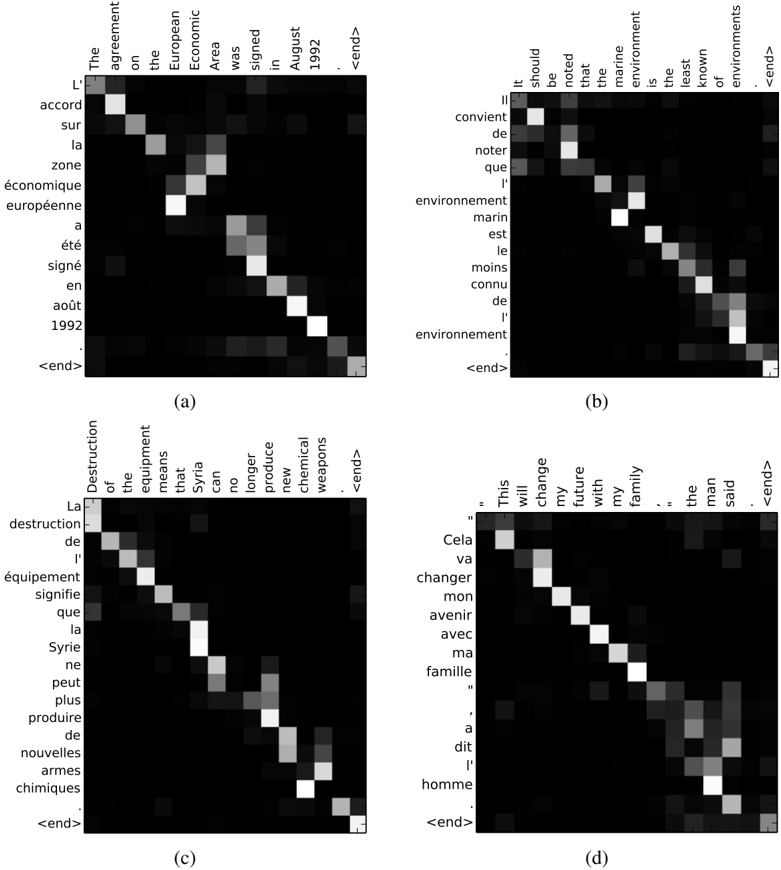
The image presents four separate heatmaps (labeled (a), (b), (c), and (d)). Each heatmap visualizes the association between phrases or sentences, likely derived from a text corpus. The intensity of the gray shading represents the strength of the association, with darker shades indicating a stronger relationship. Each heatmap has a vertical and horizontal axis listing phrases, and the cells represent the co-occurrence or semantic similarity between those phrases. The heatmaps also contain text in French.
### Components/Axes
Each heatmap shares a similar structure:
* **Axes:** Each heatmap has two axes, one horizontal and one vertical, displaying a list of phrases.
* **Color Scale:** The color scale ranges from black (strong association) to white (weak or no association). Shades of gray represent intermediate levels of association.
* **Labels:** Each phrase is labeled along both axes.
* **Markers:** Each heatmap has a `<end>` marker on both axes.
* **Sub-Labels:** Each heatmap has a sub-label (a), (b), (c), and (d) in the bottom-left corner.
**Specific Labels (per heatmap):**
* **(a):**
* Horizontal Axis: "The agreement on the European Economic Area was signed in August 1992", "<end>"
* Vertical Axis: "L'accord sur la zone économique européenne a été signé en août 1992", "<end>"
* **(b):**
* Horizontal Axis: "It should be noted that the marine environment is the least known of environments", "<end>"
* Vertical Axis: "convient de noter que l'environnement marin est le moins connu de l'environnement", "<end>"
* **(c):**
* Horizontal Axis: "Destruction of the equipment that Syria can no longer produce new chemical weapons", "<end>"
* Vertical Axis: "La destruction de l'équipement signifie que la Syrie ne plus produire de nouvelles armes chimiques", "<end>"
* **(d):**
* Horizontal Axis: "This will change my future with my family", "<end>"
* Vertical Axis: "Cela va changer mon avenir avec ma famille", "<end>"
### Detailed Analysis or Content Details
**Heatmap (a):**
The strongest association appears between "The agreement on the European Economic Area was signed in August 1992" and "L'accord sur la zone économique européenne a été signé en août 1992". The intensity is approximately 0.8-0.9 (dark gray). There is a very weak association between both phrases and "<end>" (approximately 0.1-0.2, very light gray).
**Heatmap (b):**
The strongest association is between "It should be noted that the marine environment is the least known of environments" and "convient de noter que l'environnement marin est le moins connu de l'environnement" (intensity approximately 0.7-0.8). Associations with "<end>" are weak (approximately 0.1-0.2).
**Heatmap (c):**
The strongest association is between "Destruction of the equipment that Syria can no longer produce new chemical weapons" and "La destruction de l'équipement signifie que la Syrie ne plus produire de nouvelles armes chimiques" (intensity approximately 0.8-0.9). Associations with "<end>" are weak (approximately 0.1-0.2).
**Heatmap (d):**
The strongest association is between "This will change my future with my family" and "Cela va changer mon avenir avec ma famille" (intensity approximately 0.8-0.9). Associations with "<end>" are weak (approximately 0.1-0.2).
**French Translations:**
* **(a) Vertical Axis:** "The agreement on the European Economic Area was signed in August 1992."
* **(b) Vertical Axis:** "It is appropriate to note that the marine environment is the least known of the environment."
* **(c) Vertical Axis:** "The destruction of the equipment means that Syria can no longer produce new chemical weapons."
* **(d) Vertical Axis:** "This will change my future with my family."
### Key Observations
* Each heatmap demonstrates a very strong correlation between the English and French versions of the same sentence.
* The association with the "<end>" marker is consistently weak across all heatmaps, suggesting it doesn't contribute significantly to the semantic relationship between the phrases.
* The heatmaps appear to be designed to demonstrate the semantic equivalence between the English and French phrases.
### Interpretation
These heatmaps likely represent a validation exercise for machine translation or cross-lingual information retrieval. The strong correlations between the English and French phrases suggest that the translation is accurate and preserves the meaning of the original text. The heatmaps visually demonstrate the semantic similarity, providing a clear and intuitive way to assess the quality of the translation. The consistent weak association with "<end>" suggests that this marker is simply a sentence boundary and doesn't carry significant semantic weight. The use of heatmaps allows for a quick and easy comparison of the relationships between phrases in different languages. The data suggests a high degree of semantic equivalence between the English and French versions of the sentences.