## Attention Matrix Visualization: English-French Word Alignment
### Overview
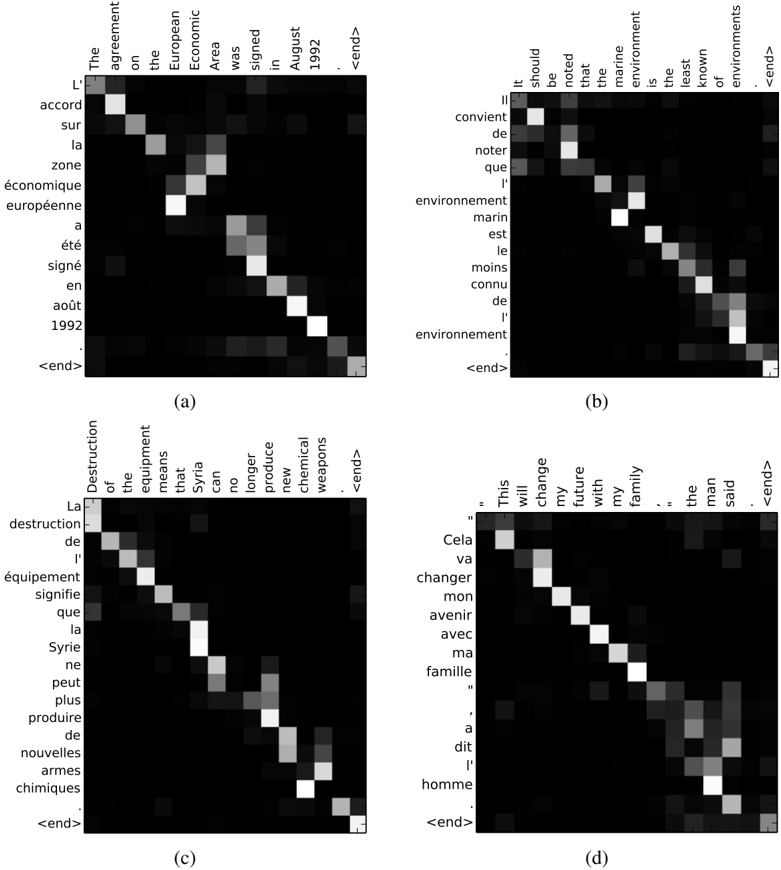
The image displays four separate attention matrices (labeled a, b, c, d) that visualize the alignment between English source sentences (top axis) and their French translations (left axis). Each matrix is a grayscale heatmap where brighter squares indicate stronger attention or alignment between corresponding words. The matrices demonstrate how a neural machine translation model or similar system aligns words between the two languages.
### Components/Axes
- **Structure**: Four distinct sub-images arranged in a 2x2 grid, each labeled with a lowercase letter in parentheses below it.
- **Axes**:
- **Top Axis (Horizontal)**: English words from a source sentence, read left to right.
- **Left Axis (Vertical)**: French words from the corresponding translation, read top to bottom.
- **Matrix**: A grid of grayscale squares where brightness corresponds to alignment strength (brighter = stronger alignment).
- **Labels**: Each sub-image includes the full English sentence at the top and the full French translation on the left. The token `<end>` marks the end of each sentence in both languages.
### Detailed Analysis
#### Sub-image (a)
- **English Sentence (Top)**: "The agreement on the European Economic Area was signed in August 1992 . <end>"
- **French Sentence (Left)**: "L' accord sur la zone économique européenne a été signé en août 1992 . <end>"
- **Matrix Pattern**: A strong diagonal trend from top-left to bottom-right, indicating mostly one-to-one word alignment. Notable alignments:
- "agreement" ↔ "accord"
- "European" ↔ "européenne"
- "Economic" ↔ "économique"
- "signed" ↔ "signé"
- "August" ↔ "août"
- "1992" ↔ "1992"
- **Spatial Grounding**: The brightest squares form a near-perfect diagonal, with some off-diagonal brightness for multi-word alignments (e.g., "European Economic" aligns with "économique européenne").
#### Sub-image (b)
- **English Sentence (Top)**: "It should be noted that the marine environment is the least known of environments . <end>"
- **French Sentence (Left)**: "Il convient de noter que l' environnement marin est le moins connu de l' environnements . <end>"
- **Matrix Pattern**: Strong diagonal alignment with some deviations:
- "marine" ↔ "marin" (note: French word order is reversed: "environnement marin" vs. "marine environment")
- "least" ↔ "moins"
- "known" ↔ "connu"
- "environments" ↔ "environnements"
- **Observation**: The alignment for "marine environment" shows a cross-pattern due to word order differences between languages.
#### Sub-image (c)
- **English Sentence (Top)**: "Destruction of the equipment means that Syria can no longer produce new chemical weapons . <end>"
- **French Sentence (Left)**: "La destruction de l' équipement signifie que la Syrie ne peut plus produire de nouvelles armes chimiques . <end>"
- **Matrix Pattern**: Clear diagonal with notable alignments:
- "Destruction" ↔ "destruction"
- "equipment" ↔ "équipement"
- "Syria" ↔ "Syrie"
- "chemical weapons" ↔ "armes chimiques"
- **Trend**: The matrix shows strong alignment for content words, with function words (e.g., "the", "of") having weaker or distributed alignments.
#### Sub-image (d)
- **English Sentence (Top)**: "This will change my future with my family , the man said . <end>"
- **French Sentence (Left)**: "Cela va changer mon avenir avec ma famille , a dit l' homme . <end>"
- **Matrix Pattern**: Diagonal alignment with some interesting patterns:
- "future" ↔ "avenir"
- "family" ↔ "famille"
- "the man said" ↔ "a dit l' homme" (note: French word order differs)
- **Spatial Grounding**: The alignment for "the man said" shows a clustered pattern due to the different syntactic structure.
### Key Observations
1. **Diagonal Dominance**: All four matrices exhibit a strong diagonal trend, indicating that the translation model generally aligns words in corresponding order.
2. **Word Order Variations**: Matrices (b) and (d) show cross-alignments where word order differs between English and French (e.g., adjective-noun order in (b), verb placement in (d)).
3. **Function Words**: Articles and prepositions (e.g., "the", "of", "in") often show weaker or distributed alignments compared to content words.
4. **Punctuation Alignment**: Periods and commas align directly between languages.
5. **Multi-Word Expressions**: Phrases like "chemical weapons" and "European Economic Area" show grouped alignments rather than strict one-to-one mappings.
### Interpretation
These attention matrices provide insight into how a neural translation model processes English-to-French translation. The strong diagonal patterns suggest the model has learned largely monotonic alignment, which is typical for closely related languages like English and French. However, the deviations from perfect diagonals reveal where the model handles linguistic differences:
1. **Syntactic Flexibility**: The model successfully aligns words despite different word orders (e.g., "marine environment" vs. "environnement marin"), showing it understands syntactic transformations.
2. **Semantic Mapping**: Content words align precisely, indicating strong semantic understanding (e.g., "chemical weapons" ↔ "armes chimiques").
3. **Translation Challenges**: The distributed alignments for function words suggest these are more ambiguous or context-dependent in translation.
4. **Model Confidence**: The brightness variations indicate the model's confidence in alignments—bright squares show high confidence, while dimmer or distributed squares suggest uncertainty or multiple possible alignments.
This visualization demonstrates both the strengths and limitations of neural machine translation: excellent at content word alignment and handling some syntactic variations, but still showing complexity in mapping function words and managing word order differences. The matrices serve as a diagnostic tool for understanding model behavior and identifying potential translation issues.