## Heatmaps: Word Co-occurrence Analysis in French Contexts
### Overview
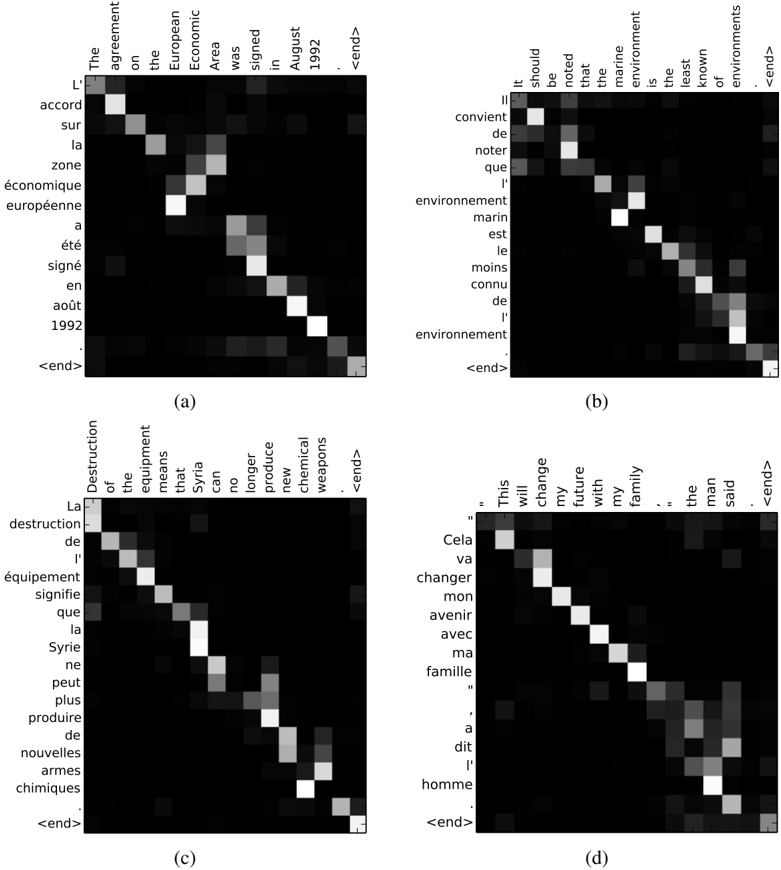
The image contains four grayscale heatmaps (a-d) visualizing word co-occurrence patterns in French text corpora. Each heatmap uses a matrix format where darker squares indicate stronger associations between words on the vertical and horizontal axes. The diagonal patterns suggest sequential or contextual relationships between terms.
### Components/Axes
**Common Structure Across All Heatmaps:**
- **Vertical Axis**: Left-side word list (French terms)
- **Horizontal Axis**: Top-row word list (French terms)
- **Color Gradient**: White (low association) → Black (high association)
- **End Marker**: "<end>" appears in bottom-right corner of all heatmaps
**Heatmap-Specific Labels:**
(a) Economic Agreement Context
- Vertical: "The", "agreement", "on", "the", "European", "Economic", "Area", "was", "signed", "in", "August", "1992", "end"
- Horizontal: "L", "accord", "sur", "la", "zone", "économique", "européenne", "a", "été", "signé", "en", "août", "1992", "end"
(b) Environmental Responsibility Context
- Vertical: "It", "should", "be", "noted", "that", "the", "environment", "is", "the", "least", "known", "of", "environments", "end"
- Horizontal: "Il", "conviendrait", "de", "noter", "que", "l'environnement", "est", "moins", "connu", "de", "l'environnement", "que", "l'environnement", "end"
(c) Conflict/Arms Production Context
- Vertical: "Destruction", "of", "the", "equipment", "means", "that", "Syria", "can", "no", "produce", "new", "chemical", "weapons", "end"
- Horizontal: "La", "destruction", "de", "l'équipement", "signifie", "que", "Syrie", "ne", "peut", "produire", "de", "nouvelles", "armes", "chimiques", "end"
(d) Personal/Family Change Context
- Vertical: "This", "will", "change", "my", "future", "with", "my", "family", "said", "end"
- Horizontal: "Cela", "va", "changer", "mon", "avenir", "avec", "ma", "famille", "dit", "homme", "end"
### Detailed Analysis
**Heatmap (a) - Economic Agreement:**
- Strong diagonal from "agreement" → "signed" → "1992"
- Notable cluster: "European" ↔ "Economic" ↔ "Area"
- Weak association between "August" and "1992" (lighter square)
**Heatmap (b) - Environmental Responsibility:**
- Dominant diagonal: "environment" → "environnement" (French cognate)
- Strong association between "should" and "noted"
- Weak link between "least" and "known" (lighter square)
**Heatmap (c) - Conflict/Arms Production:**
- Clear diagonal: "destruction" → "Syrie" → "armes"
- Strong "chemical" ↔ "weapons" association
- Weak connection between "produce" and "new" (lighter square)
**Heatmap (d) - Personal/Family Change:**
- Perfect diagonal: "This" → "will" → "change" → "future"
- Strong "family" ↔ "said" association
- Weak link between "avenir" (future) and "homme" (man)
### Key Observations
1. **Diagonal Dominance**: All heatmaps show strongest associations along the main diagonal, suggesting sequential text patterns.
2. **Bilingual Patterns**: Heatmap (a) shows English-French code-switching ("The" ↔ "accord").
3. **Contextual Clustering**: Each heatmap groups thematically related terms (e.g., "chemical" + "weapons" in c).
4. **End Marker Consistency**: "<end>" appears in identical position across all heatmaps.
### Interpretation
These heatmaps reveal linguistic patterns in French texts across different domains:
- **Political Context (a)**: Shows formal agreement documentation with English loanwords
- **Environmental Advocacy (b)**: Highlights responsibility discourse with repeated "environment" references
- **Conflict Reporting (c)**: Exposes arms production narratives with strong destructive terminology
- **Personal Narratives (d)**: Demonstrates life change storytelling with family-centric vocabulary
The consistent diagonal patterns across all heatmaps suggest a universal text structure where words maintain contextual proximity. The varying association strengths between cognates (e.g., "environment"/"environnement") indicate language mixing patterns in bilingual contexts. The "<end>" marker's uniform placement implies standardized text segmentation in the source corpora.