## Diagram: AI-Human Research Collaboration Framework
### Overview
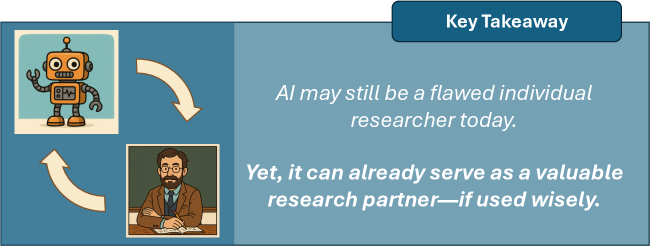
The image depicts a conceptual framework illustrating the relationship between AI and human researchers. It uses a split-screen layout with directional arrows to emphasize bidirectional interaction.
### Components/Axes
- **Left Panel**:
- **Top Section**: Cartoon robot labeled "AI" (yellow/orange color scheme, antenna, wrench-like arm).
- **Bottom Section**: Cartoon man labeled "Human Researcher" (bearded, wearing glasses, seated at a desk with papers).
- **Arrows**: Two curved arrows connecting the robot and human, indicating mutual influence.
- **Right Panel**:
- **Header**: Dark blue banner with white text "Key Takeaway."
- **Body**: Light blue background with white text:
> "AI may still be a flawed individual researcher today. Yet, it can already serve as a valuable research partner—if used wisely."
### Detailed Analysis
- **Textual Content**:
- The key takeaway explicitly states AI's current limitations ("flawed individual researcher") while emphasizing its potential as a collaborative tool ("valuable research partner").
- The phrase "if used wisely" is italicized and bolded, highlighting conditional efficacy.
- **Visual Flow**:
- Arrows suggest a cyclical or iterative relationship: AI informs human researchers, and human input refines AI's application.
### Key Observations
- No numerical data, charts, or quantitative metrics are present.
- The robot's design (antenna, wrench) symbolizes AI's technical and problem-solving capabilities.
- The human researcher's posture (crossed arms, focused on papers) implies critical evaluation or oversight.
### Interpretation
The diagram argues for a **symbiotic relationship** between AI and human researchers, acknowledging AI's current shortcomings while advocating for its strategic integration into research workflows. The emphasis on "wise use" implies that human judgment remains essential to mitigate AI's flaws and leverage its strengths. This aligns with broader discussions about AI augmentation rather than replacement in knowledge-intensive fields.