## Grammar and Shape Examples
### Overview
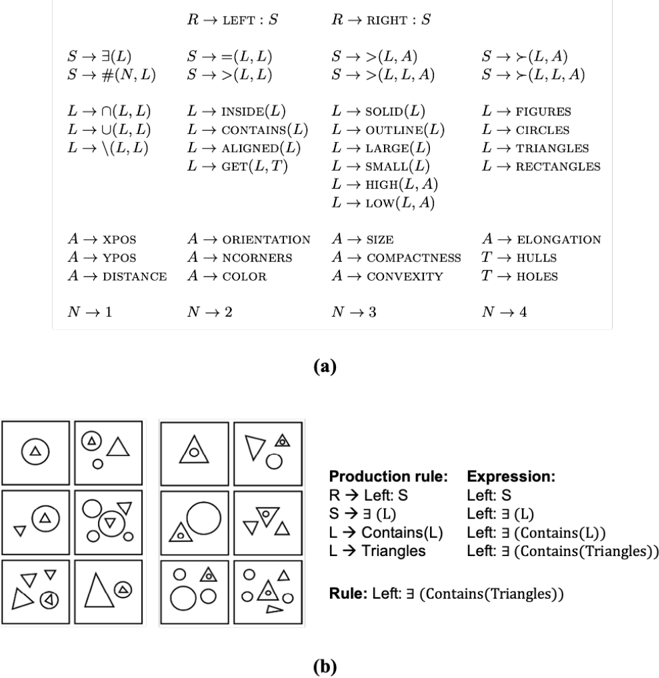
The image presents a set of grammar rules and examples of shapes generated based on those rules. Part (a) shows the grammar rules, while part (b) illustrates the application of these rules to generate specific shape configurations.
### Components/Axes
**Part (a): Grammar Rules**
* **R (Relation)**:
* `R -> LEFT : S`
* `R -> RIGHT : S`
* **S (Scene)**:
* `S -> ∃(L)`
* `S -> #(N, L)`
* `S -> =(L, L)`
* `S -> >(L, L)`
* `S -> >(L, A)`
* `S -> >(L, L, A)`
* `S -> (L, A)`
* `S -> (L, L, A)`
* **L (Location/Object)**:
* `L -> ∩(L, L)`
* `L -> ∪(L, L)`
* `L -> \(L, L)`
* `L -> INSIDE(L)`
* `L -> CONTAINS(L)`
* `L -> ALIGNED(L)`
* `L -> GET(L, T)`
* `L -> SOLID(L)`
* `L -> OUTLINE(L)`
* `L -> LARGE(L)`
* `L -> SMALL(L)`
* `L -> HIGH(L, A)`
* `L -> LOW(L, A)`
* `L -> FIGURES`
* `L -> CIRCLES`
* `L -> TRIANGLES`
* `L -> RECTANGLES`
* **A (Attribute)**:
* `A -> XPOS`
* `A -> YPOS`
* `A -> DISTANCE`
* `A -> ORIENTATION`
* `A -> NCORNERS`
* `A -> COLOR`
* `A -> SIZE`
* `A -> COMPACTNESS`
* `A -> CONVEXITY`
* `A -> ELONGATION`
* **T (Thing)**:
* `T -> HULLS`
* `T -> HOLES`
* **N (Number)**:
* `N -> 1`
* `N -> 2`
* `N -> 3`
* `N -> 4`
**Part (b): Shape Examples and Production Rules**
* **Shape Grid**: A 3x3 grid displaying different arrangements of circles and triangles.
* **Production Rules**:
* `R -> Left: S`
* `S -> ∃(L)`
* `L -> Contains(L)`
* `L -> Triangles`
* **Expressions**:
* `Left: S`
* `Left: ∃(L)`
* `Left: ∃(Contains(L))`
* `Left: ∃(Contains(Triangles))`
* **Rule**:
* `Left: ∃(Contains(Triangles))`
### Detailed Analysis or ### Content Details
**Part (a): Grammar Rules**
The grammar rules define how different elements (relations, scenes, locations/objects, attributes, things, and numbers) can be combined. For example, a scene (S) can be defined as the existence of a location/object (∃(L)), or a relation between two locations/objects (= (L, L)). Locations/objects (L) can be defined by their spatial relationships (INSIDE, CONTAINS, ALIGNED), attributes (LARGE, SMALL, HIGH, LOW), or the types of figures they represent (CIRCLES, TRIANGLES, RECTANGLES).
**Part (b): Shape Examples and Production Rules**
The shape grid provides visual examples of how the grammar rules can be applied. Each cell in the grid contains a different arrangement of circles and triangles. The production rules and expressions show how a specific rule (e.g., "L -> Contains(L)") can be expanded to generate a more complex expression (e.g., "Left: ∃(Contains(Triangles))").
The top-left shape in the grid shows a circle containing a triangle. The top-middle shape shows a triangle and a circle, with the circle partially overlapping the triangle. The top-right shape shows a circle and a triangle, with the triangle partially overlapping the circle. The middle-left shape shows a triangle containing a circle. The middle-center shape shows a circle containing a triangle, with another circle partially overlapping the triangle. The middle-right shape shows a triangle and a circle, with the triangle partially overlapping the circle. The bottom-left shape shows a triangle and a circle, with the triangle partially overlapping the circle. The bottom-middle shape shows a triangle. The bottom-right shape shows a circle and a triangle, with the circle partially overlapping the triangle.
### Key Observations
* The grammar rules provide a formal way to describe and generate spatial arrangements of objects.
* The shape grid illustrates how these rules can be used to create different visual patterns.
* The production rules and expressions show the step-by-step application of the grammar rules.
### Interpretation
The image demonstrates a system for generating and describing visual scenes using a formal grammar. The grammar rules define the relationships between different elements, while the shape grid provides concrete examples of how these rules can be applied. This approach could be used in various applications, such as computer vision, image generation, and visual communication. The system allows for the creation of complex visual patterns from a set of simple rules, providing a powerful tool for generating and understanding visual information.