\n
## Diagram: Formal Grammar for Shape Composition
### Overview
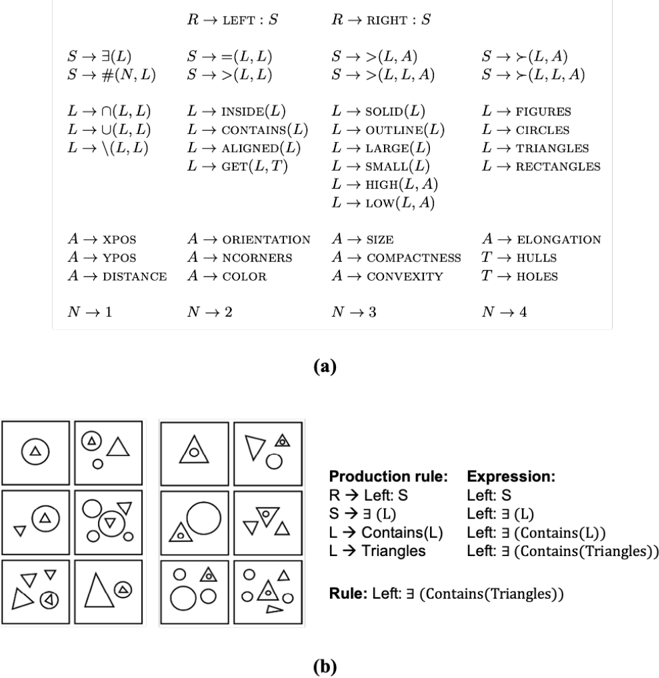
The image presents a formal grammar for generating shapes, likely for computer vision or image processing applications. It consists of two main parts: (a) a set of production rules defining how shapes can be constructed from simpler elements, and (b) an example of how these rules are applied to generate a series of shape compositions. The grammar uses symbols to represent shapes, spatial relationships, and attributes.
### Components/Axes
The diagram is divided into two sections labeled (a) and (b). Section (a) presents a set of production rules in the form "X → Y", where X is a non-terminal symbol and Y is a sequence of terminal or non-terminal symbols. Section (b) shows a sequence of shape compositions, labeled N→1, N→2, N→3, and N→4, along with a production rule and its corresponding expression.
The symbols used are:
* **S**: Represents a shape.
* **L**: Represents a layout or arrangement of shapes.
* **A**: Represents attributes of shapes.
* **N**: Represents the iteration number of the shape composition.
* **R**: Represents the right side of a production rule.
* **Left**: Represents the left side of a production rule.
Attributes (A) include:
* XPOS
* YPOS
* DISTANCE
* ORIENTATION
* NCORNERS
* COLOR
* SIZE
* COMPACTNESS
* CONVEXITY
* ELONGATION
* HULLS
* HOLES
Layouts (L) include:
* FIGURES
* CIRCLES
* TRIANGLES
* RECTANGLES
* INSIDE
* OUTLINE
* LARGE
* SMALL
* HIGH
* LOW
* ALIGNED
* CONTAINS
* GET
### Detailed Analysis or Content Details
**Section (a): Production Rules**
* **S → ∃(L)**: A shape (S) can be defined by the existence of a layout (L).
* **S → = (L, L)**: A shape (S) can be defined by equality of two layouts (L).
* **S → > (L, A)**: A shape (S) can be defined by a layout (L) and an attribute (A).
* **S → > (L, L, A)**: A shape (S) can be defined by two layouts (L) and an attribute (A).
* **S → #(L, L)**: A shape (S) can be defined by a number sign and two layouts (L).
* **L → ∩ (L, L)**: A layout (L) can be defined by the intersection of two layouts (L).
* **L → ∪ (L, L)**: A layout (L) can be defined by the union of two layouts (L).
* **L → \( (L, T)**: A layout (L) can be defined by a backslash and a term (T).
* **L → INSIDE(L)**: A layout (L) can be defined as being inside another layout (L).
* **L → CONTAINS(L)**: A layout (L) can be defined as containing another layout (L).
* **L → ALIGNED(L)**: A layout (L) can be defined as being aligned with another layout (L).
* **L → GET(L, T)**: A layout (L) can be defined by getting a term (T) from another layout (L).
* **L → SOLID(L)**: A layout (L) can be defined as solid.
* **L → OUTLINE(L)**: A layout (L) can be defined as an outline.
* **L → LARGE(L)**: A layout (L) can be defined as large.
* **L → SMALL(L)**: A layout (L) can be defined as small.
* **L → HIGH(L, A)**: A layout (L) can be defined as high with an attribute (A).
* **L → LOW(L, A)**: A layout (L) can be defined as low with an attribute (A).
* **L → FIGURES**: A layout (L) can be figures.
* **L → CIRCLES**: A layout (L) can be circles.
* **L → TRIANGLES**: A layout (L) can be triangles.
* **L → RECTANGLES**: A layout (L) can be rectangles.
**Section (b): Shape Compositions**
* **N → 1**: Shows a single triangle.
* **N → 2**: Shows a circle containing a triangle.
* **N → 3**: Shows a triangle containing a circle and a triangle.
* **N → 4**: Shows a rectangle containing a circle, a triangle, and a rectangle.
The example production rule and expression are:
* **Production rule**: R → Left: S
* **Expression**: Left: ∃ (Contains(Triangles))
* **Rule**: Left: ∃ (Contains(Triangles))
### Key Observations
The grammar is recursive, allowing for the creation of complex shapes from simpler ones. The use of symbols like ∃, =, >, #, ∩, ∪, \, and INSIDE/CONTAINS/ALIGNED suggests a formal, logical approach to shape composition. The example compositions demonstrate how the rules can be applied iteratively to generate increasingly complex shapes.
### Interpretation
This diagram presents a formal system for describing and generating shapes. It's likely intended as a foundation for algorithms that can recognize, analyze, or create images based on these rules. The grammar allows for the specification of both the geometric arrangement of shapes (layouts) and their visual properties (attributes). The example compositions show how the grammar can be used to build up complex shapes from basic elements. The use of logical symbols suggests that the grammar could be implemented in a computer program for automated shape analysis or generation. The grammar is a declarative way to define shapes, focusing on *what* shapes are rather than *how* to draw them. This is a common approach in computer vision and graphics. The example rule "Left: ∃ (Contains(Triangles))" indicates that the left side of the rule represents a shape that contains triangles. This suggests that the grammar is designed to describe shapes based on their constituent parts and spatial relationships.