## Diagram: Formal Grammar for Spatial and Geometric Reasoning
### Overview
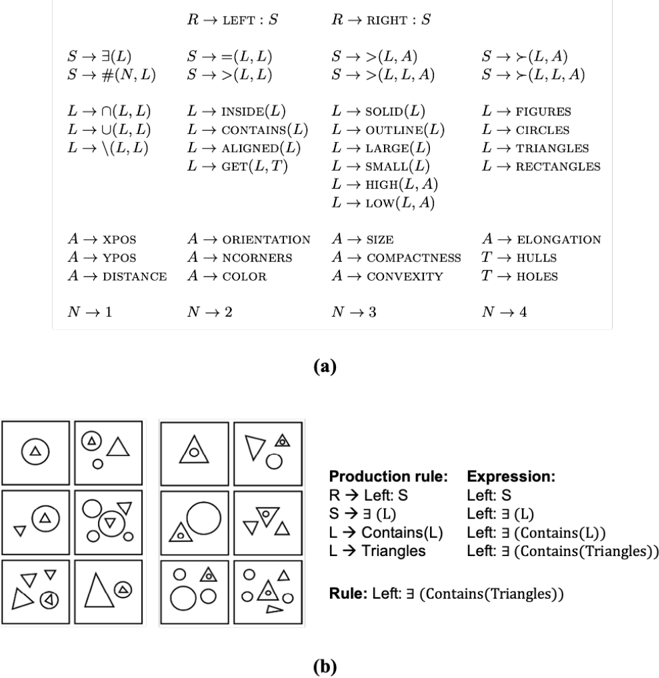
The image presents a formal production rule system (a grammar) for describing spatial relationships and geometric properties of objects in a scene. It is divided into two parts: (a) a comprehensive list of production rules categorized by symbol type, and (b) a visual example grid of scenes alongside a step-by-step derivation applying the rules to generate a specific expression.
### Components/Axes
The diagram is structured into two labeled sections:
- **(a) Production Rules**: A tabular listing of grammar rules. The left-hand side (LHS) symbols are `R`, `S`, `L`, `A`, `N`, and `T`. Each defines a category of constructs.
- **(b) Example Application**: A 3x4 grid of square panels, each containing arrangements of geometric shapes (circles, triangles, some with interior dots). To the right, a textual breakdown shows how a production rule is applied to generate a logical expression describing a scene.
### Detailed Analysis
#### Part (a): Production Rules
The rules are organized by the LHS symbol. The arrow `→` denotes a production. A colon `:` in a rule (e.g., `R → LEFT : S`) indicates a label or assignment.
**R Rules (Root/Relation):**
- `R → LEFT : S`
- `R → RIGHT : S`
**S Rules (Scene/Statement):**
- `S → ∃(L)`
- `S → =(L, L)`
- `S → >(L, A)`
- `S → ≫(L, A)`
- `S → #(N, L)`
- `S → >(L, L)`
- `S → >(L, L, A)`
- `S → ≫(L, L, A)`
**L Rules (Location/Region/Logical):**
- Spatial Operations: `L → ∩(L, L)`, `L → ∪(L, L)`, `L → \(L, L)`
- Spatial Relations: `L → INSIDE(L)`, `L → CONTAINS(L)`, `L → ALIGNED(L)`
- Object Properties: `L → SOLID(L)`, `L → OUTLINE(L)`, `L → FIGURES`, `L → CIRCLES`, `L → TRIANGLES`, `L → RECTANGLES`
- Size/Position: `L → LARGE(L)`, `L → SMALL(L)`, `L → HIGH(L, A)`, `L → LOW(L, A)`
- Retrieval: `L → GET(L, T)`
**A Rules (Attribute):**
- `A → XPOS`, `A → YPOS`, `A → ORIENTATION`, `A → SIZE`, `A → NCORNERS`, `A → COMPACTNESS`, `A → CONVEXITY`, `A → COLOR`, `A → ELONGATION`
**N Rules (Number):**
- `N → 1`, `N → 2`, `N → 3`, `N → 4`
**T Rules (Topology/Type):**
- `T → HULLS`, `T → HOLES`
#### Part (b): Visual Example and Derivation
- **Grid Content**: The 12 square panels show various scenes with circles and triangles. Some triangles contain dots, some circles contain triangles, and shapes are arranged in different spatial configurations (nested, adjacent, separate).
- **Derivation Example**:
- **Production rule**: `R → Left: S`
- **Expression**: `Left: S`
- **Production rule**: `S → ∃ (L)`
- **Expression**: `Left: ∃ (L)`
- **Production rule**: `L → Contains(L)`
- **Expression**: `Left: ∃ (Contains(L))`
- **Production rule**: `L → Triangles`
- **Expression**: `Left: ∃ (Contains(Triangles))`
- **Final Rule**: `Left: ∃ (Contains(Triangles))`
### Key Observations
1. **Hierarchical Grammar**: The rules form a hierarchical, context-free grammar where complex expressions are built from simpler components (e.g., `S` is built from `L`, which can be built from other `L`s or from `A` and `N`).
2. **Spatial and Geometric Focus**: The language is designed to describe scenes with geometric primitives, their properties (size, position, shape), and their topological/spatial relationships (contains, inside, aligned, intersection).
3. **Quantification and Comparison**: The grammar includes existential quantification (`∃`) and comparison operators (`>`, `≫`) likely for comparing attributes.
4. **Visual-Textual Link**: The example in (b) directly demonstrates how the abstract rules from (a) are applied to generate a concrete expression that could describe one of the scenes in the grid (specifically, a scene where the left region contains triangles).
### Interpretation
This diagram defines a formal language for **symbolic scene description**. It is likely used in fields like computer vision, cognitive science, or artificial intelligence for tasks such as:
- **Scene Parsing**: Translating a visual scene into a logical, compositional representation.
- **Reasoning**: Enabling algorithms to reason about spatial relationships and object properties (e.g., "Is there a triangle inside a circle on the left?").
- **Generation**: Possibly for generating scenes that satisfy certain logical constraints.
The grammar is expressive, allowing for descriptions of simple objects (`CIRCLES`), their attributes (`SIZE`, `COLOR`), complex spatial queries (`INSIDE`, `CONTAINS`), and set operations (`∩`, `∪`, `\`). The example derivation shows a move from a high-level relational statement (`Left: S`) to a specific existential claim about the presence of triangles in a containing region. The grid of example scenes serves as a visual testbed or illustration for the kinds of configurations this grammar is meant to describe. The system's power lies in its ability to break down a complex visual scene into a structured, logical expression that a machine could process or verify.