## Table and Diagram Analysis: Formal System Production Rules
### Overview
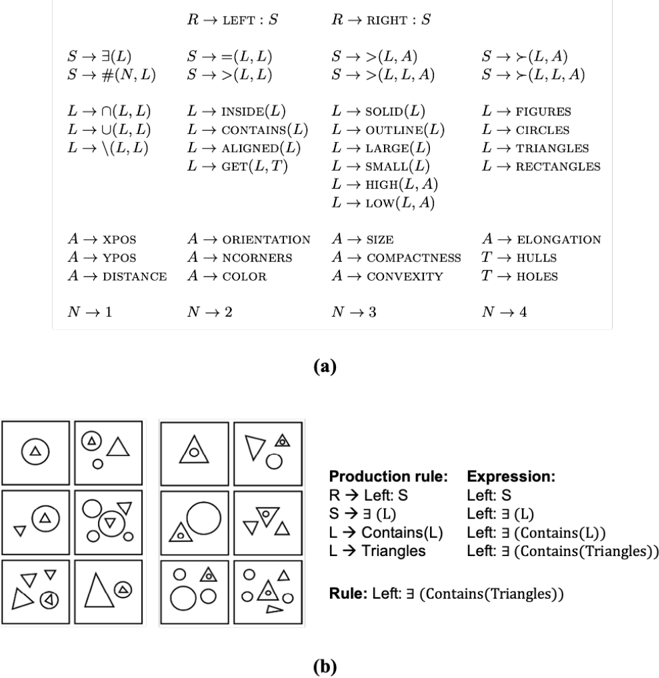
The image presents two interconnected components: (a) a transformation table defining formal system operations, and (b) a diagrammatic representation of production rules. The system appears to model geometric figure transformations and logical operations through a hierarchical rule set.
### Components/Axes
**Part (a) Transformation Table:**
- **Columns:**
1. R → LEFT: S
2. R → RIGHT: S
3. S → → (L, A)
- **Rows:**
- S → ∃(L)
- S → #(N, L)
- L → ∩(L, L)
- L → ∪(L, L)
- L → →(L, L)
- L → ←(L, L)
- L → aligned(L)
- L → small(L)
- L → high(L, A)
- L → low(L, A)
- A → xpos
- A → ypos
- A → distance
- A → color
- A → orientation
- A → compactness
- A → convexity
- **Bottom Axis:** N → 1, N → 2, N → 3, N → 4 (transformation steps)
- **Legend:** None explicitly stated, but operations are mapped through symbolic notation
**Part (b) Diagrammatic Component:**
- **Diagrams:**
- 12 geometric figures (circles, triangles, combinations)
- Symbolic annotations: ∃, #, →, ←, aligned, small, high, low
- **Production Rules:**
- R → LEFT S
- S → ∃(L)
- S → #(L, A)
- L → Contains(Triangles)
- **Legend:** Bottom-right placement with explicit rule mappings
### Detailed Analysis
**Part (a) Table Structure:**
1. **R → LEFT: S Column:**
- S → ∃(L) → L → ∩(L, L)
- S → #(N, L) → L → ∪(L, L)
- L → →(L, L) → L → aligned(L)
- L → →(L, L) → L → small(L)
- L → →(L, L) → L → high(L, A)
- L → →(L, L) → L → low(L, A)
2. **R → RIGHT: S Column:**
- S → ∃(L) → L → ∩(L, L)
- S → #(N, L) → L → ∪(L, L)
- L → →(L, L) → L → aligned(L)
- L → →(L, L) → L → small(L)
- L → →(L, L) → L → high(L, A)
- L → →(L, L) → L → low(L, A)
3. **S → → (L, A) Column:**
- S → ∃(L) → L → ∩(L, L)
- S → #(N, L) → L → ∪(L, L)
- L → →(L, L) → L → aligned(L)
- L → →(L, L) → L → small(L)
- L → →(L, A) → L → high(L, A)
- L → →(L, A) → L → low(L, A)
4. **A-Transformation Rows:**
- A → xpos/ypos/distance/color/orientation/compactness/convexity
**Part (b) Diagram Analysis:**
- **Production Flow:**
1. R (root) → LEFT S
2. S → ∃(L) or S → #(L, A)
3. L → Contains(Triangles)
- **Symbolic Notation:**
- ∃(L): Exists operator applied to L
- #(N, L): Cardinality operator with N elements
- →(L, A): Transformation with alignment parameter A
- Contains(Triangles): Set membership relation
### Key Observations
1. **Hierarchical Structure:**
- R (root) → S (intermediate) → L (leaf)
- Triangles appear as terminal nodes in the production system
2. **Transformation Consistency:**
- RIGHT and LEFT transformations show identical operations
- S → → (L, A) column introduces parameterized alignment
3. **Symbolic Logic Patterns:**
- ∃(L) appears in all R → LEFT:S operations
- #(N, L) appears in all R → RIGHT:S operations
- Contains(Triangles) appears exclusively in L → transformation
4. **Geometric Interpretation:**
- Circles represent base sets (L)
- Triangles represent derived sets (R)
- Combinations show operational results
### Interpretation
This system models a formal language production system where:
1. **R** (root) generates **S** through left/right transformations
2. **S** operates on sets **L** using existential (#) and transformation (#) operators
3. **L** contains triangles as fundamental elements
4. The system encodes spatial relationships through:
- Alignment parameters (high/low)
- Size modifiers (small/aligned)
- Positional attributes (xpos/ypos)
5. The N → 1-4 axis suggests iterative application of rules, with increasing complexity at each step
The system appears to formalize geometric figure composition rules, possibly for computer graphics or formal verification systems. The consistent use of ∃ and # operators across transformations suggests these are fundamental axioms of the system. The parameterized transformations (high/low) indicate a context-sensitive production mechanism.