## Flow Diagram: Comparison of Reasoning Methods
### Overview
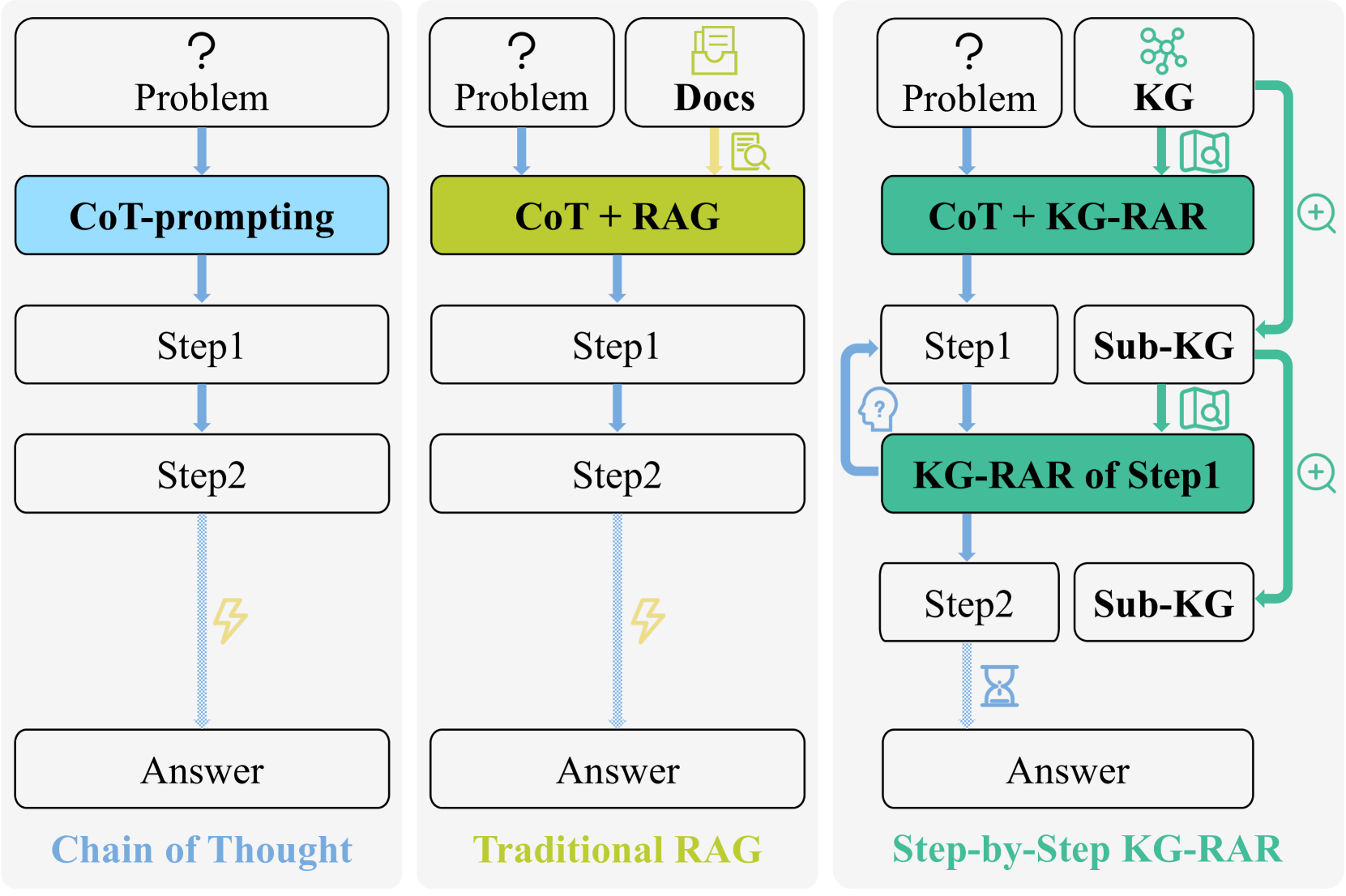
The image presents a comparative flow diagram illustrating three different reasoning methods: Chain of Thought, Traditional RAG, and Step-by-Step KG-RAR. Each method is depicted as a sequence of steps, starting from a problem and leading to an answer. The diagrams highlight the key components and processes involved in each approach.
### Components/Axes
* **Diagram Structure:** Each method is represented as a vertical flow, with rounded rectangles indicating processes or states. Arrows indicate the direction of flow.
* **Titles:** Each method has a title at the bottom: "Chain of Thought" (light blue), "Traditional RAG" (light green), and "Step-by-Step KG-RAR" (teal).
* **Initial State:** All three methods start with a "Problem" (top).
* **Intermediate Steps:** Each method includes "Step1" and "Step2".
* **Final State:** All three methods end with an "Answer" (bottom).
* **Additional Components:**
* Traditional RAG includes "Docs" at the top, feeding into "CoT + RAG".
* Step-by-Step KG-RAR includes "KG" (Knowledge Graph) at the top, feeding into "CoT + KG-RAR", and "Sub-KG" (Sub-Knowledge Graph) after each step.
* **Icons:**
* Magnifying glass icon next to "Docs" in Traditional RAG.
* Magnifying glass icon with a plus sign next to the feedback loops in Step-by-Step KG-RAR.
* Lightning bolt icon between "Step2" and "Answer" in Chain of Thought and Traditional RAG.
* Hourglass icon between "Step2" and "Answer" in Step-by-Step KG-RAR.
* Question mark icon with arrow looping back to "KG-RAR of Step1" in Step-by-Step KG-RAR.
* Map icon with magnifying glass next to "Sub-KG" in Step-by-Step KG-RAR.
### Detailed Analysis or Content Details
**1. Chain of Thought (Left Column):**
* Starts with "Problem".
* Proceeds to "CoT-prompting" (light blue).
* Flows through "Step1" and "Step2".
* Ends with "Answer".
* A dotted arrow with a lightning bolt icon connects "Step2" to "Answer".
**2. Traditional RAG (Middle Column):**
* Starts with "Problem" and "Docs".
* "Docs" feeds into "CoT + RAG" (light green).
* Flows through "Step1" and "Step2".
* Ends with "Answer".
* A dotted arrow with a lightning bolt icon connects "Step2" to "Answer".
**3. Step-by-Step KG-RAR (Right Column):**
* Starts with "Problem" and "KG".
* "KG" feeds into "CoT + KG-RAR" (teal).
* Flows through "Step1" and "Sub-KG".
* A feedback loop (light blue) with a question mark icon goes from "Step1" back to "KG-RAR of Step1" (teal).
* "Sub-KG" feeds into "KG-RAR of Step1".
* Flows through "Step2" and "Sub-KG".
* Ends with "Answer".
* A dotted arrow with an hourglass icon connects "Step2" to "Answer".
* A feedback loop (light green) with a plus sign and magnifying glass icon goes from "CoT + KG-RAR" to "KG".
* A feedback loop (light green) with a plus sign and magnifying glass icon goes from "KG-RAR of Step1" to "KG".
### Key Observations
* The diagrams illustrate the flow of information and processing steps in each reasoning method.
* Chain of Thought is the simplest, involving a direct sequence of steps.
* Traditional RAG incorporates external documents to enhance reasoning.
* Step-by-Step KG-RAR uses a knowledge graph and iterative refinement with sub-knowledge graphs.
* The lightning bolt icon in Chain of Thought and Traditional RAG might represent a direct or quick inference.
* The hourglass icon in Step-by-Step KG-RAR might represent a more time-consuming or deliberate process.
* The feedback loops in Step-by-Step KG-RAR indicate iterative refinement using knowledge graphs.
### Interpretation
The diagrams compare three different approaches to reasoning. Chain of Thought represents a basic, sequential reasoning process. Traditional RAG enhances this by incorporating external knowledge from documents. Step-by-Step KG-RAR represents a more complex approach that leverages knowledge graphs and iterative refinement. The choice of method depends on the complexity of the problem and the available resources (documents, knowledge graphs). The Step-by-Step KG-RAR method appears to be the most sophisticated, involving iterative refinement and external knowledge integration at multiple stages. The icons suggest differences in the speed and nature of the reasoning process.