TECHNICAL ASSET FINGERPRINT
4810abecf8b0145e8f5952e1
Click to view fullscreen
Press ESC or click to close
FOUND IN PAPERS
EXPERT: gemini-2.5-flash-lite-free VERSION 1
RUNTIME: google-free/gemini-2.5-flash-lite
INTEL_VERIFIED
## Diagram: Comparison of Reasoning and Retrieval Methods
### Overview
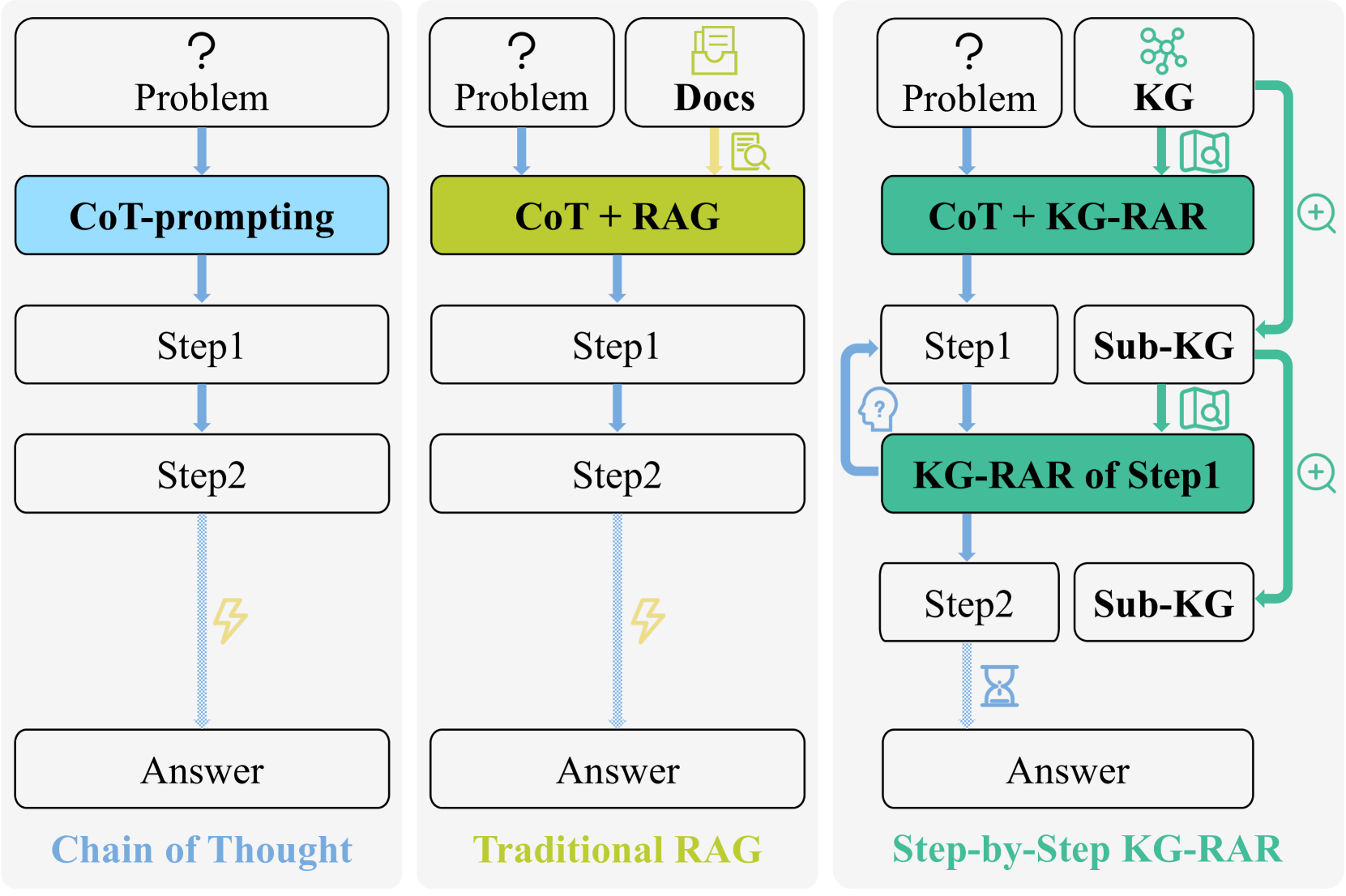
This image presents a comparative diagram illustrating three different approaches to problem-solving and information retrieval: "Chain of Thought," "Traditional RAG," and "Step-by-Step KG-RAR." Each approach is depicted as a flowchart, outlining the sequence of steps from problem input to final answer. The diagram highlights the integration of different components like "Problem," "Docs," "KG" (Knowledge Graph), and specific processing steps.
### Components/Axes
The diagram is structured into three vertical flowcharts, each representing a distinct method.
**Common Elements Across Flowcharts:**
* **Input Boxes:** Represent initial inputs to the system.
* "?" with "Problem" (present in all three flowcharts).
* "Docs" (present in the "Traditional RAG" flowchart).
* "KG" (present in the "Step-by-Step KG-RAR" flowchart).
* **Processing Boxes:** Represent intermediate steps or operations.
* "CoT-prompting" (blue, in "Chain of Thought").
* "CoT + RAG" (green, in "Traditional RAG").
* "CoT + KG-RAR" (teal, in "Step-by-Step KG-RAR").
* "Step1" (white, present in all three flowcharts).
* "Step2" (white, present in all three flowcharts).
* "KG-RAR of Step1" (teal, in "Step-by-Step KG-RAR").
* **Sub-KG Boxes:** Represent sub-knowledge graphs used in "Step-by-Step KG-RAR."
* "Sub-KG" (white, associated with "Step1" and "Step2" in "Step-by-Step KG-RAR").
* **Output Box:**
* "Answer" (white, present in all three flowcharts).
* **Connectors:** Arrows indicate the flow of information or process.
* **Icons:**
* A lightning bolt icon (yellow, between "Step2" and "Answer" in "Chain of Thought" and "Traditional RAG").
* A question mark icon within a blue circle (in "Step-by-Step KG-RAR," near "Step1").
* A document icon with a magnifying glass (yellow, near "Docs" in "Traditional RAG").
* A knowledge graph icon (green, near "KG" in "Step-by-Step KG-RAR").
* A magnifying glass icon within a green circle (green, associated with feedback loops in "Step-by-Step KG-RAR").
* A plus sign within a green circle (green, associated with feedback loops in "Step-by-Step KG-RAR").
* An hourglass icon (blue, between "Step2" and "Answer" in "Step-by-Step KG-RAR").
**Labels Below Flowcharts:**
* "Chain of Thought" (blue text).
* "Traditional RAG" (green text).
* "Step-by-Step KG-RAR" (teal text).
### Detailed Analysis
**Flowchart 1: Chain of Thought**
1. **Input:** Starts with a "?" and "Problem."
2. **Processing:** Proceeds to "CoT-prompting" (blue box).
3. **Steps:** Continues sequentially through "Step1" and "Step2."
4. **Intermediate Indicator:** A yellow lightning bolt icon appears between "Step2" and "Answer," possibly indicating a computational or reasoning process.
5. **Output:** Concludes with "Answer."
6. **Label:** Titled "Chain of Thought" in blue.
**Flowchart 2: Traditional RAG**
1. **Inputs:** Starts with "?" and "Problem," and also takes "Docs" as input.
2. **Processing:** Proceeds to "CoT + RAG" (green box).
3. **Steps:** Continues sequentially through "Step1" and "Step2."
4. **Intermediate Indicator:** A yellow lightning bolt icon appears between "Step2" and "Answer," similar to the "Chain of Thought" method.
5. **Output:** Concludes with "Answer."
6. **Label:** Titled "Traditional RAG" in green.
**Flowchart 3: Step-by-Step KG-RAR**
1. **Inputs:** Starts with "?" and "Problem," and also takes "KG" (Knowledge Graph) as input.
2. **Initial Processing:** Proceeds to "CoT + KG-RAR" (teal box).
3. **Step 1 with Sub-KG:** From "Step1," it branches to "KG-RAR of Step1" (teal box). Simultaneously, "Step1" is associated with a "Sub-KG" (white box). A question mark icon is present near "Step1" and points towards "KG-RAR of Step1."
4. **Feedback Loop 1:** The output of "KG-RAR of Step1" is fed back into "Step1" via a blue arrow. A green magnifying glass icon and a green plus sign icon are associated with this feedback loop, suggesting refinement or augmentation.
5. **Step 2 with Sub-KG:** After "KG-RAR of Step1," the process moves to "Step2." Similar to Step 1, "Step2" is associated with a "Sub-KG" (white box).
6. **Intermediate Indicator:** A blue hourglass icon appears between "Step2" and "Answer," possibly indicating a time-dependent process or a final waiting period.
7. **Output:** Concludes with "Answer."
8. **Label:** Titled "Step-by-Step KG-RAR" in teal.
9. **Feedback Loop 2:** Another green magnifying glass and green plus sign icon are shown, connecting the "Sub-KG" associated with "Step2" to a point after "KG-RAR of Step1," implying a continuous or iterative refinement process involving the knowledge graph.
### Key Observations
* The "Chain of Thought" method appears to be the simplest, focusing solely on internal reasoning steps.
* "Traditional RAG" introduces external documents ("Docs") into the process, alongside Chain of Thought principles.
* "Step-by-Step KG-RAR" is the most complex, integrating a Knowledge Graph ("KG") and employing a recursive or iterative refinement process ("KG-RAR of Step1") with sub-knowledge graphs ("Sub-KG").
* The lightning bolt icon in the first two methods suggests a direct, perhaps less structured, computational step to reach the answer.
* The hourglass icon in the third method might imply a more deliberate or time-consuming finalization of the answer after extensive KG-based reasoning.
* The feedback loops with magnifying glass and plus icons in "Step-by-Step KG-RAR" strongly suggest an iterative refinement and augmentation mechanism, potentially for improving the accuracy or completeness of the reasoning at each step.
### Interpretation
This diagram visually contrasts three distinct methodologies for tackling problems that likely require both reasoning and information retrieval.
The **"Chain of Thought"** method represents a foundational approach where a problem is broken down into sequential steps, relying on internal thought processes to arrive at a solution. The lightning bolt icon suggests a direct, possibly rapid, generation of the answer after the steps are completed.
**"Traditional RAG"** builds upon this by incorporating external documents. This implies that the reasoning process is augmented by retrieving relevant information from a corpus of documents. The structure is similar to "Chain of Thought," suggesting that RAG is integrated into the existing step-by-step reasoning.
The **"Step-by-Step KG-RAR"** method presents a more sophisticated architecture. It not only integrates Chain of Thought principles but also leverages a Knowledge Graph (KG) and a "KG-RAR" (likely Knowledge Graph Retrieval, Augmentation, and Reasoning) component. The key innovation here appears to be the iterative refinement process. The "KG-RAR of Step1" suggests that for each step, the system not only reasons but also retrieves and reasons with information from the KG, potentially refining the current step's output. The presence of "Sub-KG" boxes associated with each step indicates that specific subsets of the KG are utilized at different stages. The feedback loops with the magnifying glass and plus icons are crucial, indicating that the system can revisit and improve its reasoning based on KG interactions, leading to a more robust and potentially accurate answer. The hourglass icon might signify that this iterative KG-based reasoning process, while powerful, could be more time-intensive than the simpler methods.
In essence, the diagram demonstrates an evolution from pure internal reasoning to document-augmented reasoning, and finally to knowledge graph-augmented, iteratively refined reasoning, suggesting a progression in complexity and likely in the depth and accuracy of problem-solving capabilities.
DECODING INTELLIGENCE...