## Flowchart: Comparative Analysis of Problem-Solving Methodologies
### Overview
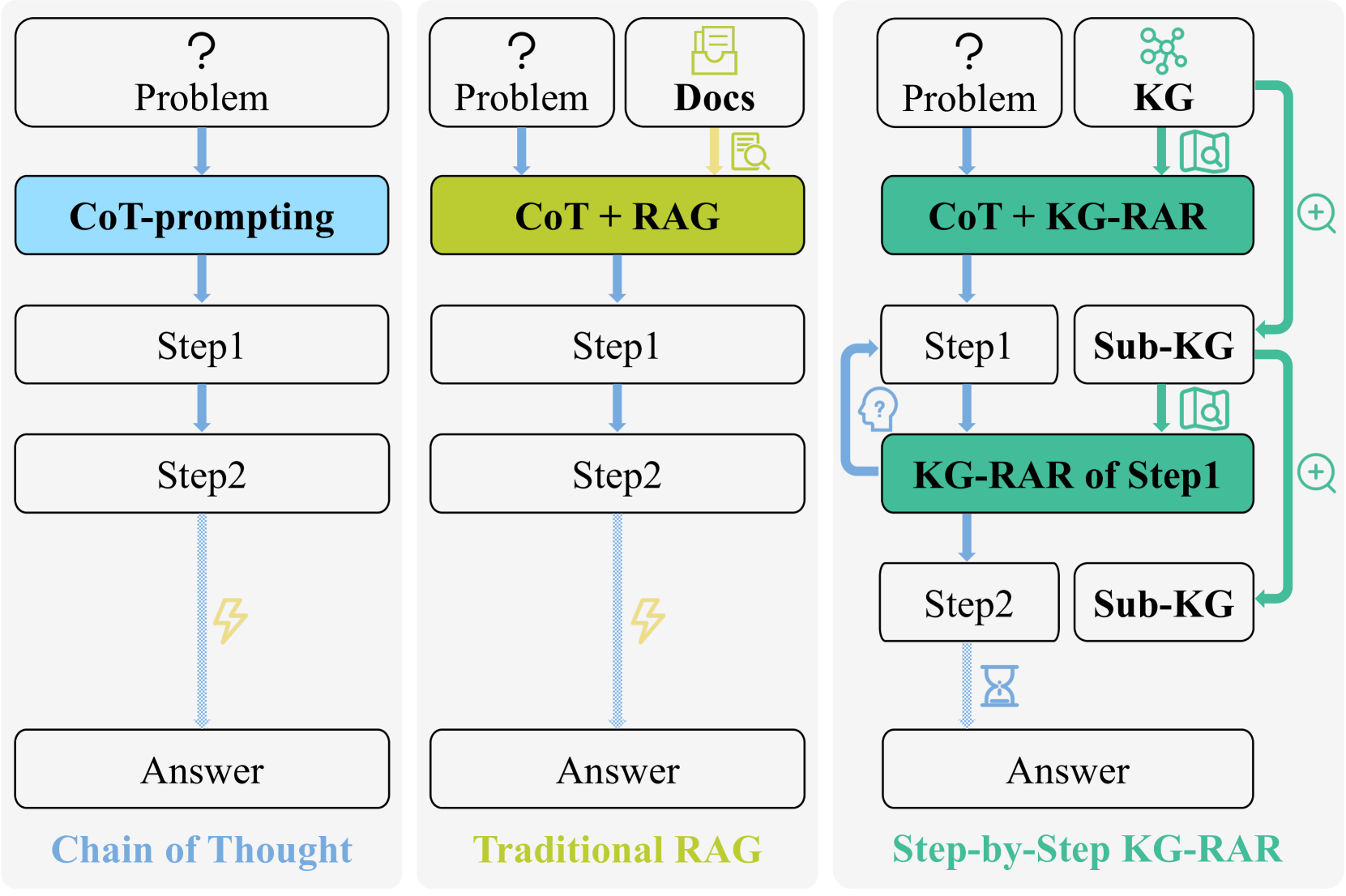
The image presents a comparative flowchart of three problem-solving methodologies:
1. **Chain of Thought (CoT)**
2. **Traditional RAG (Retrieval-Augmented Generation)**
3. **Step-by-Step KG-RAR (Knowledge Graph-Retrieval-Augmented Reasoning)**
Each methodology is structured as a vertical pipeline with inputs, intermediate steps, and outputs. The flowcharts use color-coded blocks to distinguish components and arrows to indicate sequential processing.
---
### Components/Axes
#### Common Elements Across All Methods:
- **Inputs**:
- `Problem` (question mark icon)
- **Output**:
- `Answer` (final box)
- **Steps**:
- `Step1` → `Step2` (sequential processing)
#### Method-Specific Components:
1. **Chain of Thought (CoT)**:
- **Input**: `Problem`
- **Process**:
- `CoT-prompting` (blue block)
- **Flow**:
`Problem` → `Step1` → `Step2` → `Answer`
2. **Traditional RAG**:
- **Inputs**:
- `Problem`
- `Docs` (document icon)
- **Process**:
- `CoT + RAG` (green block)
- **Flow**:
`Problem` → `Docs` → `Step1` → `Step2` → `Answer`
3. **Step-by-Step KG-RAR**:
- **Inputs**:
- `Problem`
- `KG` (knowledge graph icon)
- **Process**:
- `CoT + KG-RAR` (teal block)
- `KG-RAR of Step1` (nested teal block)
- **Subcomponents**:
- `Sub-KG` (smaller knowledge graph icon)
- **Flow**:
`Problem` → `KG` → `Step1` → `KG-RAR of Step1` → `Sub-KG` → `Step2` → `Answer`
---
### Detailed Analysis
#### 1. Chain of Thought (CoT):
- **Structure**:
- Simplest pipeline with no external inputs.
- Relies solely on internal reasoning (`CoT-prompting`).
- **Flow**:
- Direct progression from `Problem` to `Answer` via two reasoning steps.
#### 2. Traditional RAG:
- **Enhancements**:
- Integrates `Docs` (external documents) to augment reasoning.
- Maintains CoT structure but adds retrieval of contextual data.
- **Flow**:
- `Docs` are processed alongside `Problem` in `Step1`, suggesting document retrieval occurs early in the pipeline.
#### 3. Step-by-Step KG-RAR:
- **Complexity**:
- Combines `KG` (knowledge graph) with CoT.
- Introduces hierarchical reasoning:
- `KG-RAR of Step1` processes `Step1` output using the knowledge graph.
- `Sub-KG` further refines intermediate results.
- **Flow**:
- `KG` is used iteratively:
- First to inform `Step1`, then again via `Sub-KG` for `Step2`.
---
### Key Observations
1. **Incremental Complexity**:
- CoT < Traditional RAG < Step-by-Step KG-RAR in terms of input complexity and processing depth.
2. **Knowledge Integration**:
- Step-by-Step KG-RAR uniquely uses `KG` and `Sub-KG` to refine intermediate steps, suggesting a feedback loop between reasoning and structured knowledge.
3. **Visual Cues**:
- Color coding (blue, green, teal) correlates with methodology sophistication.
- Arrows indicate strict sequential dependencies (e.g., `Step1` must complete before `Step2`).
---
### Interpretation
1. **Methodological Evolution**:
- The flowchart illustrates a progression from basic reasoning (CoT) to hybrid approaches that incorporate external data (`Docs` in RAG) and structured knowledge (`KG` in KG-RAR).
2. **Knowledge Graph Role**:
- In Step-by-Step KG-RAR, the knowledge graph is not a one-time input but a dynamic tool that refines reasoning at multiple stages (`KG-RAR of Step1` and `Sub-KG`).
3. **Practical Implications**:
- Step-by-Step KG-RAR likely improves answer accuracy by leveraging domain-specific knowledge iteratively, though at the cost of increased computational complexity.
4. **Unresolved Questions**:
- The flowchart does not specify how `Sub-KG` is generated or how `KG-RAR` differs from traditional RAG. These details would require additional context.
---
**Note**: The image lacks numerical data, trends, or statistical values. All analysis is based on structural and symbolic elements.