## Algorithm: Delta Rule Implementation
### Overview
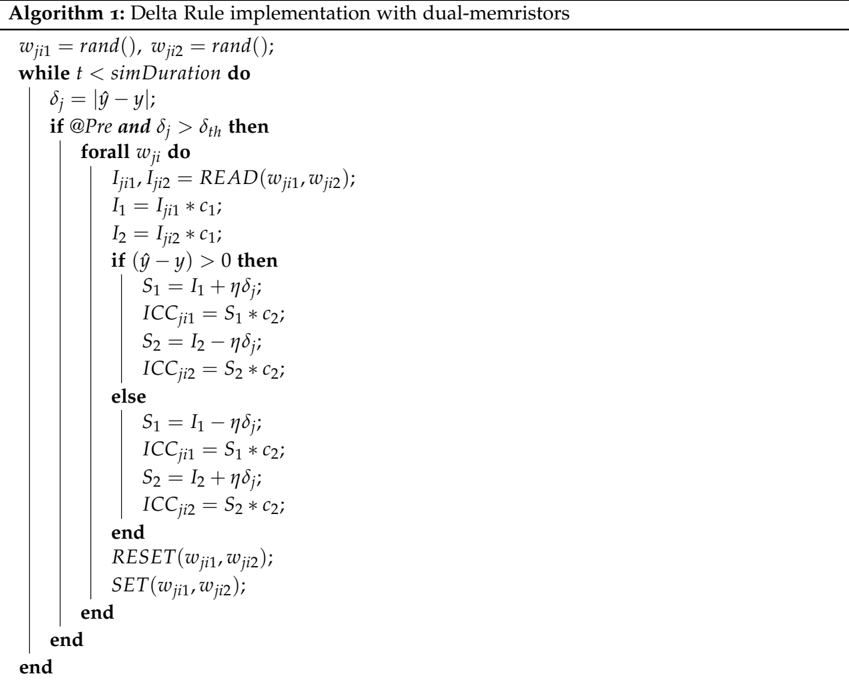
The image presents Algorithm 1, which details the Delta Rule implementation using dual-memristors. It outlines the steps involved in updating weights based on the difference between predicted and actual values, incorporating memristor characteristics.
### Components/Axes
The algorithm consists of the following components:
- **Initialization:** `wji1` and `wji2` are initialized with random values.
- **Loop:** A `while` loop continues as long as `t` is less than `simDuration`.
- **Error Calculation:** `δj` is calculated as the absolute difference between `ŷ` and `y`.
- **Conditional Update:** An `if` statement checks if `@Pre` is true and `δj` is greater than `δth`.
- **Memristor Read:** Inside the `forall` loop, `Iji1` and `Iji2` are read from the memristors `wji1` and `wji2`.
- **Current Calculation:** `I1` and `I2` are calculated based on `Iji1`, `Iji2`, and `c1`.
- **Weight Update:** Another `if` statement checks if `(ŷ - y)` is greater than 0. Based on the condition, `S1`, `S2`, `ICCji1`, and `ICCji2` are updated using `I1`, `I2`, `η`, `δj`, and `c2`.
- **Memristor Reset and Set:** `RESET(wji1, wji2)` and `SET(wji1, wji2)` are called.
### Detailed Analysis or ### Content Details
The algorithm's steps are as follows:
1. **Initialization:**
* `wji1 = rand()`
* `wji2 = rand()`
2. **Main Loop:**
* `while t < simDuration do`
* `δj = |ŷ - y|`
* `if @Pre and δj > δth then`
* `forall wji do`
* `Iji1, Iji2 = READ(wji1, wji2)`
* `I1 = Iji1 * c1`
* `I2 = Iji2 * c1`
* `if (ŷ - y) > 0 then`
* `S1 = I1 + ηδj`
* `ICCji1 = S1 * c2`
* `S2 = I2 - ηδj`
* `ICCji2 = S2 * c2`
* `else`
* `S1 = I1 - ηδj`
* `ICCji1 = S1 * c2`
* `S2 = I2 + ηδj`
* `ICCji2 = S2 * c2`
* `end`
* `end`
* `RESET(wji1, wji2)`
* `SET(wji1, wji2)`
* `end`
* `end`
### Key Observations
- The algorithm uses dual-memristors (`wji1`, `wji2`) to store weights.
- The error `δj` is calculated as the absolute difference between the predicted value `ŷ` and the actual value `y`.
- The weights are updated based on the error and a learning rate `η`.
- The `READ`, `RESET`, and `SET` functions likely interact with the memristor hardware.
- The conditional statements control the weight update process based on the error and a pre-defined condition `@Pre`.
### Interpretation
The algorithm implements a Delta Rule learning mechanism using dual-memristors. The memristors likely store the weights, and the algorithm updates these weights based on the error between the predicted and actual outputs. The use of dual-memristors might be for differential representation or to improve the stability and accuracy of the weight updates. The `@Pre` condition and `δth` threshold likely introduce a form of regularization or control over when the weights are updated. The algorithm aims to minimize the error between the predicted and actual values by iteratively adjusting the weights stored in the memristors.