## Network Graph: Physics Equation Cluster (Cluster #10)
### Overview
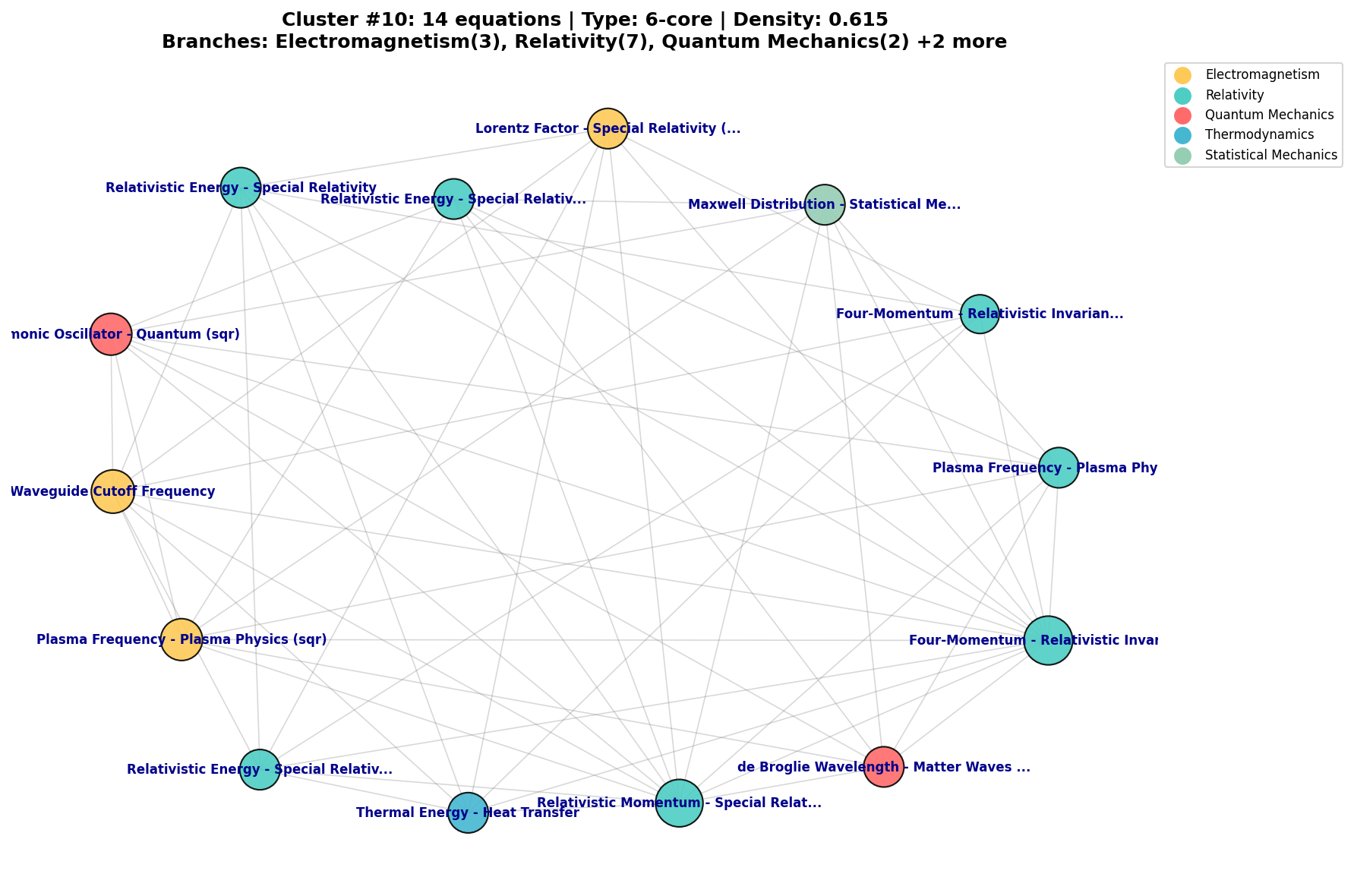
The image is a **network graph** (cluster diagram) visualizing 14 physics equations, color-coded by their branch of physics. The title reads: *“Cluster #10: 14 equations | Type: 6-core | Density: 0.615”* with a subtitle: *“Branches: Electromagnetism(3), Relativity(7), Quantum Mechanics(2) +2 more”*. It illustrates connections (edges) between equations, highlighting cross-disciplinary relationships in physics.
### Components/Axes (Legend & Nodes)
- **Legend (Top-Right)**:
- Yellow: *Electromagnetism*
- Teal: *Relativity*
- Red: *Quantum Mechanics*
- Blue: *Thermodynamics*
- Light Green: *Statistical Mechanics*
- **Nodes (Equations)**: Each node is a circle with a label (truncated in some cases) and color-coded by branch. Full/visible labels (with color):
- **Yellow (Electromagnetism)**:
- *Lorentz Factor - Special Relativity (...)*
- *Waveguide Cutoff Frequency*
- *Plasma Frequency - Plasma Physics (sqr)*
- **Teal (Relativity)**:
- *Relativistic Energy - Special Relativity*
- *Relativistic Energy - Special Relativ...* (truncated)
- *Relativistic Energy - Special Relativ...* (truncated)
- *Four-Momentum - Relativistic Invarian...* (truncated)
- *Plasma Frequency - Plasma Phy* (truncated)
- *Four-Momentum - Relativistic Invar* (truncated)
- *Relativistic Momentum - Special Relat...* (truncated)
- **Red (Quantum Mechanics)**:
- *Harmonic Oscillator - Quantum (sqr)* (note: “nonic” may be a typo for “Harmonic”)
- *de Broglie Wavelength - Matter Waves ...* (truncated)
- **Blue (Thermodynamics)**:
- *Thermal Energy - Heat Transfer*
- **Light Green (Statistical Mechanics)**:
- *Maxwell Distribution - Statistical Me...* (truncated)
### Detailed Analysis (Connections & Structure)
- **Density (0.615)**: ~61.5% of all possible node-to-node connections exist, indicating strong interrelationships between equations.
- **Branch Distribution**: Relativity (7 nodes) dominates, followed by Electromagnetism (3), Quantum Mechanics (2), Thermodynamics (1), and Statistical Mechanics (1).
- **Edges (Connections)**: Nodes are highly interconnected, with edges spanning multiple branches (e.g., Relativity nodes connect to Electromagnetism, Quantum, and Thermodynamics nodes), showing cross-disciplinary physics relationships.
### Key Observations
- **Truncated Labels**: Many node labels are truncated (e.g., *“Relativistic Energy - Special Relativ...”*), so full equation names are not visible.
- **Color Consistency**: Nodes match the legend’s color coding, enabling clear branch identification.
- **Core Structure**: The “6-core” type suggests a central subgraph with 6 key nodes (exact core not labeled, but implied by the “6-core” designation).
### Interpretation
This graph demonstrates the **interconnectedness of physics concepts** across disciplines. The high density (0.615) implies that equations from different branches (e.g., Relativity, Electromagnetism, Quantum Mechanics) are deeply related, reflecting how physics theories build on one another. For example:
- Relativity (teal) nodes connect to Electromagnetism (yellow) nodes, illustrating how relativistic principles interact with electromagnetic phenomena.
- Quantum Mechanics (red) nodes link to Relativity and Electromagnetism, showing the overlap between quantum and relativistic physics.
The “6-core” designation hints at a central cluster of 6 equations that anchor the network, though their exact identities are not labeled. Overall, the graph visualizes the complex web of relationships in physics, emphasizing that no branch exists in isolation.
(Note: All text is in English; no other languages are present. Truncated labels are noted, and color coding is verified against the legend.)