## Diagram: Multi-Stage MERT Architecture for Audio Processing
### Overview
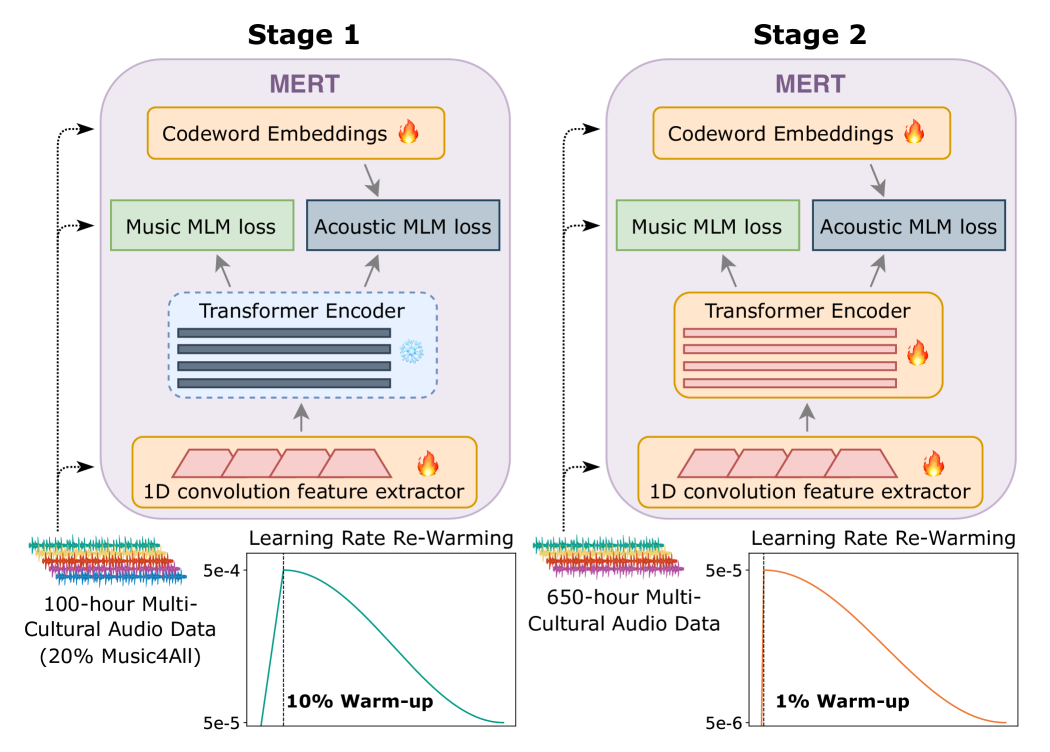
The diagram illustrates a two-stage machine learning model (MERT) for processing multi-cultural audio data. It compares Stage 1 (100-hour data) and Stage 2 (650-hour data) architectures, highlighting differences in learning rate re-warming and component configurations. Key elements include transformer encoders, masked language modeling (MLM) losses, and 1D convolution feature extractors.
### Components/Axes
#### Stage 1 (100-hour Data)
- **Input**: 100-hour multi-cultural audio data (20% Music4All)
- **Components**:
- 1D Convolution Feature Extractor (orange)
- Transformer Encoder (blue dashed box)
- Music MLM Loss (green)
- Acoustic MLM Loss (blue)
- Codeword Embeddings (orange flame icon)
- **Learning Rate Graph**:
- X-axis: Epochs (0 to 100k)
- Y-axis: Learning Rate (5e-5 to 5e-4)
- Legend: Green = 100-hour data (20% Music4All)
- Warm-up: 10% (steep initial rise)
#### Stage 2 (650-hour Data)
- **Input**: 650-hour multi-cultural audio data
- **Components**:
- 1D Convolution Feature Extractor (orange)
- Transformer Encoder (red solid box)
- Music MLM Loss (green)
- Acoustic MLM Loss (blue)
- Codeword Embeddings (orange flame icon)
- **Learning Rate Graph**:
- X-axis: Epochs (0 to 100k)
- Y-axis: Learning Rate (5e-6 to 5e-5)
- Legend: Red = 650-hour data
- Warm-up: 1% (gentle initial rise)
### Detailed Analysis
1. **Learning Rate Re-Warming**:
- Stage 1 shows a rapid warm-up (10%) with a peak at ~5e-4, followed by decay.
- Stage 2 uses a slower 1% warm-up, peaking at ~5e-5, indicating scaled training for larger datasets.
2. **Component Flow**:
- Both stages share identical component order: 1D convolution → Transformer Encoder → MLM losses → Codeword Embeddings.
- Stage 2's transformer encoder is visually emphasized with a red box and flame icon, suggesting enhanced optimization.
3. **Data Representation**:
- Audio waveforms (colored lines) feed into the 1D convolution layer.
- Loss functions (green/blue) are positioned above the transformer encoder, indicating backpropagation paths.
### Key Observations
- **Warm-up Duration**: Stage 2's 1% warm-up contrasts with Stage 1's 10%, reflecting adjustments for dataset size.
- **Component Consistency**: Identical architecture across stages suggests incremental scaling rather than structural changes.
- **Loss Function Balance**: Equal placement of Music and Acoustic MLM losses implies multi-task learning for domain generalization.
### Interpretation
The diagram demonstrates a progressive training strategy where Stage 2 optimizes for larger, more diverse datasets through:
1. **Extended Warm-up**: Gradual learning rate increases prevent instability with 650-hour data.
2. **Component Emphasis**: The red-highlighted transformer encoder in Stage 2 may indicate deeper fine-tuning or regularization.
3. **Multi-Cultural Focus**: The explicit separation of Music4All data (20% in Stage 1) suggests targeted improvements for musical audio processing.
The architecture prioritizes stability (via controlled warm-up) and scalability (identical components across stages), enabling efficient training on both small and large-scale audio corpora. The flame icons on codeword embeddings likely represent critical components for semantic representation in audio-text tasks.