## Line Chart: Accuracy vs. Attack Ratio for Federated Learning Algorithms
### Overview
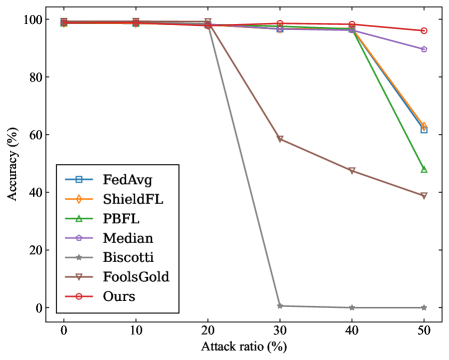
This line chart depicts the accuracy of several Federated Learning (FL) algorithms under varying attack ratios. The x-axis represents the attack ratio (in percentage), and the y-axis represents the accuracy (also in percentage). The chart compares the performance of FedAvg, ShieldFL, PBFL, Median, Biscotti, FoolsGold, and a method labeled "Ours".
### Components/Axes
* **X-axis:** "Attack ratio (%)" - Scale ranges from 0% to 50%, with markers at 0, 10, 20, 30, 40, and 50.
* **Y-axis:** "Accuracy (%)" - Scale ranges from 0% to 100%, with markers at 0, 20, 40, 60, 80, and 100.
* **Legend:** Located in the bottom-left corner. Contains the following labels and corresponding colors:
* FedAvg (Blue) - Represented by squares.
* ShieldFL (Orange) - Represented by circles.
* PBFL (Green) - Represented by triangles.
* Median (Purple) - Represented by diamonds.
* Biscotti (Black) - Represented by stars.
* FoolsGold (Brown) - Represented by plus signs.
* Ours (Red) - Represented by circles with an 'o' inside.
### Detailed Analysis
Here's a breakdown of each line's trend and approximate data points, cross-referencing with the legend colors:
* **FedAvg (Blue):** The line starts at approximately 97% accuracy at 0% attack ratio and remains relatively stable until approximately 40% attack ratio, where it begins to decline. At 50% attack ratio, the accuracy is approximately 88%.
* **ShieldFL (Orange):** The line starts at approximately 98% accuracy at 0% attack ratio and remains stable until approximately 30% attack ratio, where it begins to decline. At 50% attack ratio, the accuracy is approximately 92%.
* **PBFL (Green):** The line starts at approximately 98% accuracy at 0% attack ratio and remains stable until approximately 40% attack ratio, where it begins to decline sharply. At 50% attack ratio, the accuracy is approximately 50%.
* **Median (Purple):** The line starts at approximately 97% accuracy at 0% attack ratio and remains stable until approximately 20% attack ratio, where it begins to decline. At 50% attack ratio, the accuracy is approximately 93%.
* **Biscotti (Black):** The line starts at approximately 97% accuracy at 0% attack ratio and remains stable until approximately 20% attack ratio, where it begins to decline. At 50% attack ratio, the accuracy is approximately 93%.
* **FoolsGold (Brown):** The line starts at approximately 98% accuracy at 0% attack ratio and remains stable until approximately 20% attack ratio, where it declines sharply to approximately 58% at 30% attack ratio. At 50% attack ratio, the accuracy is approximately 40%.
* **Ours (Red):** The line starts at approximately 99% accuracy at 0% attack ratio and remains stable until approximately 20% attack ratio, where it declines sharply to approximately 0% at 30% attack ratio. At 50% attack ratio, the accuracy is approximately 38%.
### Key Observations
* The "Ours" algorithm exhibits the most significant drop in accuracy as the attack ratio increases, falling to near 0% accuracy at 30% attack ratio.
* ShieldFL, Median, and Biscotti demonstrate the most robust performance, maintaining relatively high accuracy even at 50% attack ratio.
* PBFL and FoolsGold show a more moderate decline in accuracy, but are more susceptible to attacks than ShieldFL, Median, and Biscotti.
* FedAvg shows a moderate decline in accuracy, falling between the robust algorithms and the more susceptible ones.
### Interpretation
The chart demonstrates the vulnerability of Federated Learning algorithms to attacks, quantified by the "Attack ratio". The "Attack ratio" likely represents the proportion of malicious participants in the federated learning process. The "Ours" algorithm, while performing well under no attack, is highly susceptible to even a small attack ratio, suggesting a potential weakness in its defense mechanisms. ShieldFL, Median, and Biscotti appear to be the most resilient to attacks, indicating they incorporate effective defense strategies. The sharp decline in accuracy for "Ours" at 30% attack ratio suggests a critical threshold beyond which the algorithm's performance is severely compromised. The data suggests that robust defense mechanisms are crucial for ensuring the reliability and security of Federated Learning systems in adversarial environments. The differences in performance between the algorithms highlight the importance of considering attack resilience when selecting or designing FL algorithms.