\n
## Radar Chart: Comparison of Average Scores per Dimension (EN vs. CN)
### Overview
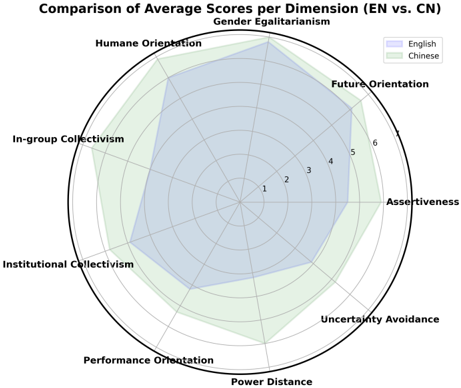
This image presents a radar chart comparing average scores across several dimensions for English (EN) and Chinese (CN) cultures. The chart uses a circular layout with eight dimensions radiating from the center. Each dimension is represented by a spoke, and the values for each culture are plotted along these spokes, connecting to form a polygon. The chart is titled "Comparison of Average Scores per Dimension (EN vs. CN)" and includes a sub-title "Gender Egalitarianism".
### Components/Axes
* **Title:** Comparison of Average Scores per Dimension (EN vs. CN)
* **Subtitle:** Gender Egalitarianism
* **Dimensions (Spokes):**
* Humane Orientation
* In-group Collectivism
* Institutional Collectivism
* Performance Orientation
* Power Distance
* Uncertainty Avoidance
* Assertiveness
* Future Orientation
* **Legend:**
* English (Blue)
* Chinese (Light Green)
* **Radial Scale:** The chart has a radial scale marked from 1 to 6, indicating the average score.
### Detailed Analysis
The chart displays two polygons, one for English (blue) and one for Chinese (light green) cultures. The polygons represent the average scores for each dimension.
**English (Blue Polygon):**
The English polygon shows a relatively consistent score across most dimensions, with slight variations.
* Humane Orientation: Approximately 5.5
* In-group Collectivism: Approximately 3.5
* Institutional Collectivism: Approximately 2.5
* Performance Orientation: Approximately 4.5
* Power Distance: Approximately 2
* Uncertainty Avoidance: Approximately 3
* Assertiveness: Approximately 5
* Future Orientation: Approximately 5.5
**Chinese (Light Green Polygon):**
The Chinese polygon exhibits more pronounced variations in scores across dimensions.
* Humane Orientation: Approximately 4
* In-group Collectivism: Approximately 5.5
* Institutional Collectivism: Approximately 4
* Performance Orientation: Approximately 3
* Power Distance: Approximately 5
* Uncertainty Avoidance: Approximately 4.5
* Assertiveness: Approximately 3.5
* Future Orientation: Approximately 4.5
**Trend Verification:**
The English line generally maintains a higher level across most dimensions, with a slight dip in Institutional Collectivism and Power Distance. The Chinese line shows higher scores in In-group Collectivism and Power Distance, but lower scores in Performance Orientation and Assertiveness.
### Key Observations
* **Power Distance:** The Chinese culture scores significantly higher on Power Distance (approximately 5) compared to the English culture (approximately 2).
* **In-group Collectivism:** The Chinese culture scores significantly higher on In-group Collectivism (approximately 5.5) compared to the English culture (approximately 3.5).
* **Performance Orientation:** The English culture scores higher on Performance Orientation (approximately 4.5) compared to the Chinese culture (approximately 3).
* **Assertiveness:** The English culture scores higher on Assertiveness (approximately 5) compared to the Chinese culture (approximately 3.5).
* The English polygon is generally more rounded, indicating a more balanced distribution of scores across dimensions. The Chinese polygon is more irregular, suggesting greater variation in cultural values.
### Interpretation
The radar chart suggests that English and Chinese cultures differ significantly in their values and orientations. The higher Power Distance score for China indicates a greater acceptance of hierarchical structures and inequalities. The higher In-group Collectivism score suggests a stronger emphasis on group harmony and loyalty. The higher Performance Orientation and Assertiveness scores for England suggest a greater focus on individual achievement and direct communication.
The chart provides a visual representation of cultural differences, which can be useful for understanding cross-cultural interactions and communication. The differences in scores may reflect historical, social, and economic factors that have shaped these cultures. The chart highlights the importance of cultural sensitivity and adaptation in international contexts. The sub-title "Gender Egalitarianism" suggests that these dimensions are being considered in the context of gender roles and equality, but the chart itself does not directly address this topic. It is likely that the dimensions are being used as proxies for understanding broader cultural values that may influence gender dynamics.