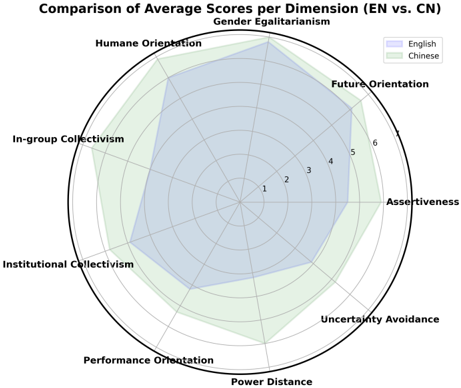
## Radar Chart: Comparison of Average Scores per Dimension (EN vs. CN)
### Overview
The chart compares average scores across nine cultural dimensions between English (EN) and Chinese (CN) speakers. Two overlapping polygons (blue for EN, green for CN) are plotted on a circular radar chart with axes labeled from 1 to 7. The legend is positioned in the top-right corner.
### Components/Axes
- **Legend**:
- Blue: English (EN)
- Green: Chinese (CN)
- **Axes (clockwise from top)**:
1. **Assertiveness**
2. **Future Orientation**
3. **Gender Egalitarianism**
4. **Humane Orientation**
5. **In-group Collectivism**
6. **Institutional Collectivism**
7. **Performance Orientation**
8. **Power Distance**
9. **Uncertainty Avoidance**
- **Scale**: Radial axis marked 1 (center) to 7 (outer edge).
### Detailed Analysis
- **English (Blue)**:
- **Highest Scores**:
- Future Orientation (~6.5)
- Gender Egalitarianism (~6.2)
- Humane Orientation (~6.0)
- **Lower Scores**:
- Power Distance (~4.5)
- Uncertainty Avoidance (~5.0)
- **Moderate Scores**:
- Assertiveness (~5.5)
- In-group Collectivism (~5.3)
- Institutional Collectivism (~5.1)
- Performance Orientation (~5.4)
- **Chinese (Green)**:
- **Highest Scores**:
- Power Distance (~6.5)
- Uncertainty Avoidance (~6.3)
- Institutional Collectivism (~6.0)
- **Lower Scores**:
- Future Orientation (~5.5)
- Gender Egalitarianism (~5.0)
- Humane Orientation (~5.2)
- **Moderate Scores**:
- Assertiveness (~5.5)
- In-group Collectivism (~5.7)
- Performance Orientation (~5.6)
### Key Observations
1. **Divergent Priorities**:
- EN emphasizes **Future Orientation** and **Gender Egalitarianism**, while CN prioritizes **Power Distance** and **Uncertainty Avoidance**.
2. **Overlap**:
- Both groups score similarly in **Assertiveness** (~5.5) and **In-group Collectivism** (~5.3–5.7).
3. **Cultural Contrasts**:
- EN’s lower **Power Distance** (~4.5 vs. CN’s 6.5) suggests less acceptance of hierarchical structures.
- CN’s higher **Institutional Collectivism** (~6.0 vs. EN’s 5.1) reflects stronger adherence to societal norms.
### Interpretation
The chart highlights cultural differences in values:
- **EN** aligns with individualistic, forward-thinking societies (e.g., Western cultures), prioritizing equality and future planning.
- **CN** reflects collectivist, hierarchical societies (e.g., East Asian cultures), emphasizing stability and institutional cohesion.
- Overlaps in **Assertiveness** and **In-group Collectivism** suggest shared traits in communication styles or social bonding, possibly influenced by globalization.
### Spatial Grounding
- **Legend**: Top-right corner, clearly distinguishing EN (blue) and CN (green).
- **Axes**: Evenly spaced around the circle, labeled clockwise starting with **Assertiveness** at the top.
- **Data Points**: Lines connect dimension scores for each group, with EN’s polygon generally larger in Future/Gender axes and CN’s in Power/Uncertainty axes.
### Content Details
- **Scale**: 1–7, with no intermediate markers between integers.
- **Uncertainty**: Approximate values inferred from visual alignment (e.g., EN’s Future Orientation at ~6.5, CN’s Power Distance at ~6.5).
### Final Notes
The chart uses color-coded polygons to contrast cultural dimensions, with spatial positioning and scale aiding interpretation. No textual data tables or embedded text beyond axis labels and legend are present.