\n
## Chart: Cooperation Probability vs. Opponent Cooperation Probability & Total Score
### Overview
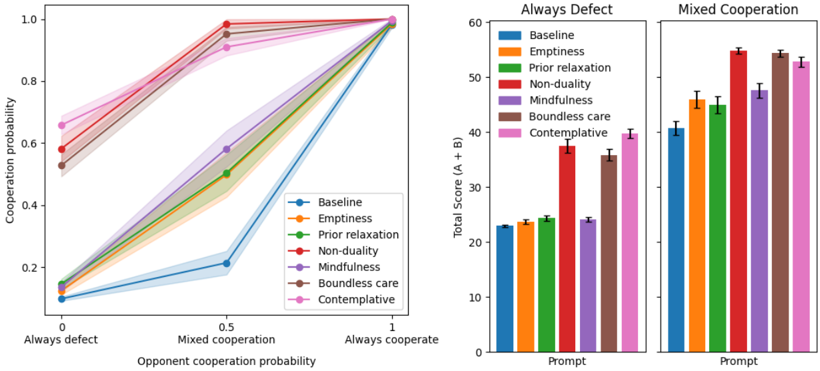
The image presents two charts side-by-side. The left chart is a line graph showing the relationship between cooperation probability and opponent cooperation probability for different meditation techniques. The right chart is a bar graph displaying the total score (A+B) for the same meditation techniques under "Always Defect" and "Mixed Cooperation" prompts. Error bars are present on the bar graph.
### Components/Axes
**Left Chart:**
* **X-axis:** "Opponent cooperation probability" ranging from 0 to 1, with markers at 0, 0.5, and 1. Labels: "Always defect", "Mixed cooperation", "Always cooperate".
* **Y-axis:** "Cooperation probability" ranging from 0 to 1, with markers at 0.2, 0.4, 0.6, 0.8, and 1.
* **Legend (bottom-right):**
* Baseline (Blue)
* Emptiness (Orange)
* Prior relaxation (Green)
* Non-duality (Red)
* Mindfulness (Purple)
* Boundless care (Pink)
* Contemplative (Magenta)
**Right Chart:**
* **X-axis:** "Prompt" with two categories: "Always Defect" and "Mixed Cooperation".
* **Y-axis:** "Total Score (A + B)" ranging from 0 to 60, with markers at 10, 20, 30, 40, 50, and 60.
* **Legend (top-left):**
* Baseline (Blue)
* Emptiness (Orange)
* Prior relaxation (Green)
* Non-duality (Red)
* Mindfulness (Purple)
* Boundless care (Pink)
* Contemplative (Magenta)
### Detailed Analysis
**Left Chart:**
* **Baseline (Blue):** Starts at approximately 0.2 cooperation probability when the opponent always defects, increases to approximately 0.25 at 0.5 opponent cooperation, and reaches approximately 0.35 at 1 opponent cooperation.
* **Emptiness (Orange):** Starts at approximately 0.25, increases to approximately 0.6 at 0.5 opponent cooperation, and reaches approximately 0.85 at 1 opponent cooperation.
* **Prior relaxation (Green):** Starts at approximately 0.3, increases to approximately 0.7 at 0.5 opponent cooperation, and reaches approximately 0.9 at 1 opponent cooperation.
* **Non-duality (Red):** Starts at approximately 0.4, increases to approximately 0.8 at 0.5 opponent cooperation, and reaches approximately 0.95 at 1 opponent cooperation.
* **Mindfulness (Purple):** Starts at approximately 0.45, increases to approximately 0.85 at 0.5 opponent cooperation, and reaches approximately 0.98 at 1 opponent cooperation.
* **Boundless care (Pink):** Starts at approximately 0.5, increases to approximately 0.9 at 0.5 opponent cooperation, and reaches approximately 1 at 1 opponent cooperation.
* **Contemplative (Magenta):** Starts at approximately 0.55, increases to approximately 0.95 at 0.5 opponent cooperation, and reaches approximately 1 at 1 opponent cooperation.
**Right Chart:**
* **Baseline (Blue):** Approximately 24 under "Always Defect" and approximately 42 under "Mixed Cooperation".
* **Emptiness (Orange):** Approximately 26 under "Always Defect" and approximately 45 under "Mixed Cooperation".
* **Prior relaxation (Green):** Approximately 28 under "Always Defect" and approximately 48 under "Mixed Cooperation".
* **Non-duality (Red):** Approximately 36 under "Always Defect" and approximately 55 under "Mixed Cooperation".
* **Mindfulness (Purple):** Approximately 38 under "Always Defect" and approximately 52 under "Mixed Cooperation".
* **Boundless care (Pink):** Approximately 40 under "Always Defect" and approximately 54 under "Mixed Cooperation".
* **Contemplative (Magenta):** Approximately 42 under "Always Defect" and approximately 56 under "Mixed Cooperation".
### Key Observations
* In the left chart, all meditation techniques show an increase in cooperation probability as the opponent's cooperation probability increases.
* The Baseline consistently exhibits the lowest cooperation probability.
* Boundless care, Contemplative, Mindfulness, and Non-duality show the highest cooperation probabilities, especially when the opponent cooperates.
* In the right chart, all meditation techniques result in higher total scores under the "Mixed Cooperation" prompt compared to the "Always Defect" prompt.
* Contemplative consistently yields the highest total score, followed by Boundless care, Mindfulness, and Non-duality.
* Error bars on the right chart indicate some variability in the scores, but the general trend remains consistent.
### Interpretation
The data suggests that certain meditation techniques can significantly influence cooperative behavior. The left chart demonstrates that as an opponent becomes more cooperative, individuals practicing these meditation techniques are more likely to reciprocate. The right chart shows that these techniques also lead to higher overall scores in a mixed cooperative environment.
The Baseline, representing a control group without specific meditation practice, consistently shows the lowest levels of cooperation. This suggests that the observed increases in cooperation are attributable to the meditation techniques themselves.
The techniques of Boundless care, Contemplative, Mindfulness, and Non-duality appear to be particularly effective in promoting cooperation. This could be due to their focus on cultivating empathy, compassion, and a sense of interconnectedness. The consistent increase in scores under the "Mixed Cooperation" prompt indicates that these techniques may be beneficial in fostering more collaborative interactions.
The error bars on the right chart suggest that individual responses to these techniques may vary, but the overall trends are clear. Further research could investigate the underlying mechanisms by which these meditation techniques influence cooperative behavior and explore the potential applications of these findings in various social contexts. The data implies a positive correlation between specific meditative practices and prosocial behavior.