TECHNICAL ASSET FINGERPRINT
48ae4b66e4a118b2585e10df
Click to view fullscreen
Press ESC or click to close
FOUND IN PAPERS
EXPERT: healer-alpha-free VERSION 1
RUNTIME: free/openrouter/healer-alpha
INTEL_VERIFIED
## [Chart/Diagram Type]: Composite Figure with Line Graph and Bar Charts
### Overview
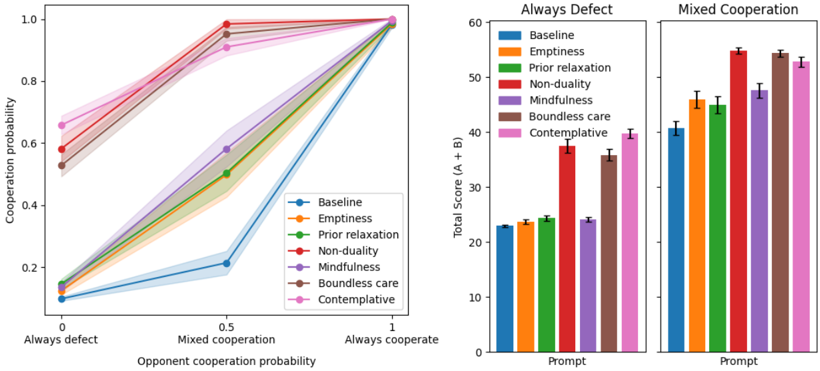
The image displays a composite figure containing three related charts that analyze the effect of different psychological or meditative "prompts" on cooperative behavior in a game-theoretic context. The left panel is a line graph showing the relationship between an opponent's cooperation probability and the subject's cooperation probability. The right side contains two bar charts comparing the "Total Score (A + B)" achieved under two distinct opponent strategies: "Always Defect" and "Mixed Cooperation." The data compares seven conditions: Baseline, Emptiness, Prior relaxation, Non-duality, Mindfulness, Boundless care, and Contemplative.
### Components/Axes
**Left Panel (Line Graph):**
* **X-axis:** "Opponent cooperation probability". Markers at 0 ("Always defect"), 0.5 ("Mixed cooperation"), and 1 ("Always cooperate").
* **Y-axis:** "Cooperation probability". Scale from 0.0 to 1.0.
* **Legend:** Located in the bottom-right corner. Lists seven series with corresponding colors and markers:
* Baseline (Blue, circle marker)
* Emptiness (Orange, square marker)
* Prior relaxation (Green, diamond marker)
* Non-duality (Red, upward triangle marker)
* Mindfulness (Purple, downward triangle marker)
* Boundless care (Brown, left-pointing triangle marker)
* Contemplative (Pink, right-pointing triangle marker)
* **Data Series:** Each series is represented by a line connecting three data points (at x=0, 0.5, 1) with shaded regions around each line, likely indicating confidence intervals or standard error.
**Right Panel (Bar Charts):**
* **Two separate charts:** Titled "Always Defect" (left) and "Mixed Cooperation" (right).
* **Y-axis (shared):** "Total Score (A + B)". Scale from 0 to 60.
* **X-axis (for each chart):** "Prompt". Categories are the same seven conditions as the legend.
* **Legend:** Located in the top-left corner of the "Always Defect" chart. Identical to the line graph legend.
* **Data Representation:** Grouped bar charts. Each bar corresponds to a prompt condition, colored according to the legend. Black error bars are present on top of each bar.
### Detailed Analysis
**Line Graph - Cooperation Probability vs. Opponent Cooperation:**
* **Trend Verification:** All seven lines show a positive, roughly linear trend. As the opponent's cooperation probability increases from 0 to 1, the subject's cooperation probability also increases for all conditions.
* **Data Points (Approximate):**
* **At x=0 (Always defect):** Cooperation probabilities are low, clustered between ~0.1 and ~0.2 for most conditions. The "Contemplative" (pink) and "Non-duality" (red) conditions start notably higher, at approximately 0.65 and 0.58, respectively.
* **At x=0.5 (Mixed cooperation):** A clear separation emerges. "Baseline" (blue) remains lowest (~0.22). "Emptiness" (orange) and "Prior relaxation" (green) are in the middle (~0.45-0.5). "Mindfulness" (purple) is higher (~0.58). "Boundless care" (brown), "Non-duality" (red), and "Contemplative" (pink) are the highest, clustered between ~0.9 and ~1.0.
* **At x=1 (Always cooperate):** All conditions converge to a cooperation probability of 1.0.
**Bar Charts - Total Score:**
* **"Always Defect" Chart:**
* Scores are generally lower, ranging from ~23 to ~40.
* "Baseline" (blue) is the lowest (~23).
* "Emptiness" (orange), "Prior relaxation" (green), and "Mindfulness" (purple) are similar, in the ~24-25 range.
* "Non-duality" (red) is the highest (~38), followed by "Boundless care" (brown, ~36) and "Contemplative" (pink, ~40).
* **"Mixed Cooperation" Chart:**
* Scores are generally higher, ranging from ~41 to ~55.
* "Baseline" (blue) is again the lowest (~41).
* "Emptiness" (orange) and "Prior relaxation" (green) are similar (~46).
* "Mindfulness" (purple) is higher (~48).
* "Non-duality" (red), "Boundless care" (brown), and "Contemplative" (pink) are the highest, clustered between ~53 and ~55.
### Key Observations
1. **Prompt Efficacy Hierarchy:** A consistent hierarchy is visible across all charts. "Baseline" consistently shows the least cooperation and lowest scores. "Emptiness," "Prior relaxation," and "Mindfulness" form a middle tier. "Non-duality," "Boundless care," and "Contemplative" consistently form the top-performing tier.
2. **Convergence at Cooperation:** When the opponent always cooperates (x=1), all prompts lead to perfect cooperation (probability=1.0), suggesting the prompts don't hinder cooperation when it's risk-free.
3. **Resilience to Defection:** The most striking difference is at x=0 ("Always defect"). The top-tier prompts ("Contemplative," "Non-duality") maintain a high baseline cooperation probability (~0.6-0.65), whereas others drop to ~0.1-0.2. This suggests these prompts instill a more robust, less retaliatory cooperative stance.
4. **Score Correlation:** The total score rankings mirror the cooperation probability rankings, especially in the "Mixed Cooperation" condition. Higher cooperation probability correlates with a higher total score.
### Interpretation
This data suggests that specific meditative or psychological framing ("prompts") can significantly alter strategic behavior in social dilemmas, moving individuals away from a purely rational, defect-first "Baseline" strategy.
* **The "Top-Tier" Prompts (Non-duality, Boundless care, Contemplative):** These appear to foster a form of "principled cooperation." Even when facing a defecting opponent, subjects in these conditions cooperate more than half the time. This could indicate an internalized value for cooperation that is less contingent on immediate reciprocation, potentially leading to more stable long-term cooperation in repeated interactions, as evidenced by their high scores in the "Mixed Cooperation" scenario.
* **The "Middle-Tier" Prompts (Emptiness, Prior relaxation, Mindfulness):** These show a moderate increase in cooperation over baseline, but their behavior is more contingent on the opponent's actions. They defect more readily against a defector but increase cooperation as the opponent becomes more cooperative.
* **Mechanism:** The prompts likely work by altering the participant's psychological state—reducing ego-defensiveness, increasing empathy, or fostering a long-term perspective—thereby changing the cost-benefit calculus of cooperation versus defection. The high initial cooperation of the top-tier prompts against defectors is particularly notable, as it defies the classic game-theoretic prediction of mutual defection, suggesting a shift in the underlying utility function.
**In summary, the figure demonstrates that cognitive framing can be a powerful modulator of cooperative behavior, with certain contemplative states promoting a robust, high-trust, and high-scoring strategy that is resilient to exploitation.**
DECODING INTELLIGENCE...