## Line Chart: Cooperation Probability vs. Opponent Cooperation Strategy
### Overview
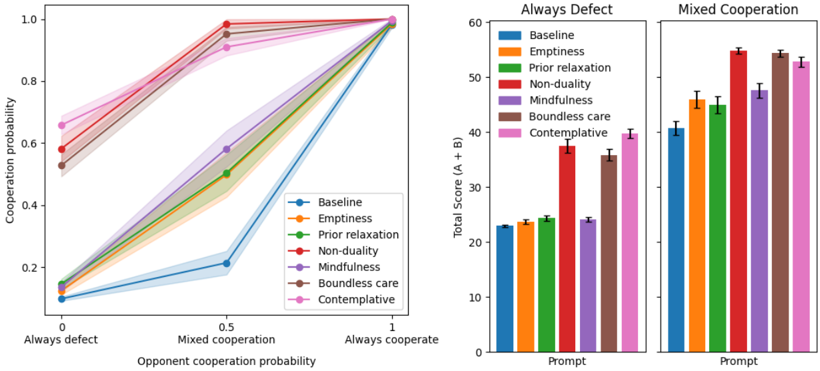
The left chart is a line plot showing how different behavioral strategies (e.g., Baseline, Emptiness, Prior relaxation) adjust their cooperation probability in response to opponent cooperation levels ("Always defect," "Mixed cooperation," "Always cooperate"). Shaded regions represent 95% confidence intervals.
### Components/Axes
- **X-axis**: Opponent cooperation probability (categorical: "Always defect," "Mixed cooperation," "Always cooperate")
- **Y-axis**: Cooperation probability (continuous, 0–1 scale)
- **Legend**: 7 strategies with color codes:
- Blue: Baseline
- Orange: Emptiness
- Green: Prior relaxation
- Red: Non-duality
- Purple: Mindfulness
- Brown: Boundless care
- Pink: Contemplative
### Detailed Analysis
- **Baseline (blue)**:
- Always defect: ~0.12
- Mixed cooperation: ~0.21
- Always cooperate: ~0.98
- *Trend*: Sharp increase from mixed to always cooperate
- **Emptiness (orange)**:
- Always defect: ~0.13
- Mixed cooperation: ~0.35
- Always cooperate: ~0.95
- *Trend*: Moderate increase, flatter slope than Baseline
- **Prior relaxation (green)**:
- Always defect: ~0.15
- Mixed cooperation: ~0.50
- Always cooperate: ~0.92
- *Trend*: Steeper increase than Baseline in mixed cooperation
- **Non-duality (red)**:
- Always defect: ~0.58
- Mixed cooperation: ~0.98
- Always cooperate: ~0.99
- *Trend*: High cooperation even with defecting opponents
- **Mindfulness (purple)**:
- Always defect: ~0.14
- Mixed cooperation: ~0.58
- Always cooperate: ~0.97
- *Trend*: Balanced response across scenarios
- **Boundless care (brown)**:
- Always defect: ~0.53
- Mixed cooperation: ~0.94
- Always cooperate: ~0.99
- *Trend*: High cooperation across all scenarios
- **Contemplative (pink)**:
- Always defect: ~0.65
- Mixed cooperation: ~0.90
- Always cooperate: ~0.99
- *Trend*: Highest cooperation in always defect scenario
### Key Observations
1. **Non-duality** and **Boundless care** maintain high cooperation (>0.5) even when opponents always defect.
2. **Contemplative** strategy shows the highest cooperation probability (0.65) in the "Always defect" scenario.
3. All strategies converge near 1.0 in the "Always cooperate" scenario.
4. Confidence intervals (shaded regions) are widest for "Mixed cooperation" across most strategies.
### Interpretation
The data suggests that strategies like **Non-duality** and **Boundless care** are robust in maintaining cooperation despite adversarial conditions. The **Contemplative** strategy uniquely excels in defect-heavy environments. The convergence near 1.0 in cooperative scenarios indicates universal adaptability to mutual cooperation. The widest confidence intervals in mixed scenarios highlight uncertainty in transitional cooperation dynamics.
---
## Bar Chart: Total Score (A + B) by Strategy and Scenario
### Overview
The right chart compares total scores (A + B) for the same strategies across two scenarios: "Always Defect" and "Mixed Cooperation." Error bars represent standard error.
### Components/Axes
- **X-axis**: Scenario (categorical: "Always Defect," "Mixed Cooperation")
- **Y-axis**: Total Score (A + B) (continuous, 0–60 scale)
- **Legend**: Same 7 strategies as the line chart
### Detailed Analysis
- **Always Defect Scenario**:
- Baseline: ~23 (±2)
- Emptiness: ~24 (±3)
- Prior relaxation: ~25 (±2)
- Non-duality: ~38 (±3)
- Mindfulness: ~25 (±2)
- Boundless care: ~36 (±3)
- Contemplative: ~40 (±3)
- **Mixed Cooperation Scenario**:
- Baseline: ~41 (±3)
- Emptiness: ~47 (±4)
- Prior relaxation: ~46 (±3)
- Non-duality: ~55 (±4)
- Mindfulness: ~48 (±3)
- Boundless care: ~54 (±4)
- Contemplative: ~53 (±4)
### Key Observations
1. **Non-duality** and **Boundless care** achieve the highest scores in both scenarios.
2. **Contemplative** strategy scores highest in "Always Defect" (40) but slightly lower than Boundless care in "Mixed Cooperation."
3. All strategies score significantly higher in "Mixed Cooperation" than "Always Defect."
4. Error bars are largest for "Non-duality" and "Boundless care" in "Mixed Cooperation."
### Interpretation
Strategies emphasizing mutualistic principles (**Non-duality**, **Boundless care**) outperform others in both adversarial and cooperative scenarios. The **Contemplative** strategy’s high score in "Always Defect" suggests unique adaptability to exploitation. The score gap between scenarios underscores the importance of reciprocal cooperation for maximizing outcomes. Error margins indicate greater variability in mixed scenarios, possibly due to dynamic interactions.