\n
## Diagram: Formal Verification Process
### Overview
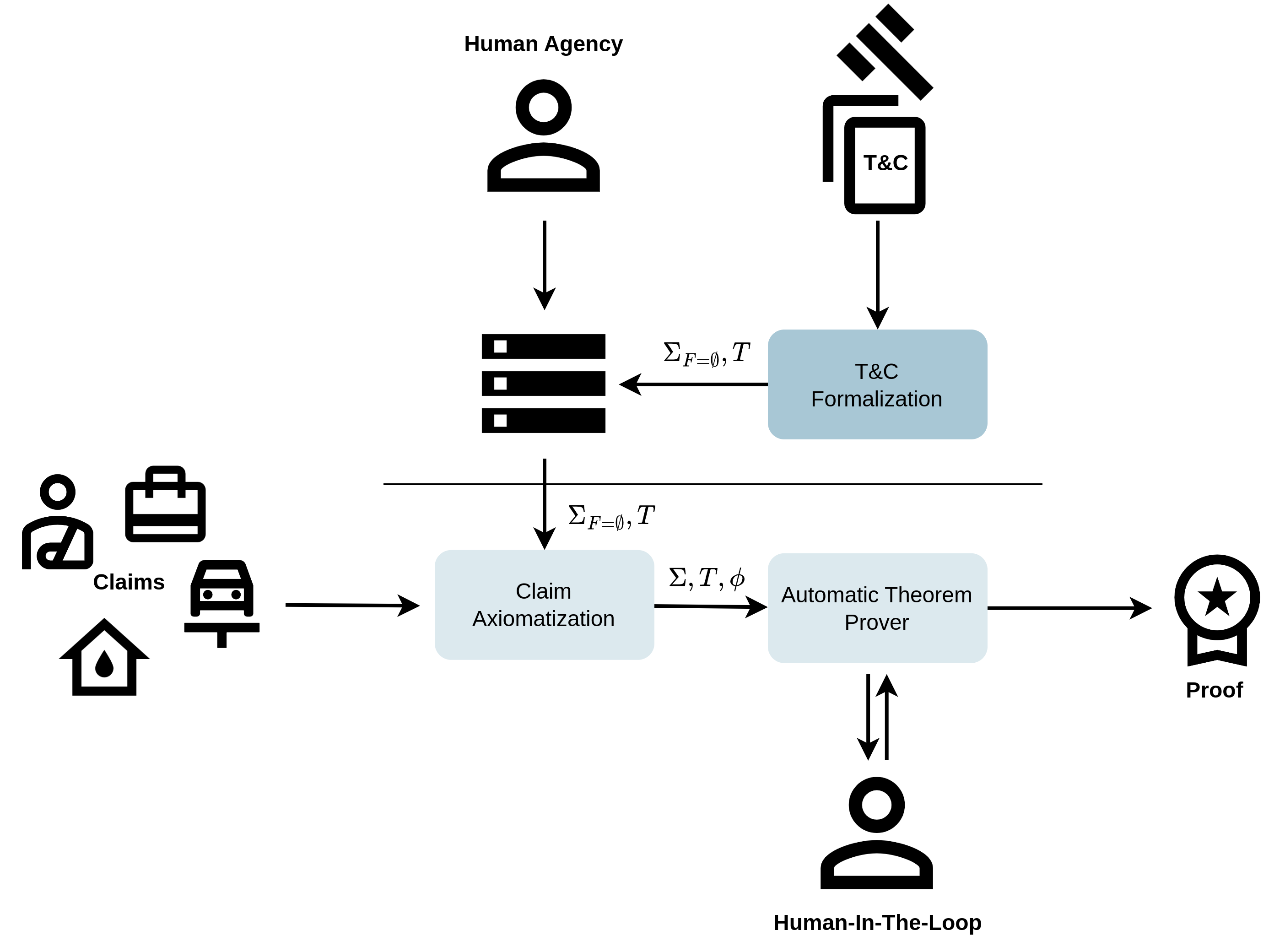
This diagram illustrates a formal verification process, likely for software or legal contracts (Terms & Conditions - T&C). It depicts a workflow starting with human agency, moving through formalization and axiomization, utilizing an automatic theorem prover, and culminating in a proof, with human-in-the-loop interaction. The diagram uses icons to represent concepts and arrows to indicate the flow of information.
### Components/Axes
The diagram consists of the following components:
* **Human Agency:** Represented by a head-and-shoulders icon at the top-left.
* **Terms & Conditions (T&C):** Represented by a rectangular icon with "T&C" written inside, positioned to the right of Human Agency.
* **T&C Formalization:** A green rounded rectangle labeled "T&C Formalization".
* **Claims:** Represented by a collection of icons (document, file, house) at the bottom-left.
* **Claim Axiomatization:** A green rounded rectangle labeled "Claim Axiomatization".
* **Automatic Theorem Prover:** A green rounded rectangle labeled "Automatic Theorem Prover".
* **Proof:** Represented by a shield icon with a star, at the far right.
* **Human-In-The-Loop:** Represented by a head-and-shoulders icon at the bottom-center.
* **Mathematical Notation:** "Σ<sub>F=0</sub>, T" appears twice, associated with the T&C Formalization and Claim Axiomatization stages. "Σ, T, φ" appears associated with the Automatic Theorem Prover.
Arrows indicate the direction of the process flow.
### Detailed Analysis / Content Details
The process begins with **Human Agency** initiating the process. This leads to **T&C Formalization**, which is accompanied by the mathematical notation "Σ<sub>F=0</sub>, T". The output of this stage is then fed into **Claim Axiomatization**, also accompanied by the notation "Σ<sub>F=0</sub>, T".
The output of Claim Axiomatization is then passed to the **Automatic Theorem Prover**, which uses the notation "Σ, T, φ". The theorem prover has a bi-directional arrow connecting it to the **Human-In-The-Loop**, indicating iterative interaction.
Finally, the output of the Automatic Theorem Prover is a **Proof**.
The mathematical notation suggests a formal system, where:
* Σ likely represents a set of axioms or assumptions.
* T likely represents a theory or logical framework.
* F might represent a function or variable.
* φ likely represents a formula or proposition.
### Key Observations
The diagram emphasizes the iterative nature of formal verification, as indicated by the bi-directional arrow between the Automatic Theorem Prover and the Human-In-The-Loop. The use of mathematical notation suggests a rigorous, logic-based approach. The diagram highlights the transformation of human-readable terms and conditions and claims into a formal, machine-processable representation.
### Interpretation
This diagram illustrates a workflow for formally verifying the correctness of claims against a set of terms and conditions. The process involves translating both the T&C and the claims into a formal logical system (represented by Σ, T, φ). An automatic theorem prover then attempts to prove the claims based on the formalized T&C. The human-in-the-loop component suggests that the process may require human intervention to guide the theorem prover or to resolve ambiguities.
The notation "Σ<sub>F=0</sub>, T" appearing in the initial stages suggests a specific constraint or condition being applied during the formalization process. The "F=0" could represent a simplification or a base case.
The overall goal of this process is to provide a high degree of assurance that the claims are consistent with the terms and conditions, reducing the risk of errors or disputes. This is particularly relevant in contexts where correctness is critical, such as software security or legal contracts. The diagram suggests a shift from relying on human interpretation to a more rigorous, mathematically-grounded approach to verification.