## Diagram: Formal Verification Process Flowchart
### Overview
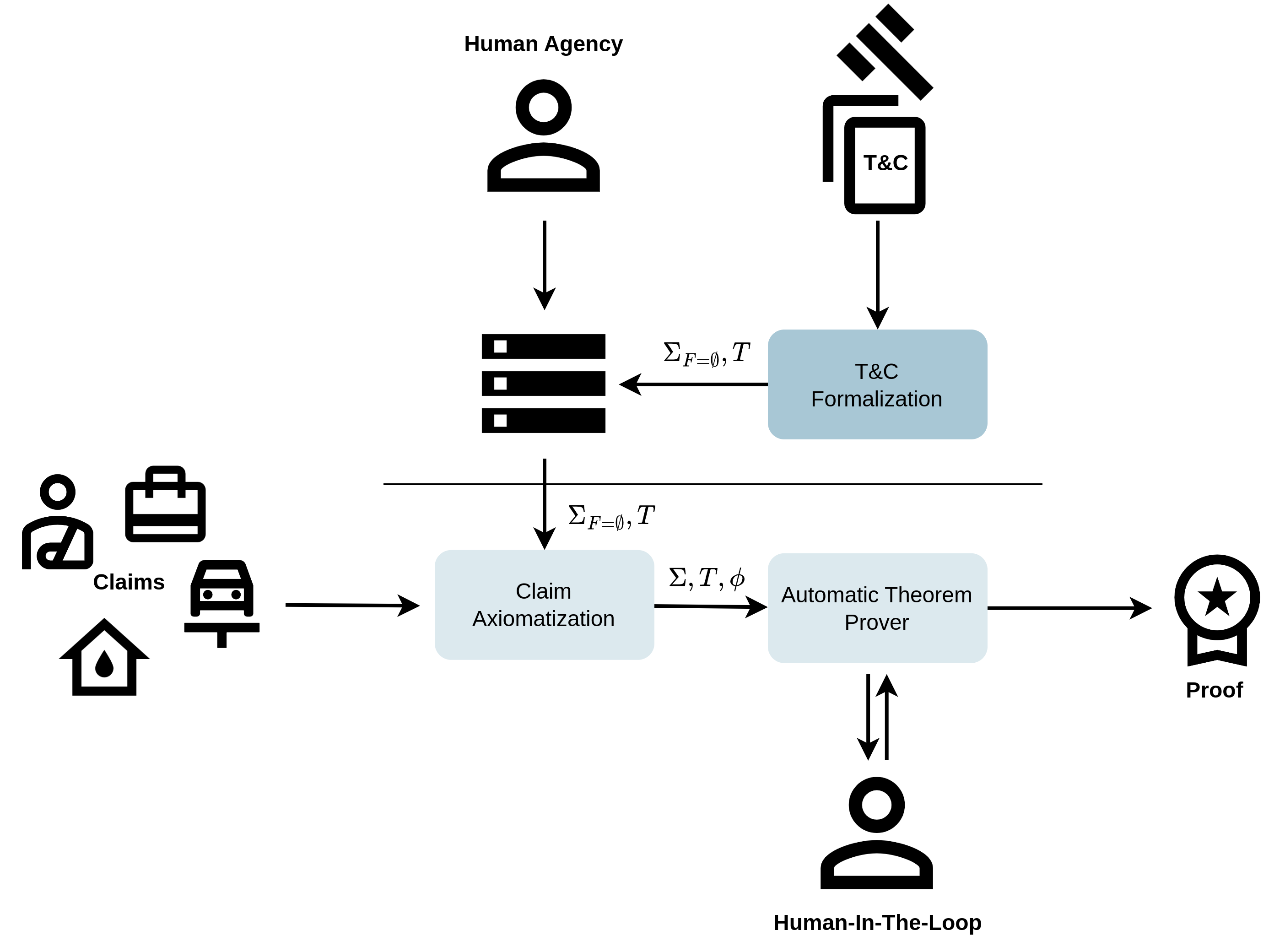
The image is a flowchart diagram illustrating a formal verification or theorem-proving process. It depicts how human inputs, terms and conditions (T&C), and various claims are transformed through formalization and axiomatization steps, ultimately processed by an automatic theorem prover to generate a proof, with human oversight integrated into the system. The diagram is divided into two main sections by a horizontal line.
### Components/Axes
The diagram consists of icons, labeled process boxes, directional arrows, and mathematical notation. There are no traditional chart axes.
**Icons & Labels (with approximate positions):**
* **Top-Left:** Icon of a person labeled **"Human Agency"**.
* **Top-Right:** Icon of a satellite dish and a document labeled **"T&C"**.
* **Left-Center:** A cluster of icons labeled **"Claims"**, including:
* A person with a briefcase (business/professional claim).
* A car (automotive claim).
* A house with a water drop (home/property claim).
* **Bottom-Center:** Icon of a person labeled **"Human-In-The-Loop"**.
* **Far Right:** A badge/ribbon icon labeled **"Proof"**.
**Process Boxes (Light Blue):**
1. **T&C Formalization** (Top-Right quadrant)
2. **Claim Axiomatization** (Center, below the horizontal line)
3. **Automatic Theorem Prover** (Center-Right, below the horizontal line)
**Flow & Notation:**
* A horizontal line separates the diagram into an upper "Formalization" phase and a lower "Proving" phase.
* Arrows indicate the flow of information or control.
* Mathematical notation labels the data being passed between components:
* **Σ_F=∅, T**: Appears on arrows from "T&C Formalization" to a server icon and from the server icon to "Claim Axiomatization".
* **Σ, T, φ**: Appears on the arrow from "Claim Axiomatization" to "Automatic Theorem Prover".
### Detailed Analysis
**Flow Description:**
1. **Upper Section (Formalization Phase):**
* "Human Agency" provides input to a server/database icon (three stacked black rectangles).
* "T&C" (Terms & Conditions) are input into the **"T&C Formalization"** process.
* The output of "T&C Formalization", denoted as **Σ_F=∅, T**, is sent to the server icon.
* The server icon then sends the same data, **Σ_F=∅, T**, downward across the horizontal line to the **"Claim Axiomatization"** process.
2. **Lower Section (Proving Phase):**
* Various "Claims" (represented by the icon cluster) are input into the **"Claim Axiomatization"** process.
* "Claim Axiomatization" combines the formalized T&C (**Σ_F=∅, T**) with the claims to produce a new formal output, denoted as **Σ, T, φ**.
* This output (**Σ, T, φ**) is fed into the **"Automatic Theorem Prover"**.
* The "Automatic Theorem Prover" interacts bidirectionally with the **"Human-In-The-Loop"**, indicating a collaborative or oversight relationship.
* The final output of the "Automatic Theorem Prover" is a **"Proof"**.
**Mathematical Notation Interpretation:**
* **Σ (Sigma):** Typically represents a set of axioms or a signature in formal logic.
* **T:** Likely represents a set of theories or theorems.
* **φ (Phi):** Often denotes a specific formula or proposition to be proven.
* **Σ_F=∅:** Suggests an initial formal signature or axiom set that is empty (F=∅), which is then populated or defined by the T&C formalization process.
### Key Observations
1. **Two-Phase Process:** The diagram clearly separates the preparatory work of formalizing rules (T&C) from the core activity of axiomatizing specific claims and proving them.
2. **Central Data Repository:** The server icon acts as a central hub, receiving formalized T&C and distributing them to the claim processing stage.
3. **Human Roles:** Humans are involved at two critical points: as the source of agency and claims ("Human Agency", "Claims") and as an interactive component within the proving engine ("Human-In-The-Loop").
4. **Formal Transformation:** The notation changes from **Σ_F=∅, T** to **Σ, T, φ**, indicating that the "Claim Axiomatization" step enriches the formal system with specific propositions (φ) derived from the claims.
5. **Unidirectional Final Output:** The process culminates in a single, definitive output: the "Proof".
### Interpretation
This diagram models a **human-in-the-loop formal verification system**, likely for legal, contractual, or regulatory compliance. It demonstrates a pipeline for translating real-world claims (e.g., insurance claims, compliance assertions) and governing terms into a formal mathematical language that can be automatically verified.
* **What it suggests:** The system aims to bring rigor and automation to domains traditionally reliant on human interpretation. By formalizing T&C and claims, it creates a machine-checkable framework. The "Human-In-The-Loop" component is crucial, suggesting that full automation is not the goal; instead, human judgment guides, validates, or intervenes in the automated proving process.
* **Relationships:** The flow shows dependency: meaningful proof cannot occur without first formalizing the governing rules (T&C) and then axiomatizing the specific claims within that formal context. The "Human Agency" initiates the process by setting the rules, while the "Claims" provide the specific instances to be verified.
* **Notable Anomaly/Insight:** The initial empty signature (**Σ_F=∅**) is significant. It implies the formal system is built from the ground up based on the provided T&C, ensuring the proving environment is perfectly tailored to the specific contract or regulation in question, rather than using a generic, pre-existing logical framework. This makes the system highly adaptable but also dependent on the quality of the initial formalization step.