## Flowchart: Automated Claim Verification System
### Overview
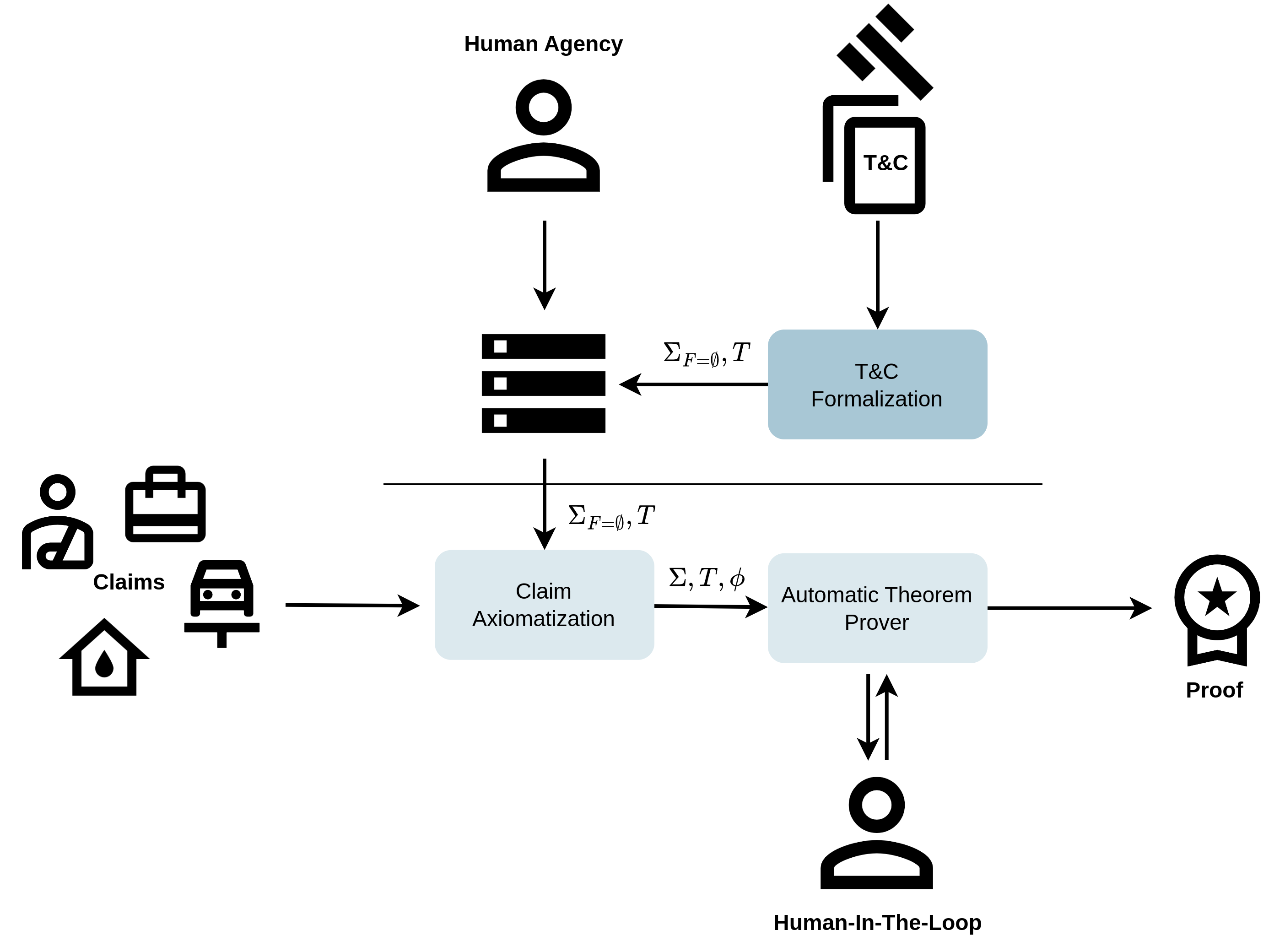
The diagram illustrates a multi-stage process for validating claims through automated theorem proving and human oversight. It shows the flow from raw claims to formalized terms and conditions (T&C), with iterative refinement via human-in-the-loop validation.
### Components/Axes
1. **Human Agency** (Top-center): Represented by a person icon, initiates the process.
2. **Claims** (Left-side cluster): Includes:
- Person with seatbelt (vehicle insurance)
- Briefcase (business-related claims)
- Car (automotive claims)
- House with water droplet (property damage)
3. **Claim Axiomatization** (Central blue box): Converts claims into formal representations.
4. **T&C Formalization** (Top-right blue box): Processes axiomatized claims into formal terms.
5. **Automatic Theorem Prover** (Right-side blue box): Validates claims using formal logic.
6. **Proof** (Star icon): Final validated output.
7. **Human-In-The-Loop** (Bottom-center): Human oversight stage.
### Flow Relationships
- **Input Flow**:
- Claims → Claim Axiomatization (via Σ_F=∅, T)
- Human Agency → T&C Formalization (via Σ_F=∅, T)
- **Output Flow**:
- Claim Axiomatization → T&C Formalization (via Σ_F=∅, T)
- Claim Axiomatization → Automatic Theorem Prover (via Σ, T, φ)
- Automatic Theorem Prover → Human-In-The-Loop (bidirectional arrows)
- Human-In-The-Loop → Human Agency (final validation)
### Symbols and Notation
- **Σ_F=∅, T**: Represents empty set conditions and temporal parameters
- **Σ, T, φ**: Formal logic parameters for theorem proving
- **T&C**: Scale and document icon (legal formalization)
- **Proof**: Star icon (validated conclusion)
### Key Observations
1. **Iterative Refinement**: Bidirectional arrows between Claim Axiomatization and Automatic Theorem Prover suggest continuous improvement.
2. **Human Oversight**: Human-In-The-Loop acts as a quality control checkpoint before final validation.
3. **Multi-modal Claims**: System handles diverse claim types (vehicular, property, business).
4. **Formal Verification**: Mathematical logic (Σ, T, φ) underpins automated validation.
### Interpretation
This system implements a hybrid approach to claim validation:
1. **Automation**: Machine learning (Claim Axiomatization) converts raw claims into formal models.
2. **Verification**: Automated theorem provers check claims against formal logic (Σ, T, φ).
3. **Human Judgment**: Critical decisions require human oversight (Human-In-The-Loop).
4. **Formalization**: Final outputs become legally binding T&C documents.
The architecture suggests a high-stakes domain (likely insurance/legal) where:
- Accuracy is paramount (hence formal verification)
- Complexity requires both automation and human expertise
- Compliance with regulatory standards (T&C formalization) is essential
- Iterative refinement improves system reliability over time
The bidirectional flow between axiomatization and theorem proving implies the system can:
1. Generate new axioms from validated claims
2. Refine existing axioms based on proof outcomes
3. Maintain a dynamic knowledge base of validated claim patterns